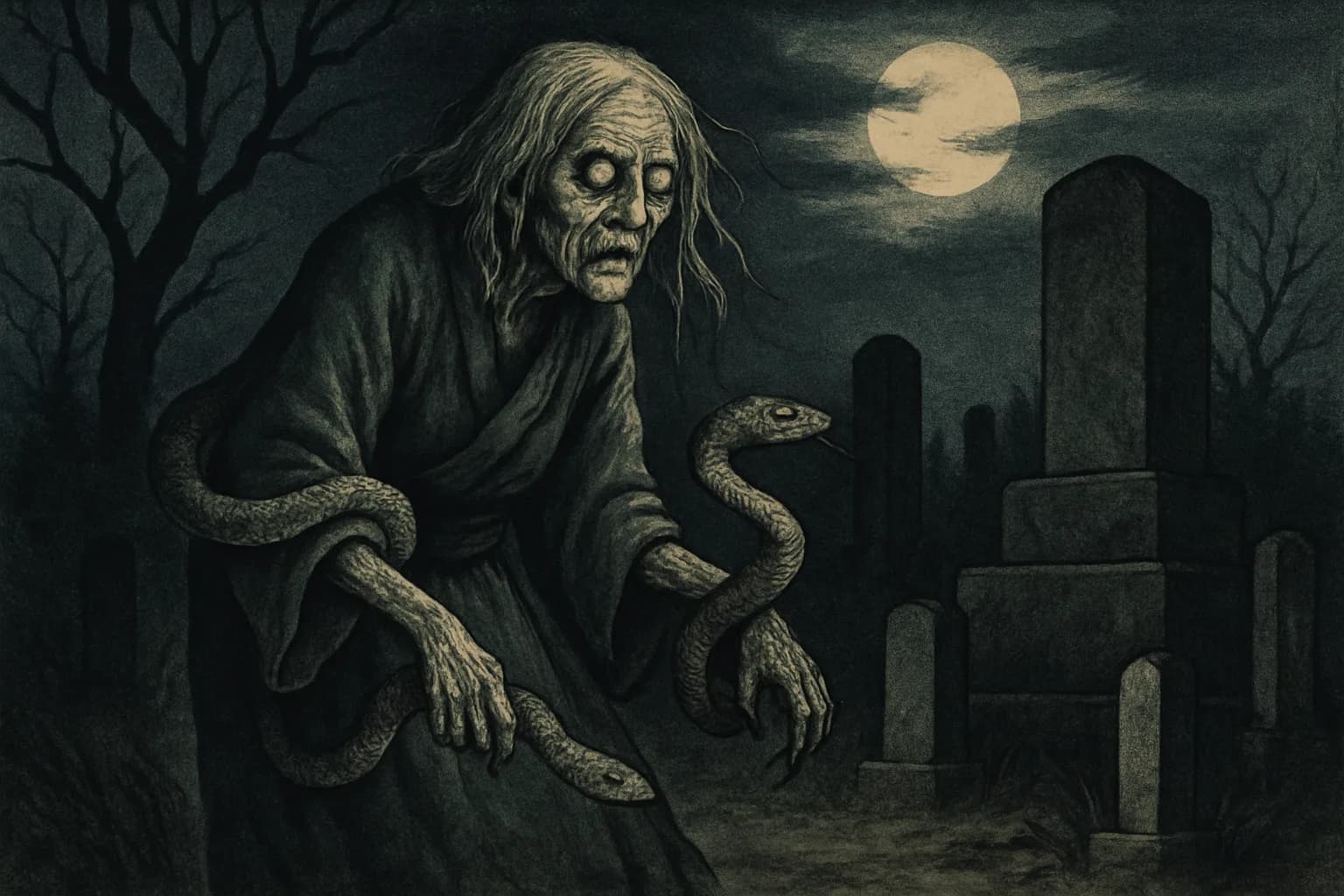
Picture a room lined with a hundred paper lanterns, each one covered in blue paper so the light comes out cold and wrong. A hundred guests sit in a circle. Each tells one true ghost story, then snuffs one lantern before the next story begins. The room dims, story by story, story by story, until only a single blue lantern is left burning — and then that one goes out too. Ao-andon, the "blue lantern," is the figure Edo-period artists imagined standing in the dark that follows.
What does it look like?
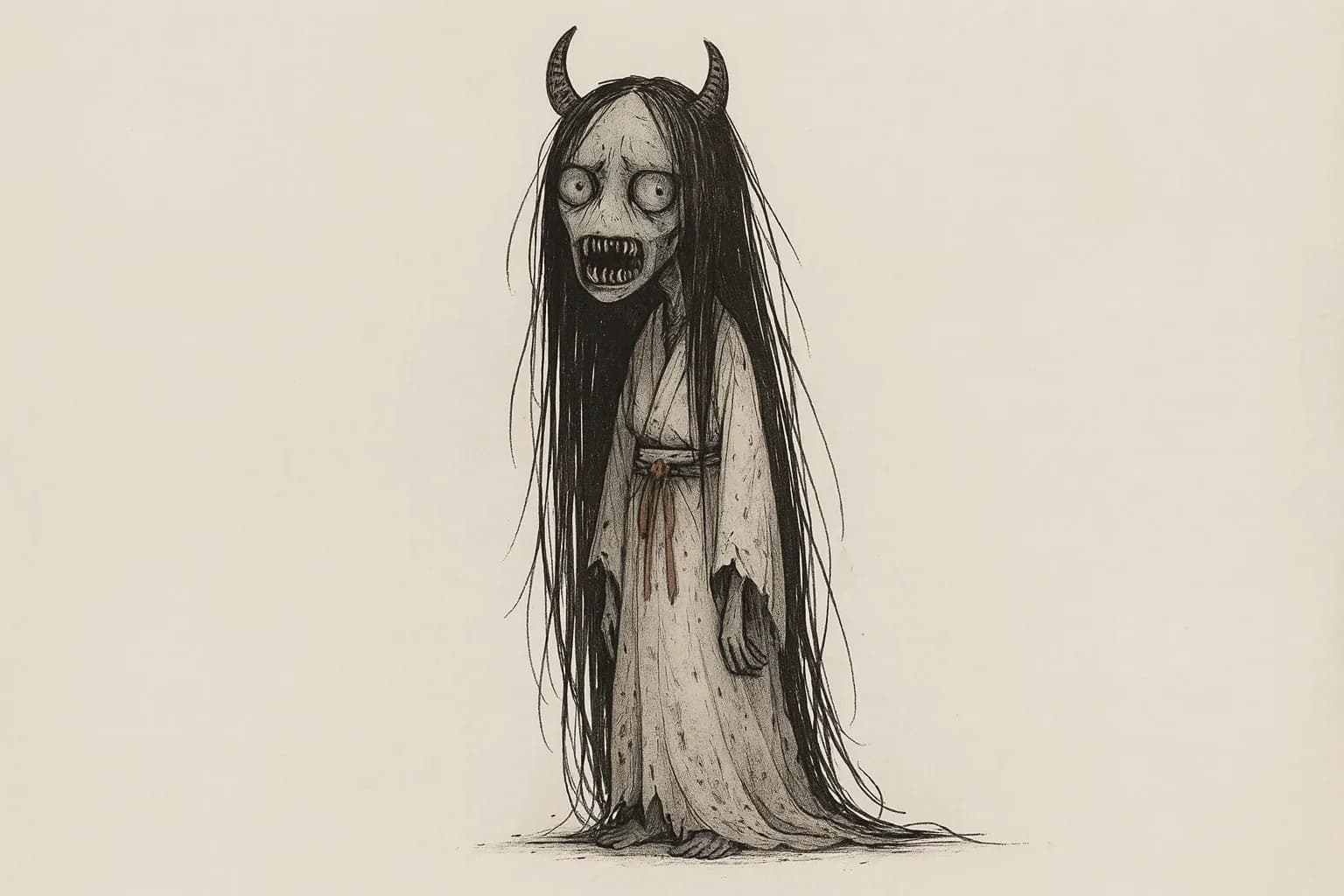
Toriyama Sekien's print shows a woman with a faintly blue-tinged complexion, two short horns rising from her forehead, and a mouth full of sharp black teeth, her long hair hanging loose and unkempt in the manner of a yūrei. She wears a plain white kimono, the same funeral-white associated with Japanese ghosts generally, and she stands directly beside the andon lamp itself — the one covered in blue paper that gives both her and the game their name. There is no elaborate scene around her, no burning house or flooded river. Sekien draws her the way she was meant to be encountered: alone, in a room that has just gone dark.
The game that summoned her
Hyakumonogatari Kaidankai — "the gathering of a hundred supernatural tales" — began as a test of nerve among samurai households before it spread to merchants and townspeople in the seventeenth and eighteenth centuries. The rules were simple and specific: light a hundred wicks, usually set inside andon lamps with paper shades dyed blue for a more unsettling glow, then take turns telling kaidan, real or borrowed accounts of ghosts and strange happenings. After each story, the teller — or sometimes each guest in turn — snuffed out one lamp and, in some versions of the game, walked alone to a darkened room to check their reflection in a mirror before returning. As the count climbed toward a hundred, the room grew darker, the stories grew stranger, and the tension in the circle grew with it. Reaching the hundredth story and extinguishing the final lamp was widely believed to invite something into the room. Many hosts stopped at ninety-nine on purpose.
Where it comes from
Ao-andon is unusual among Sekien's yokai in one respect: there's no earlier folk tradition of a creature by this name for him to be illustrating. Konjaku Hyakki Shui (1781), the book where she first appears, is the third volume of his four-part Gazu Hyakki Yagyo series, and across that catalog Sekien regularly worked the other direction — starting from a word, a pun, or a piece of everyday material culture and inventing a face to go with it. Aoandon reads as exactly that kind of invention: the game already had a name for its climax, "the blue lantern," and Sekien gave that phrase a body. What he was illustrating wasn't a creature villagers already told stories about, but the dread the game itself was built to produce — the specific fear of being the one left in the room when the last light goes out. Because his prints were copied and referenced for generations afterward, the invented figure came to be treated as folklore in its own right, the same way several of his other Konjaku entries did.
Ao-andon today
The hyakumonogatari game itself faded as electric lighting made a fully dark room harder to arrange, but Ao-andon has kept turning up as a character in her own right. She appears as a collectible shikigami in the long-running mobile game Onmyoji, cast fittingly as a spirit with an affinity for storytelling, and she shows up as a mini-boss encounter in Ubisoft's 2025 title Assassin's Creed Shadows, set in Sengoku-era Japan. Both keep the core image Sekien drew nearly two and a half centuries ago: horns, black teeth, and a woman standing in blue light where the last lamp used to be.