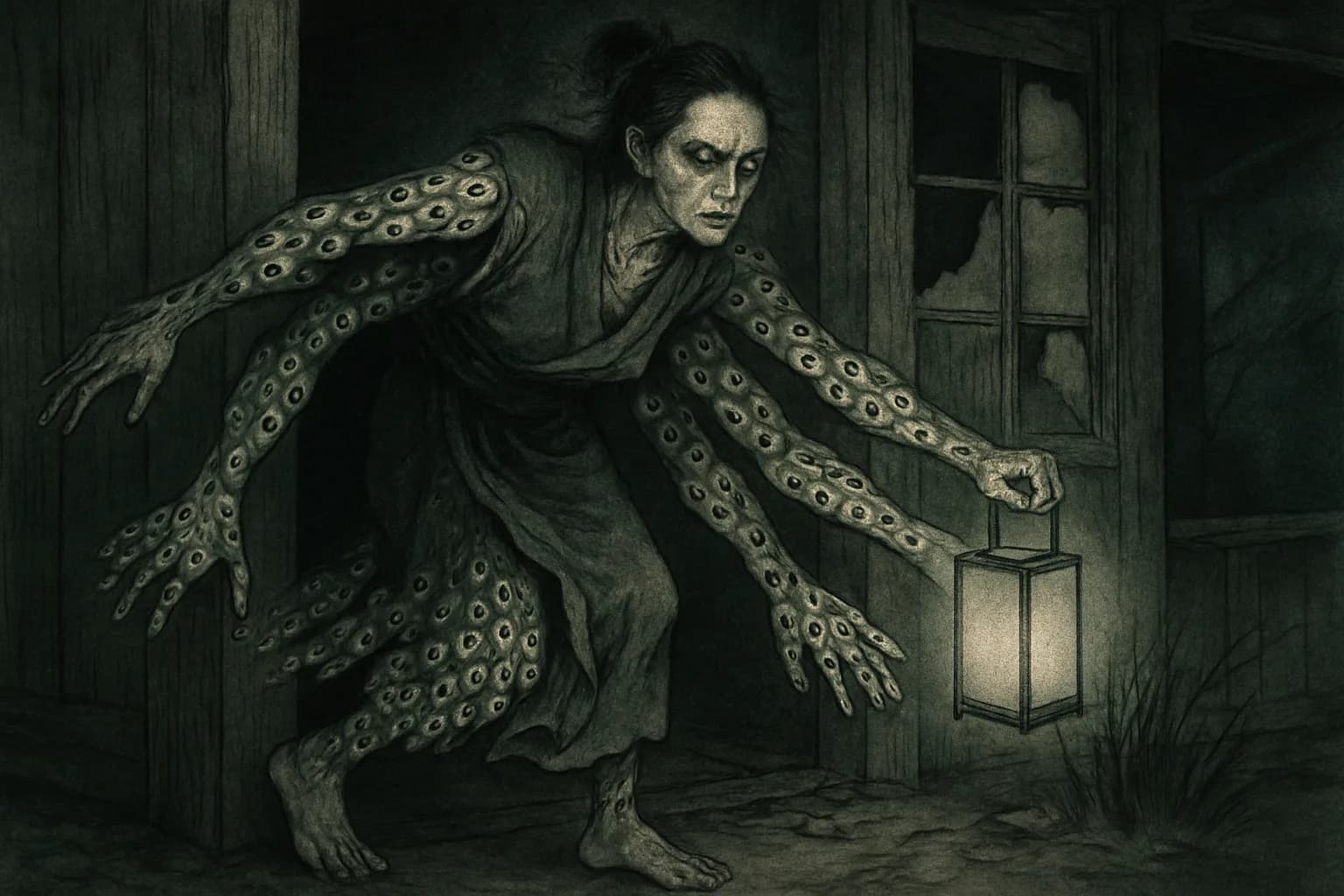
Edo-period Japanese had a slang word for money: chōme, "bird's eye," a nod to the small square hole punched through every copper coin. The dodomeki takes that pun literally. She was a woman with a habit of theft, and for every coin she pocketed, the folklore says, an eye opened somewhere on her arms — until both limbs, from wrist to shoulder, were studded with staring bird-like eyes.
What does it look like?
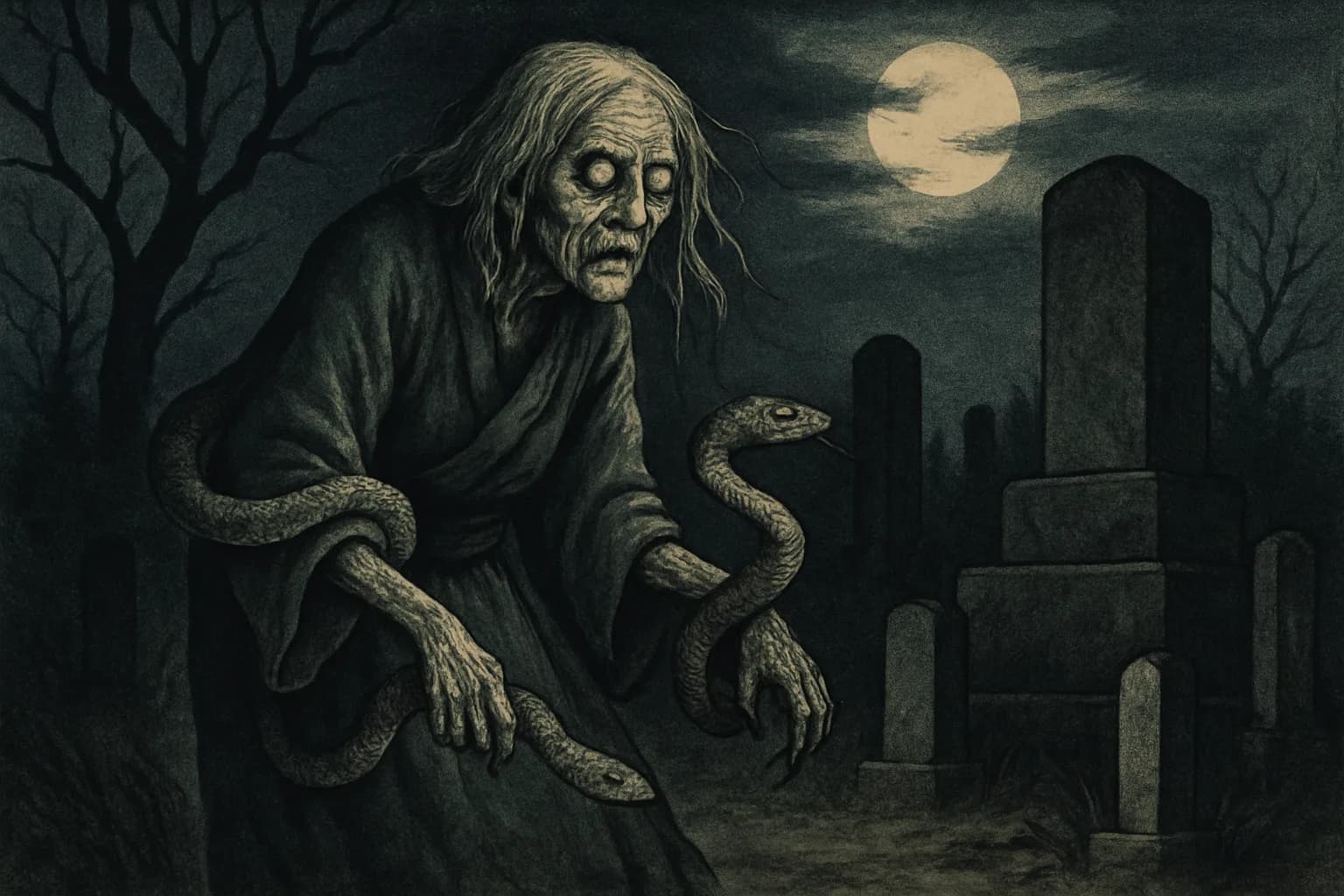
Toriyama Sekien drew her as a woman, otherwise unremarkable, with sleeves pushed back to reveal forearms covered in small round eyes — dozens of them, packed close together like scales or coins themselves. There is no fur, no fangs, no horns. The horror is entirely in that one detail, made worse by how ordinary the rest of her looks. Later retellings sometimes push the transformation further, giving her an oni's clawed hands to match the demon component folded into her name, but Sekien's original image stays close to a simple human figure marked by an unnatural affliction.
The name is the whole story
Dodomeki's kanji, 百々目鬼, spell out "hundred-hundred-eye-demon" — an exaggerated way of saying "countless eyes." Sekien's brief text in Konjaku Gazu Zoku Hyakki (1779) explains the mechanism directly: a woman addicted to stealing coins is transformed so that her arms bear as many eyes as the coins she took. Because Edo-era cash was nicknamed for its bird's-eye hole, the punishment and the crime rhyme — steal a bird's eye, grow a bird's eye. It's a yokai built almost entirely out of wordplay, in the same tradition as Sekien's other invented entries that dress up an old idiom or figure of speech as a monster.
A curse, not a species
Unlike a kappa or a kitsune, the dodomeki isn't described as a race of creatures living somewhere in the wild. She is a single transformed person, cursed by her own repeated theft rather than born or summoned. That makes her closer in spirit to other Edo-period cautionary figures — women whose bodies change to visibly announce a moral failing — than to the nature spirits and household gods that fill most of the yokai canon. The eyes don't grant her any power described in the sources; they are simply the mark of what she did, permanently displayed on the one part of her body a thief can't hide.
Where it comes from
Sekien compiled Konjaku Gazu Zoku Hyakki as a sequel to his earlier Gazu Hyakki Yagyō, and by this point in the series he was inventing a good number of his entries from proverbs, puns, and scraps of folk speech rather than transcribing older oral traditions wholesale. Dodomeki fits that pattern. She reads less like a creature villagers claimed to have seen and more like an illustrated joke with a moral attached: greed leaves a mark, and in her case the mark happens to match the shape of what she stole. Some later yokai compendiums grouped her loosely with tales of hands and arms that misbehave — reaching, grasping, unable to stop — though the coin-eye connection is what earlier sources consistently repeat.
Dodomeki today
She's a minor figure next to Sekien's more famous creations, but illustrators and yokai encyclopedias that work through his four picture-book collections in order always land on her, precisely because the design is so compact: one clean visual idea, one pun, no elaborate backstory required. She turns up in yokai card games and art books that catalogue the lesser-known entries from the Hyakki series, usually rendered close to Sekien's original — a woman, sleeves rolled back, a hundred eyes looking back at the viewer.