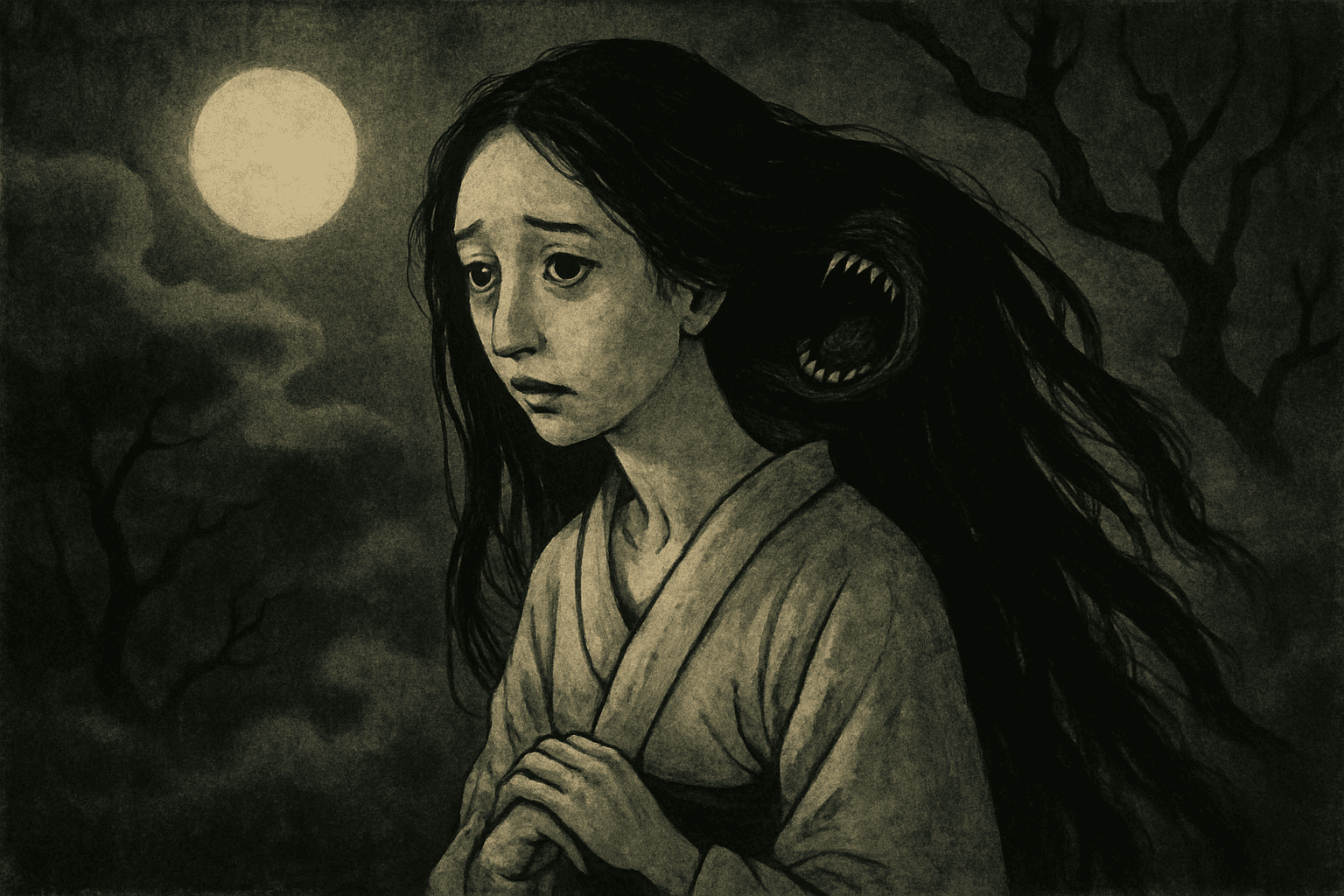
A housewife eats almost nothing, and yet the household's rice keeps disappearing. Her husband grows suspicious, then watches, then one day sees her hair part on its own at the back of her skull, revealing a second mouth that talks, demands, and swallows bowl after bowl on its own. This is the futakuchi-onna, 二口女 — literally "two-mouth woman" — one of the stranger domestic hauntings in the Edo-period catalog of yokai.
What does a futakuchi-onna look like?
By day she looks entirely ordinary: a wife or mother going about her chores, her long hair worn up or loose in the usual style of the period. The second mouth sits at the back of her head, under the hair, and stays hidden until it wants something. When it opens, the surrounding strands of hair are often described moving like living things — thin tendrils that reach out, snake toward food, and stuff it into the hidden mouth without the woman's hands ever touching it. Toriyama Sekien illustrated her this way in the Edo period, hair fanned out around a second face at the crown of the skull, and the image has changed very little since.
A mouth that talks back
The ordinary mouth stays polite. The second one does not. It curses, complains, and berates the woman if it isn't fed enough, and in many versions of the story she can't fully control it — it speaks with a will of its own, separate from hers, as if something else had taken up residence in her skull. Villagers who told these stories often linked the mouth to old wounds: a blow from an axe or hoe that never properly healed, the scar reopening as lips, or a wound earned in an accident that would not close.
The stepmother's curse
The most common version of her origin is a domestic one, and a grim one. A woman remarries and resents her new husband's child from a previous marriage. She secretly starves the child, feeding herself while giving the child nothing, and the child eventually dies of hunger or neglect. Some time later, a wound opens on the back of the stepmother's head. It will not heal, and before long it has grown lips, teeth, and a voice — a mouth that eats constantly and never feels satisfied, no matter how much rice is pushed into it. In this telling the futakuchi-onna is a punishment made flesh: the child's hunger returned to torment the woman who caused it, mouth for mouth, meal for meal.
A quieter variant swaps the cruelty for simple thrift — a wife who prided herself on eating almost nothing to save money for the household, until her husband discovered where all that unexplained food was actually going.
Where it comes from
Folklorists generally read the futakuchi-onna as a story about hidden appetite and hidden guilt — what a household doesn't want to see about the woman running it, made literal. She belongs to a small family of Edo-period yokai built from ordinary women transformed by something unspoken: the long-necked rokurokubi is her closest relative, another housewife whose body reveals a secret at night that her waking self would never admit to. Both are cautionary figures from a domestic world, not the mountains or crossroads that produce most yokai — hauntings that start at the dinner table.
Toriyama Sekien recorded her in his Edo-period yokai catalogs alongside dozens of similar figures, giving the futakuchi-onna the fixed, illustrated form that later tellings would keep returning to.
Futakuchi-onna today
She remains a minor fixture of Japanese ghost-story anthologies and yokai encyclopedias, the kind of illustrated compendia that catalog regional monsters rather than invent new ones. Video games and manga that draw on the full roster of Edo-period yokai — rather than any single studio's original characters — have kept the design in circulation, usually leaning on the same detail every artist reaches for first: hair that moves on its own, parting to reveal a mouth that was never meant to be seen.