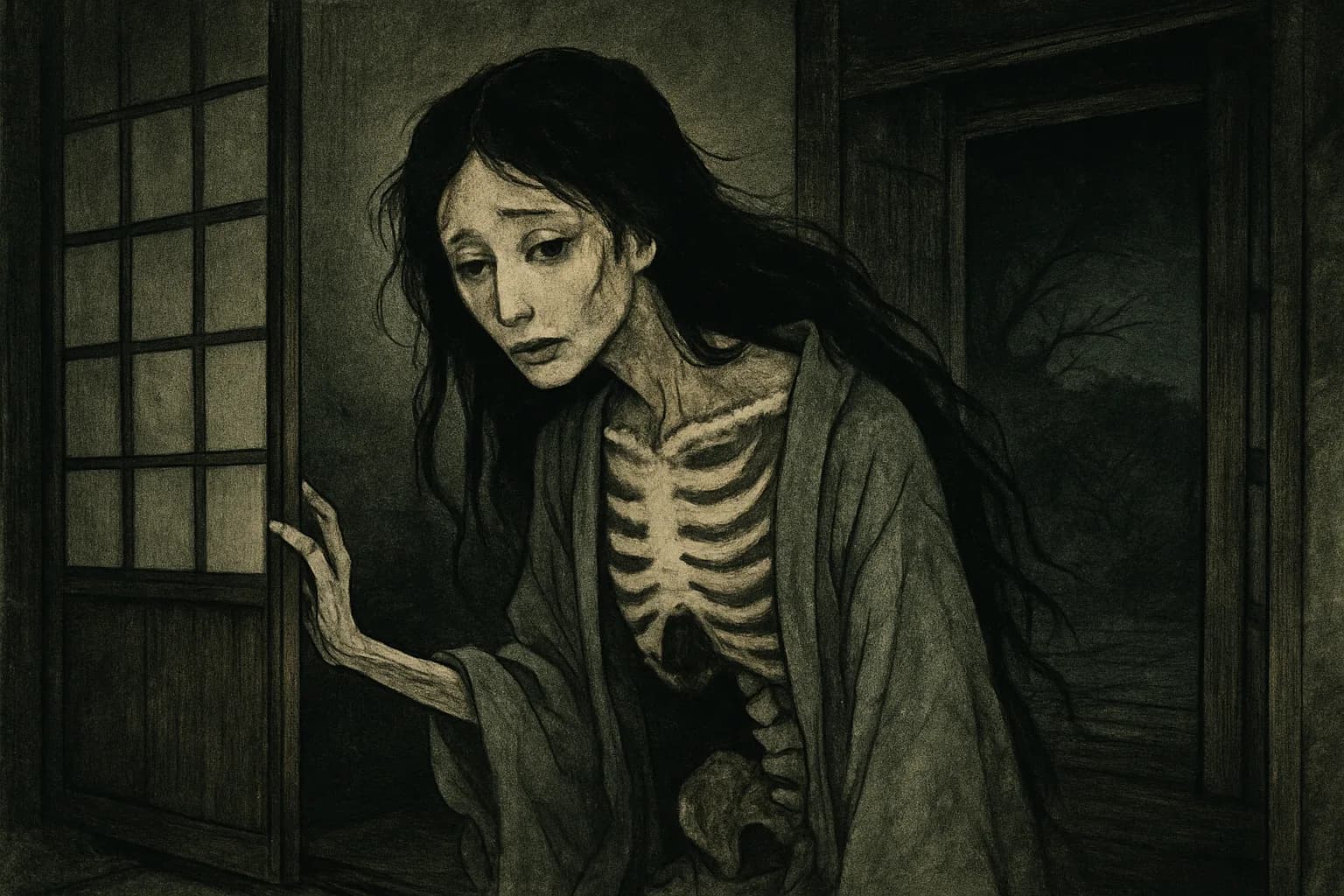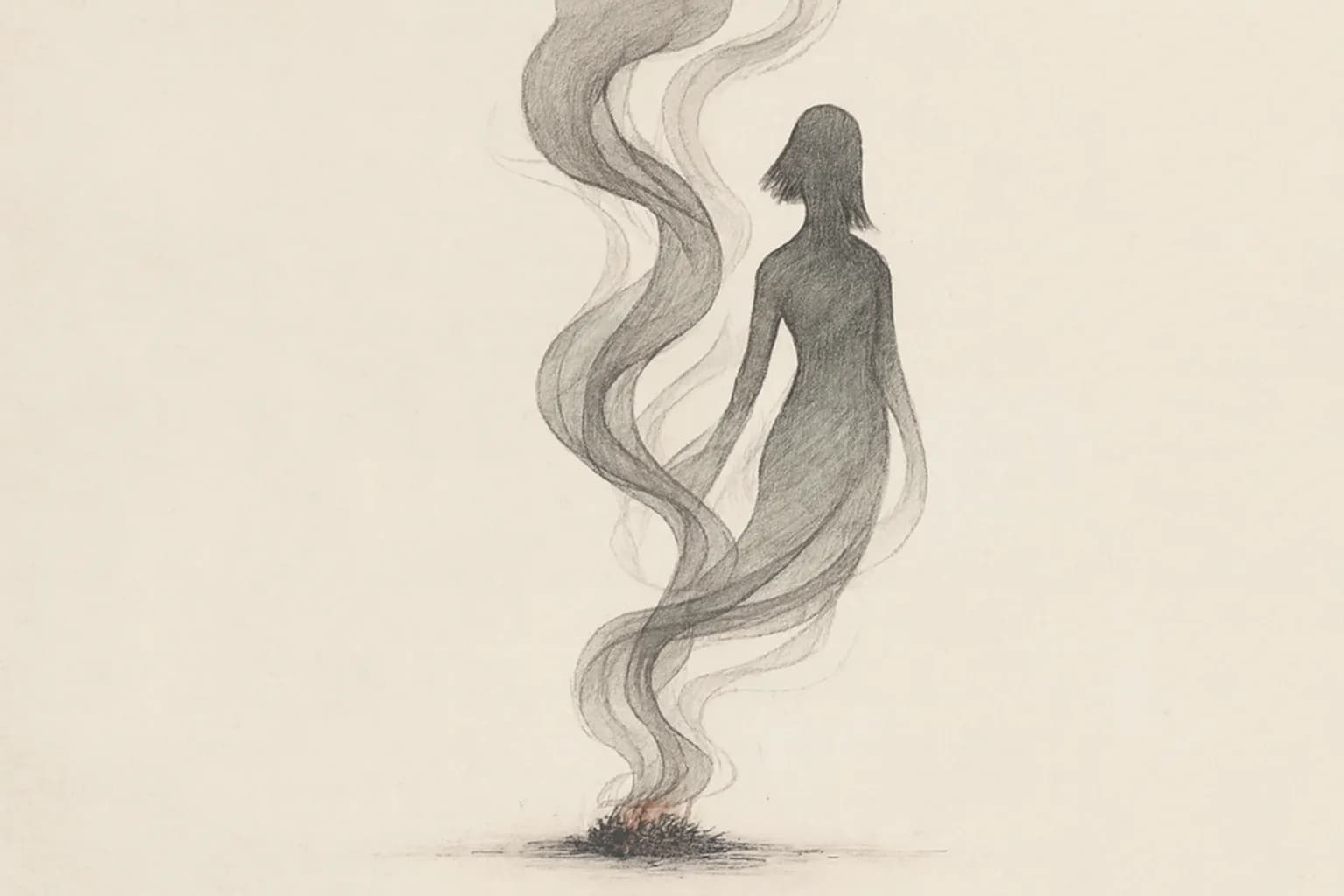
Watch smoke rise from a bonfire or a kitchen hearth on a still evening long enough, and it stops looking like smoke. It thickens, curls, and for a moment holds a shape — a sleeve, a trailing hem, the turn of a shoulder — before the air takes it apart again. Most people see nothing but haze. Modern yokai books say only some people can see a figure in it.
What does it look like?
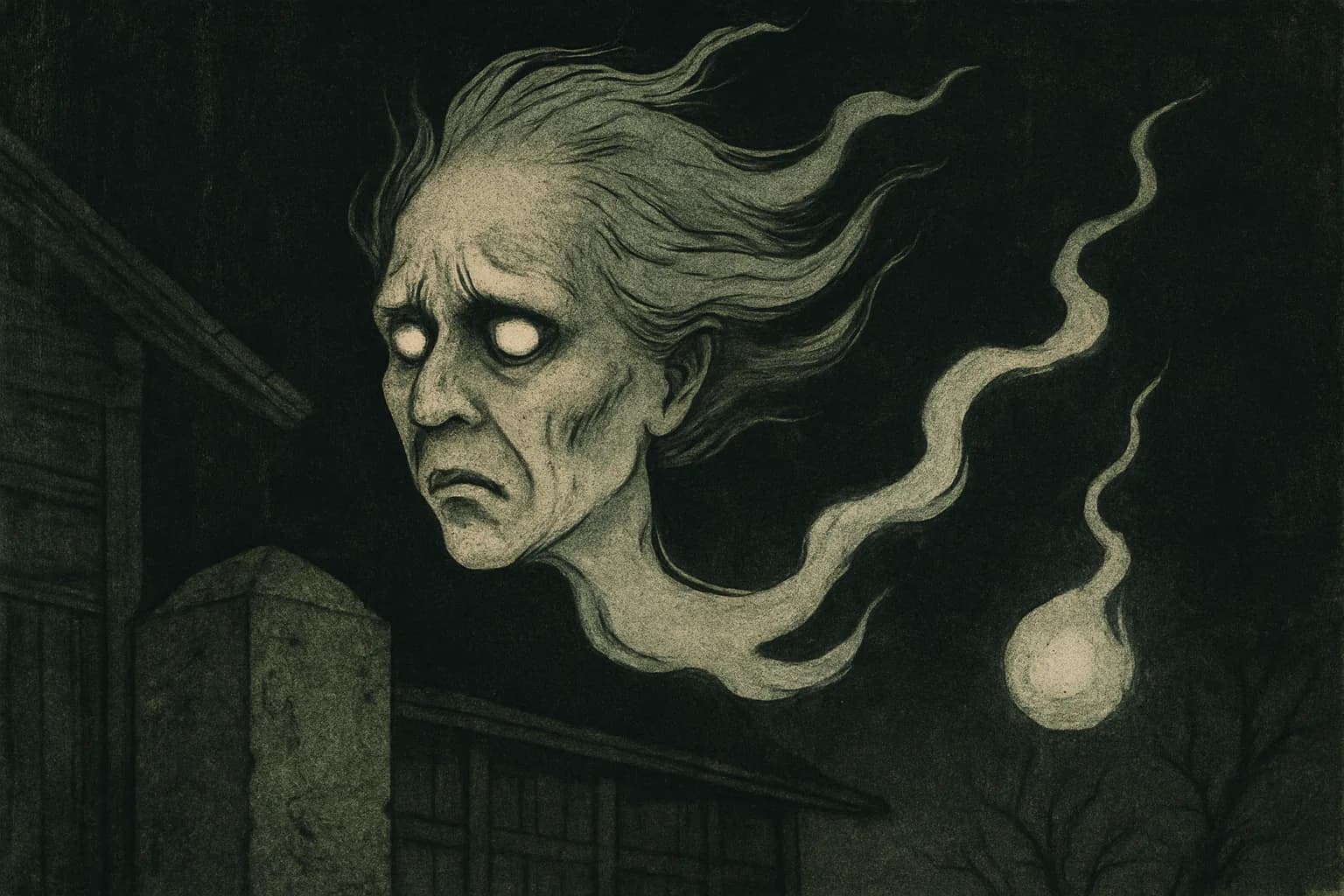
En-enra (煙々羅) has no fixed body at all — it is smoke and shadow that happens to have gathered into a human silhouette, gauzy and half-transparent, built from a rising column of smoke rather than standing apart from it. The name plays on this directly: 煙 (en) is smoke, doubled by the repetition mark 々, and 羅 (ra) is a thin, sheer silk gauze — the kind of fabric that ripples and shows through itself in the wind. Put together, the name describes exactly what the eye is supposed to catch: smoke behaving like a drifting length of gauze cloth, folding into a shape rather than simply dispersing.
A figure only some eyes can find
The defining trait of an en-enra isn't menace — it barely interacts with anyone. It is the seeing itself that's the trick. Modern yokai books, following Mizuki Shigeru, add that only a calm, pure-hearted person can make out its form; everyone else standing at the same fire watches ordinary haze rise and drift apart. There's no trial to pass and no bargain to strike, which sets en-enra apart from most yokai that block a road or demand something from a traveler. It simply appears, briefly, to whoever is capable of noticing, and vanishes when the smoke does.
Later books call it either a spirit made of smoke, or a spirit that lives in smoke. Both readings keep the same core image: a human outline built from something that has no fixed shape to begin with.
Where it comes from
En-enra first appears in Toriyama Sekien's Konjaku Hyakki Shui (今昔百鬼拾遺, "Supplement to the Hundred Demons of the Past and Present"), published around 1781 as the third book in his four-volume illustrated catalogue of yokai. Sekien filled these volumes with more than the famous mountain and river monsters; he also gave form to smaller, quieter phenomena of daily life — the flicker of a paper lantern, the after-image of a soul, the shape smoke makes over a cooking fire. En-enra belongs to that quieter register: not a threat to ward off, but an observation about how the eye finds faces and figures in things that have none, dressed up as a matter of moral character rather than eyesight.
That framing fits the setting Sekien gives it. His caption puts it in the smoke of a mosquito-smudge fire at a poor house. This isn't a spirit of remote mountains or flooded rivers; it rises from the kind of small fire every Edo-period home used, which is presumably why it reads as a domestic, half-comforting apparition rather than a dangerous one. It asks nothing and takes nothing — it only exists at the edge of what an ordinary fire already does.
Sekien's caption names the smoke after torn gauze
Sekien wrote a short caption beside the picture. Here is a plain translation of what it says. At a poor man's house, the smoke of a mosquito fire tangles together. It takes on a strange shape. That shape looks like thin gauze, which the wind tears easily. So, the caption says, perhaps it should be called en'enra.
The caption spells the name 烟々羅. The first character, 烟, is an older way to write "smoke." Today the name is usually written 煙々羅.
The picture itself is simple. Sekien drew an eerie face showing through a cloud of smoke. The rest is left to the drifting smoke.
The idea goes back to a 14th-century essay
The scholar Kondō (近藤瑞木) traced the scene to an older book. Kondō's chapter appeared in Yōkai Bunka no Dentō to Sōzō (2010), edited by Komatsu Kazuhiko. The chapter points to section 19 of Tsurezuregusa, the essay collection by Yoshida Kenkō.
In that section, Kenkō lists small things he finds moving. One of them is a summer evening at a poor house. White yūgao flowers show in the dusk. A mosquito fire smolders nearby. Kenkō found that touching.
Sekien knew his classics. His readers did too. A poor house, a mosquito fire, and smoke would call up Kenkō's line for them. Sekien then added one thing: a face in the smoke.
It has other names, and one points to hell
The yokai is also called enra-enra (煙羅煙羅). That is the same name with the parts flipped around.
Mizuki Shigeru's Nihon Yōkai Taizen (1991) mentions a third spelling: 閻羅閻羅. Here 閻羅 (enra) is another name for Enma, the king of hell. With this spelling, some read the smoke as rising from the fires of hell.
The same Mizuki book gives the idea about who can see it. One version says you need a calm mind, the kind that stares at smoke with no aim. Another says only people with a beautiful heart see it.
Both ideas are modern. Sekien's caption says nothing about hell or about who can see the smoke. They were added in the 20th century.
There is no other smoke yokai like it
Murakami Kenji's Yōkai Jiten (2000) calls en-enra rare. The dictionary notes there is no other yokai made of smoke.
There is also no folk tale behind it. No village told stories about meeting one. A 2002 reference book by Murakami Kenji and Sasaki (佐々木卓) treats it as one of Sekien's own inventions.
Later writers widened where it appears. Tada Katsumi's 1990 book on Japanese fantasy creatures describes it as a spirit living in smoke. In Tada's telling, it wanders the air. It can show a human-like face in smoke from a kitchen stove or a bathhouse.
En-enra today
En-enra remains one of the lesser-known entries from Sekien's catalogue, overshadowed by the kappa and tengu that share the same books, but it circulates steadily in modern collections and encyclopedias of yokai art as an example of how much invention Sekien packed into phenomena nobody else had bothered to name. The core image — smoke that holds, for an instant, the shape of someone standing there — needs no updating. Anyone who has stared too long into a fire has already seen roughly what Sekien was drawing.
Quick answers
Is en-enra a real Japanese legend? Not a folk legend. It is thought to be Toriyama Sekien's own invention, from his 1781 picture book. No older local story about it is known.
Who can see an en-enra? Sekien never says. The idea that only some people can see it comes from Mizuki Shigeru's 1991 book: a calm mind in one version, a beautiful heart in another.
How do you spell enenra? You will see en-enra, enenra and en'enra. All are the same 煙々羅. Another name is enra-enra (煙羅煙羅).
Is en-enra dangerous? No source gives it any harmful act. It is smoke that briefly takes a shape, then fades.