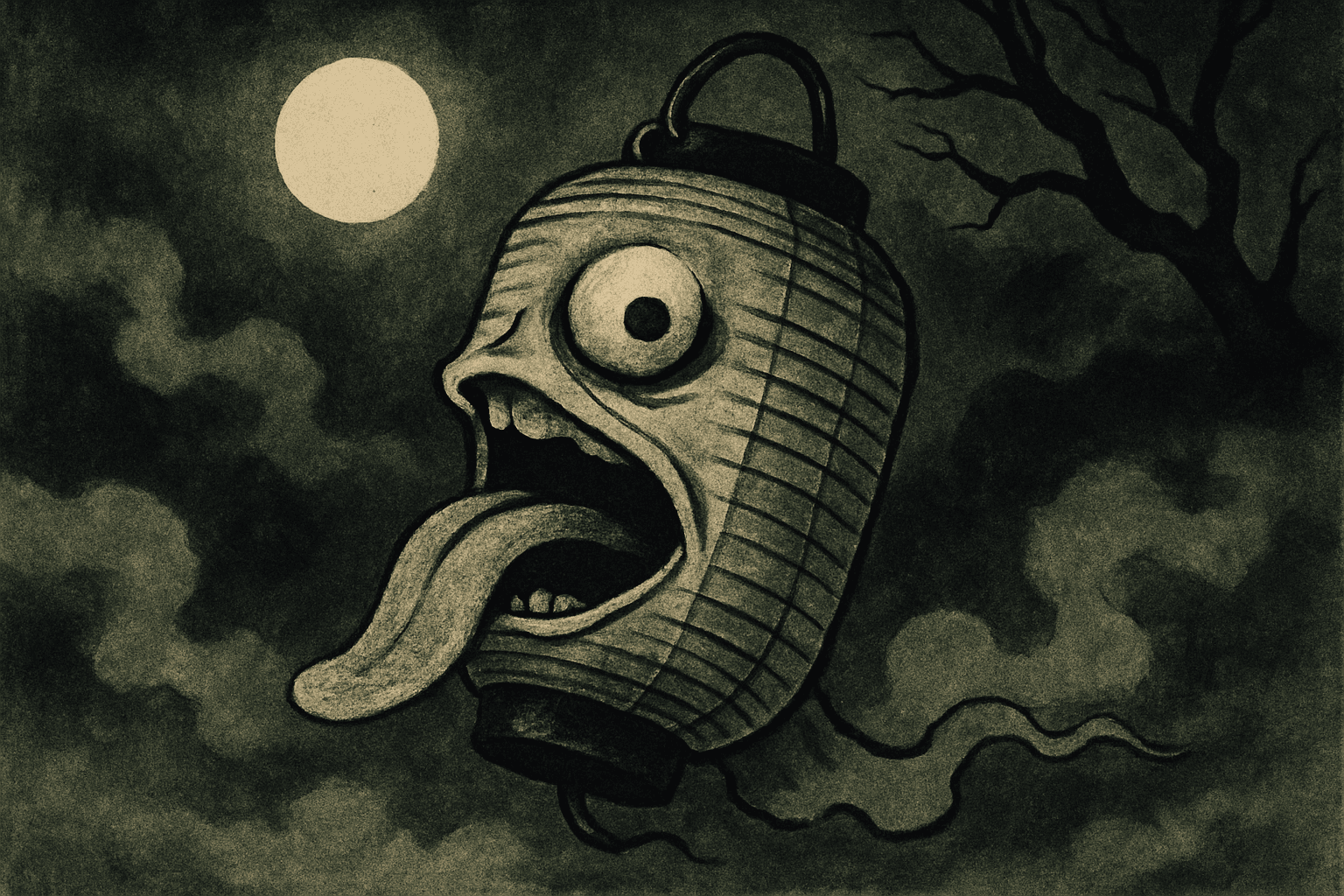
Before electric light, a paper lantern was the one thing standing between a traveler and total darkness on a country road. It was cheap, disposable, and worn out fast — the bamboo ribs sagging, the paper skin torn and patched until it was more mend than lantern. Out of exactly that kind of neglect, Edo storytellers imagined chochin-obake, "the transforming lantern": a discarded chochin that splits open along its own tears, sprouts a single eye, and sticks out a tongue longer than its body.
What does it look like?
The design leans on the object's own construction. A paper chochin is built from a spiral of thin bamboo strips wrapped in paper, which lets it collapse flat and pop back open like an accordion. Artists turned that fold into a mouth: the lantern gapes open along one side, the torn paper reads as a wide, ragged grin, and a long red tongue lolls out of it. A single round eye sits where the paper has worn through or split, usually off-center rather than symmetrical, which is part of what makes the face look so unsettled. Unlike its cousin the kasa-obake, it rarely grows legs or arms — it simply floats, swings from where it hung, or bobs along at head height, since a real lantern was carried or hung, not walked.
A stage trick before it was a stock character
Chochin-obake's most vivid documented appearance isn't in a scroll but on a kabuki stage. Tsuruya Nanboku IV's 1825 play Tokaido Yotsuya Kaidan — still one of the most performed ghost plays in the kabuki repertoire — built an entire special-effects sequence, known as chochin-nuke, around a paper lantern hanging on stage. At the climax, the lantern's paper splits apart from within, and through the tear the murdered Oiwa's ghost is revealed, her face said to be disfigured by poison. The trick relied on a specially rigged lantern and a hidden trapdoor, and it was popular enough that similar lantern-transformation gimmicks turned up across other ghost plays of the period. A living, splitting lantern was, for Edo theatergoers, already a familiar piece of stagecraft before it settled into folklore as a named yokai.
Riding with the tool spirits
Like kasa-obake, chochin-obake is classed as a tsukumogami (付喪神) — an everyday tool that comes to life after long years of use or after being thrown away unused. The idea traces to the Muromachi-period Tsukumogami-ki, in which household objects abandoned during New Year's housecleaning resent their treatment and rise up before eventually finding Buddhist salvation. Tsukumogami were pictured moving together, not alone, and illustrated hyakki yagyo ("night parade of a hundred demons") scrolls place animated lanterns marching alongside walking umbrellas, koto, and old sandals. A stray chochin-obake bobbing down an empty street at night was, in that tradition, one straggler from a much larger procession of forgotten household goods.
An Edo print-shop favourite
Whatever its folk roots, the specific one-eyed, tongue-out lantern face spread through the same commercial print culture that made kappa and kasa-obake into recognizable characters: cheap woodblock-printed toy prints (omocha-e) sold to city children, and obake karuta, a card game built entirely around yokai portraits that taught kids to recognize dozens of monsters by their silhouette alone. A lantern with a face was an easy, funny image to reproduce at scale, and by the nineteenth century it needed no introduction — audiences already knew the joke a fright-print was making the moment they saw the shape.
Where it comes from
Fire and light held real weight in old Japanese belief — a lit lantern marked the boundary between a safe, human space and the dark beyond it. Objects tied that closely to warding off darkness were natural candidates for animist unease once they broke down or were tossed aside: something that had done the work of keeping night at bay for years doesn't stop mattering just because its owner is finished with it. The chochin-obake's face is the shape that unease took — comic rather than tragic, since a torn lantern makes a much funnier monster than a frightening one.
Chochin-obake today
The lantern ghost still turns up wherever old Edo yokai iconography is wanted at a glance: haunted-house attractions during Obon, festival lantern decorations, and yokai-themed merchandise aimed at children, the same audience obake karuta once had. It remains most often paired visually with kasa-obake, the two neglected household objects sharing display cases and toy sets a century and a half after the print shops that made them famous first put them side by side.