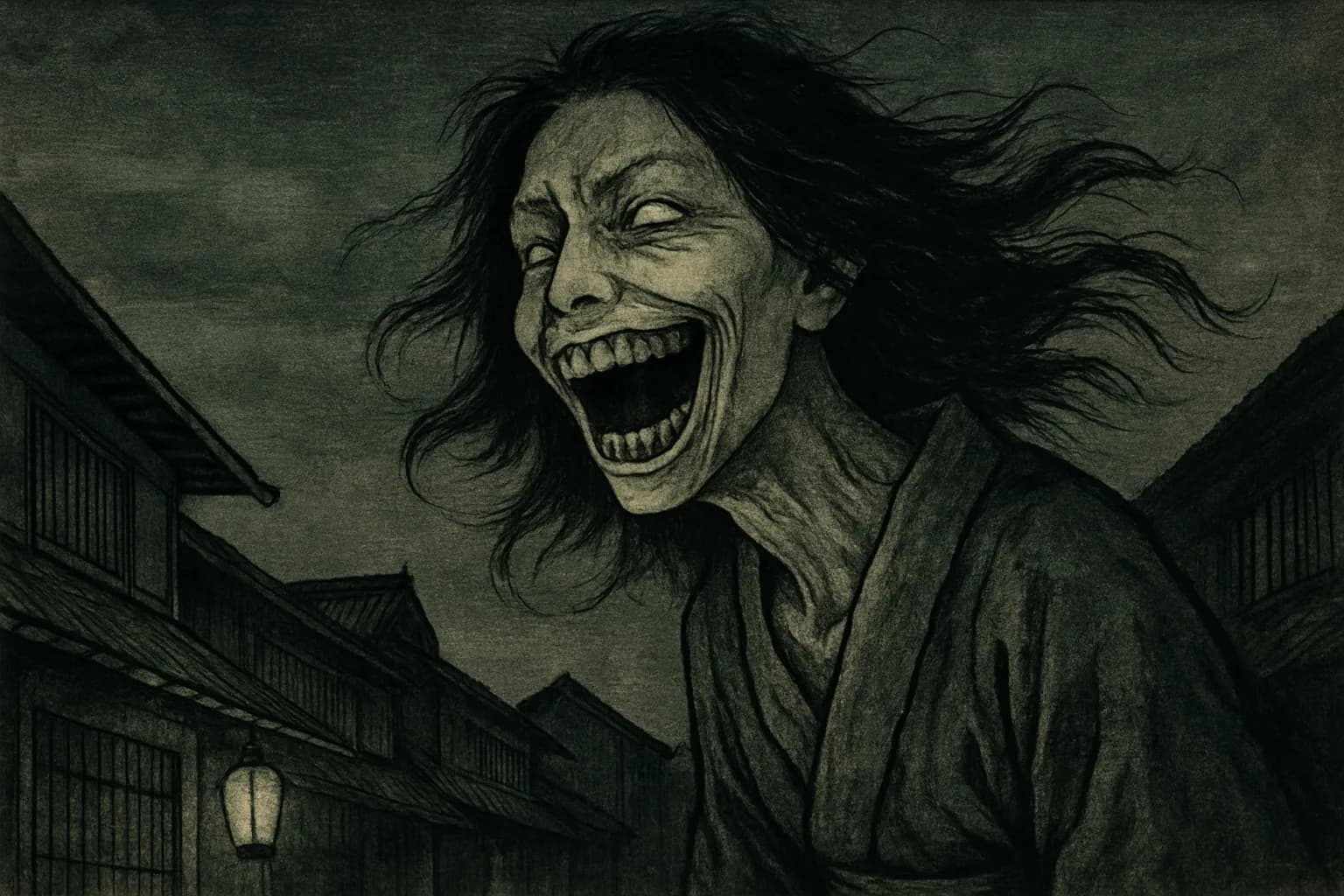
Walk down an empty street, and modern yokai books say you might hear her before you see her: a great, rolling cackle pouring down from above. Look up, and the laugh belongs to a woman taller than the fence beside you, in a mirth that shows no sign of stopping. That is Kerakera-onna, and there is nothing comforting about her laughter.
What does it look like?
Toriyama Sekien drew her in his 1781 catalogue Konjaku Hyakki Shūi (今昔百鬼拾遺, "A Supplement to the Hundred Demons of the Past and Present") as, in every particular but one, an ordinary woman in kimono. The one exception is scale. She looms over a fence, mouth open in a laugh that carries for streets. There are no fangs, no claws, nothing grotesque about her face. She is frightening the way a sound is frightening when it is too big for the space it's in.
A name borrowed from ancient poetry
Kerakera is ordinary Japanese onomatopoeia — the light, ringing sound of someone who finds something delightfully funny. But Sekien didn't just write the name in kana; he chose the characters 倩兮女, and the choice is a piece of wordplay dressed up as a monster. 倩 on its own means a smile so becoming it turns heads, and 兮 is an exclamatory particle borrowed straight from classical Chinese verse, a syllable that does nothing but hang in the air after a phrase for emphasis. The pairing 倩兮 echoes a line from the Shijing, China's oldest anthology of poetry, praising a beauty's "artful smile, so entrancing" — qiǎoxiào qiàn xī (巧笑倩兮). Sekien was as much a trained poet as a painter, and folding a fragment of ancient love poetry into a monster's name was exactly his kind of joke: the classical ideal of an irresistible smile, inflated to a giant's height and turned into something that follows you home.
Laughter as performance
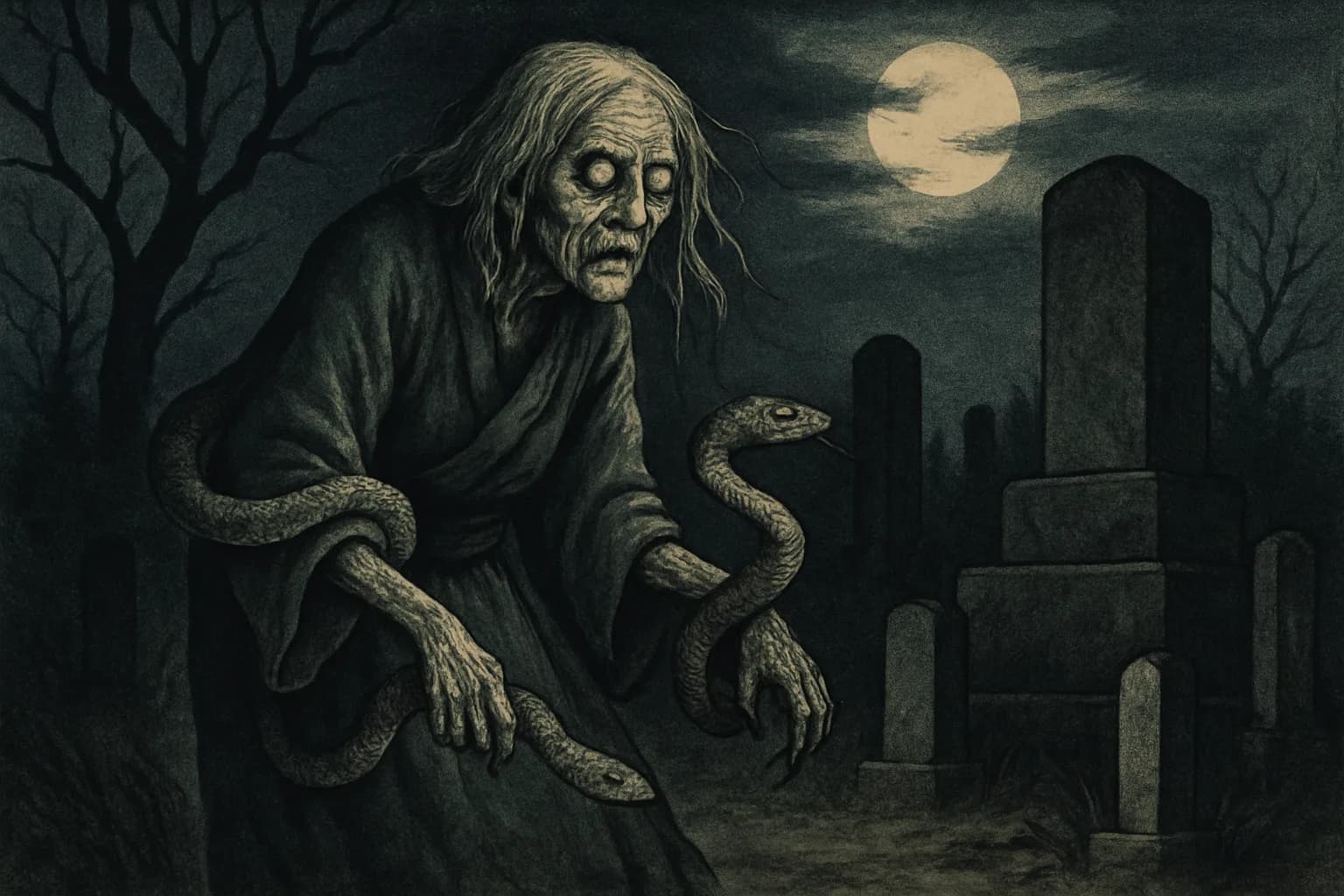
Sekien's caption does not name a place. It points to an old Chinese tale instead. The poet Song Yu had a beautiful neighbor. She climbed the wall between their houses to gaze at him. One smile from her, the story says, could bewitch a whole town. Sekien notes that beauty has led people astray in every age. He then guesses that Kerakera-onna is the ghost of a wanton woman. With her red lips, she once led many people astray. Her laugh is that seduction pushed past its limit, blown up to a giant's size.
Sekien gives her no rescue story, no named victim, no charm or ritual for driving her off. He supplies an image, a classical story and a piece of wordplay, and leaves the rest to the reader.
Neighbors across Sekien's catalogues
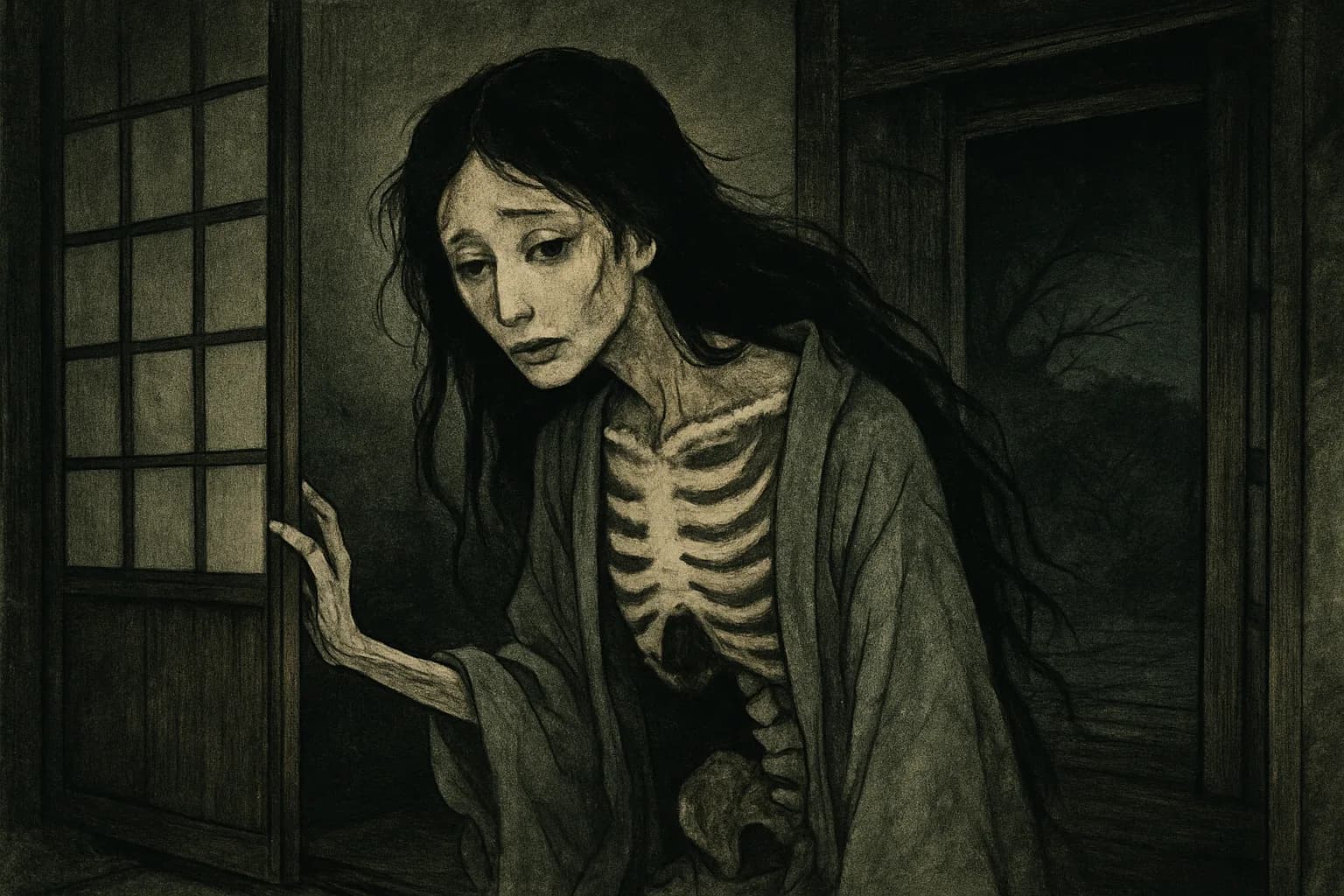
Kerakera-onna keeps company with a small cluster of oversized or uncanny women in Sekien's earlier books. Taka-onna (1776) stretches her body tall beside what looks like a brothel. Hone-onna (1779) is a skeleton who visits her lover as the beauty she once was. Ōkubi (1779) is a giant woman's head with blackened teeth, floating in a rainy night sky. None of them are hunting in the conventional sense. Each takes something about women, desire or beauty and makes it monstrous by exaggeration.
Where it comes from
Sekien did not invent her from nothing. Before his book, Edo picture books already showed women's heads that laughed "kerakera." One example is the illustrated story Heike Bakemono Taiji. Its caption reads, roughly, "A woman's head laughs kerakera — how eerie." So the laughing woman was already a known image. Sekien's step was to give her a full, giant body. He also gave her a learned name and a classical backstory. She is not a village legend, but she is not purely his invention either.
Kerakera-onna today
Kerakera-onna has mostly stayed inside the reference literature: reprinted in modern editions of Sekien's four print series, cited in yokai encyclopedias beside Taka-onna and Hone-onna, occasionally discussed by folklorists as an example of Sekien's habit of hiding classical allusions inside monster names. Twentieth-century books added details Sekien never gave. Only her victim can hear the laugh, they say, and a timid person may faint. She hasn't picked up a signature legend or a defeat scene the way Kappa or Yuki-onna have. What survives is the print and the pun — a giant woman laughing over a fence, her name a line of ancient love poetry stretched into something that no longer sounds like a compliment.