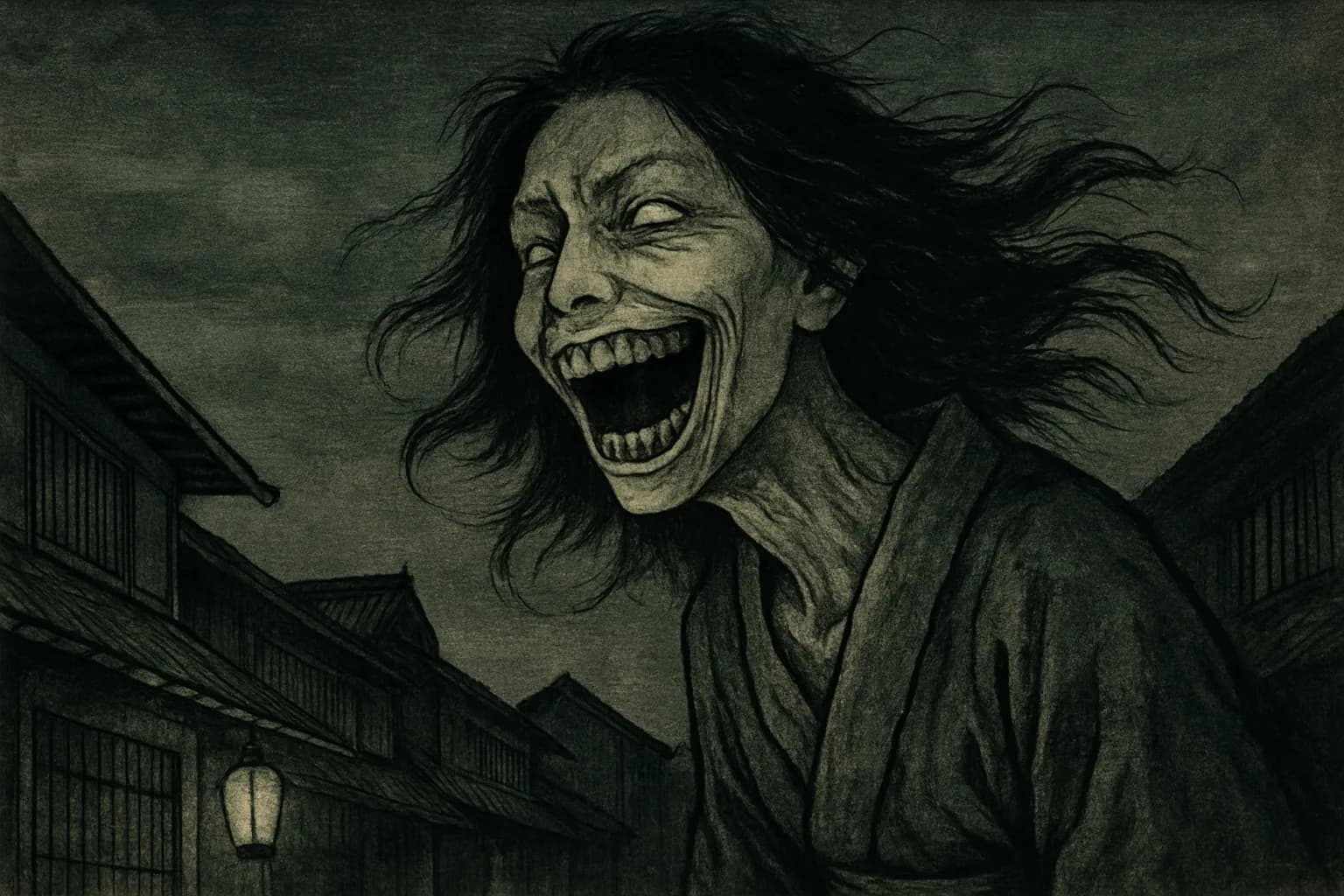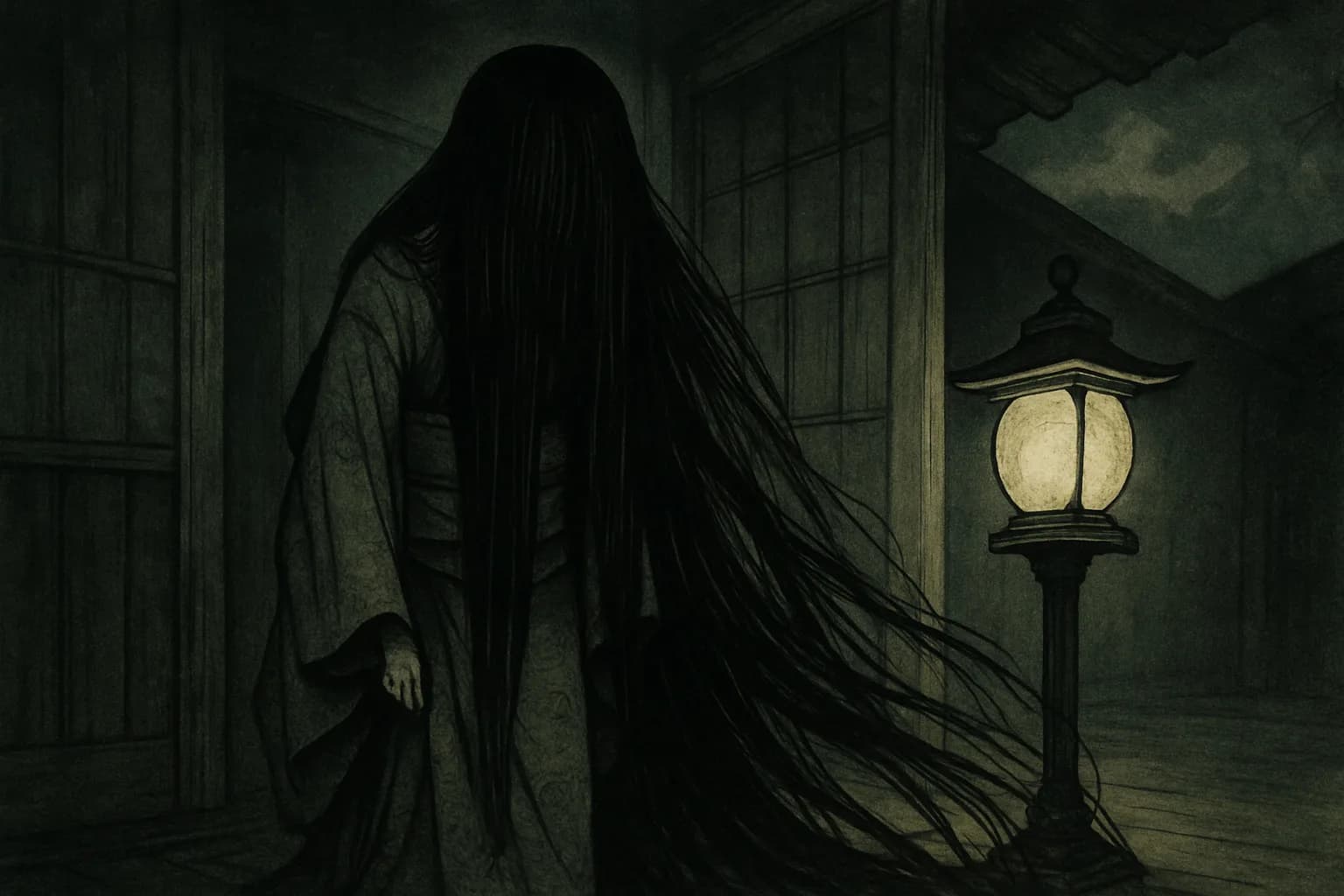
Walk the mountain paths above Yamakita after dark, and the old warning is simple: if you hear a woman laughing, keep walking. Don't look for her. Don't laugh back. Warai-onna, the Laughing Woman, is one of the few yokai that old accounts never bother to draw a face for. She is a sound in the dark, nothing more, and that is exactly what makes her dangerous.
What does it look like?
Almost nothing. Unlike most yokai, Warai-onna has no settled shape in the old records of Tosa — the historical name for today's Kōchi Prefecture, on the island of Shikoku. Villagers reported only a laugh rolling down from the slopes above Yamakita, now part of Kōnan City. No one claimed to see a woman, a shadow, or even an outline. The picture book that first recorded her, the Tosa Bakemono Ehon (a late Edo–early Meiji collection of Tosa's local monsters), gives the laugh a name and a place. It does not give it a body.
A laugh on three fixed nights
The detail every account agrees on is timing. Warai-onna was said to laugh on three specific nights of the month: the 1st, the 9th, and the 17th. This is not a vague "sometimes she appears at night." It is a fixed, countable schedule, repeating every month, tied to no season and no weather.
That precision matters. A monster that could show up on any night just means "be careful in the mountains." A monster with three named nights functions more like a calendar warning — a way of marking certain nights as unsafe for a specific, memorable reason, passed down without needing to explain the reasoning behind the dates themselves.
Do not laugh back
Every telling of Warai-onna carries the same rule, and it is almost absurdly simple: if you hear her laughing and you laugh back, you suffer for it. The one_liner that survives in local memory is blunt — you come down from the mountain half dead. Some versions describe a sudden collapse. Others describe a lingering illness that sets in after the walk home.
The protection is just as simple as the threat. Stay silent. Keep walking. Do not answer a laugh you did not ask to hear. It is folk wisdom built for people who had to cross those slopes at night anyway — farmers, travelers, anyone with a reason to be out past dark — and needed a rule short enough to remember under pressure.
Where it comes from
Warai-onna reads less like a creature and more like a piece of safety advice wearing a yokai's name. Mountain villages across Japan kept lists of unlucky or forbidden days, a kind of mono-imi (忌み日), taboo day, when certain activities were avoided. A laugh that returns on exactly three dates a month looks like exactly that kind of folk calendar, given a voice instead of a written rule.
She has no face in the old accounts for a reason that fits this reading. A rule about which nights to avoid does not need a monster to fight or outwit. It only needs a sound frightening enough that people remember not to answer it, and a consequence clear enough that the warning sticks after one bad telling.
Warai-onna today
Warai-onna has stayed a local figure. She shows up in regional yokai compendiums covering Kōchi and Shikoku folklore, usually filed alongside other mountain apparitions tied to specific places rather than the nationwide names like kappa or tengu. She has not picked up a game or anime role, and no major franchise has borrowed her laugh.
She does share shelf space with kerakera-onna, a very different giant laughing woman recorded by the artist Toriyama Sekien in Edo, and with the mountain figures yamauba and yamahime. The resemblance between Warai-onna and kerakera-onna stops at the laugh. One is a towering print from a city artist's catalogue. The other has no catalogue entry at all — just a name, three nights, and a slope above Kōnan where people still remember not to answer back.