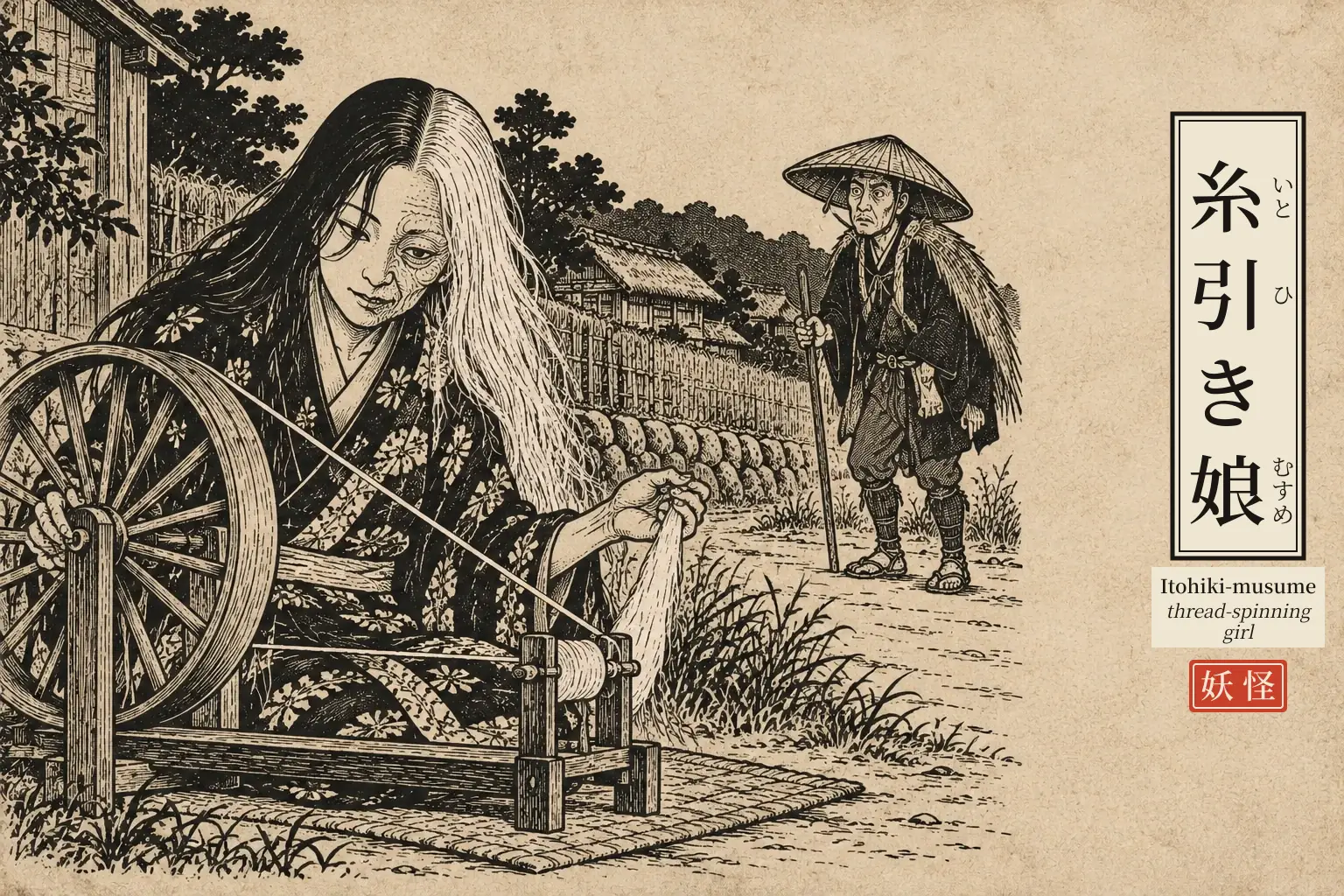
Walk a quiet road near Horie, an old village in Tokushima, and you might pass a woman at a spinning wheel. She sits by the roadside, drawing out thread. She is beautiful enough to make a traveler slow down. That is the mistake. Keep looking, and her hair turns white in front of you. She is an old woman now. Then she laughs, loud and sudden, and you are the one who gets the fright.
What does she look like?
The story gives her only two forms, and the switch between them is the whole point. First, she is a beautiful woman, seated at a spinning wheel, working thread by the road. A traveler stops, caught by her looks. That is when she changes. Her hair goes white. Her face becomes an old woman's. She bursts into loud laughter and startles whoever is still standing there.
The sources we found don't describe her size, her clothes, or what happens after the laugh. The recorded tale centers on one transformation and one sound.
A warning with no victim
What stands out is what does not happen. None of the sources we found say she hurts anyone, drags them anywhere, or follows them home. She spins, she is watched, she changes shape, she laughs. That is the whole story in the one telling we found.
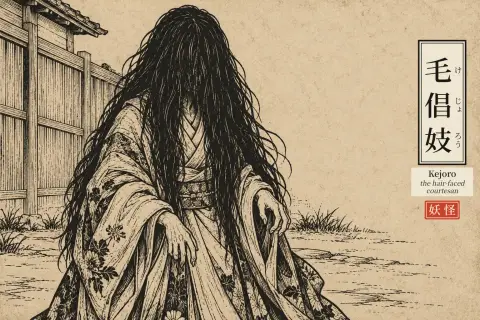
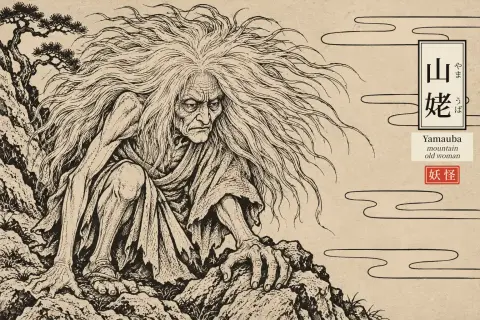
Compare her to kejoro, a courtesan so covered in hair that you cannot see her face, or to yamauba, the mountain crone who sometimes eats travelers outright. Itohiki-musume does neither. Her only weapon is surprise. The danger in her story is not violence. It is being caught staring at a stranger on an empty road.
Where it comes from
Kōchi's warai-onna, the laughing woman, also laughs at people. But she lives in the mountains, and her laugh can make people sick. Itohiki-musume's laugh only gives a fright.
Her name matches her task exactly. 糸 (ito, "thread") and 引き (hiki, "to pull" or "draw") describe spinning thread; 娘 (musume) means "girl." Put together, she is simply the girl who draws thread — until she is not a girl anymore.
Go deeper
Where Japanese ghosts come from.
- Yūrei: The Japanese Ghost →Zack DavissonWhere Japanese ghosts come from, told through old paintings, kabuki and ghost stories.
- Kwaidan: Stories and Studies of Strange Things →Lafcadio HearnThe classic 1904 collection of Japanese ghost stories that shaped how the West first met kaidan.
Some links are affiliate links; if you buy through them we may earn a small commission at no extra cost to you.
Itohiki-musume in the record today
Itohiki-musume never grew into a national figure the way kappa or tengu did. She survives mainly in folklore catalogues: Yanagita Kunio's 1955 Sōgō Nihon Minzoku Goi, a nationwide glossary of folk vocabulary compiled under his supervision, and later in Tada Katsumi's 1990 survey of Japanese fantastical beings, Gensō Sekai no Jūnintachi IV: Nihon-hen. Japanese Wikipedia lists both books as sources for her entry.
No source we found mentions a shrine, a festival, or a modern mascot for her. What she has is a single scene, fixed for decades. A spinning wheel by the road in old Horie. A woman who looks young until you look twice. And a sudden laugh.