A shrine in the old province of Awa keeps a strange object. Most shrines house a mirror or a sword as their shintai, the object a shrine enshrines. This one holds hair. The hair sits folded inside a hemp tub, called an asaoke. Most of the time it stays still. But when the kami's mood turns unsettled, the hair wakes up. It pushes the tub's lid open. It grows long enough to reach whoever is nearby. And it does not stop at growing.
What does it look like?
The creature has no face and no body of its own. It is simply hair, kept inside a hemp tub as a shrine's sacred object. The tub sits at the shrine of Yatsuhime (彌都比売神社), in what was once Kamo village, in Awa's Miyoshi District. Some old accounts instead name the shrine Mitsuhanome Shrine (弥都波能売神社). Either way, the hair itself is the shintai — not a decoration kept beside it.
As long as the enshrined kami stays calm, the hair stays hidden in its tub. When the kami's mood turns unsettled, the hair grows out past the tub's rim and binds whoever is nearby.
The night the bandits divided their loot
The oldest account of the hair's power comes from a book called the Ashū Kiji Zatsuwa. Japanese Wikipedia dates it only to the Edo period. National Diet Library records go further: they date its author, Yokoi Kijun, to around the Kansei era, the late 1700s.
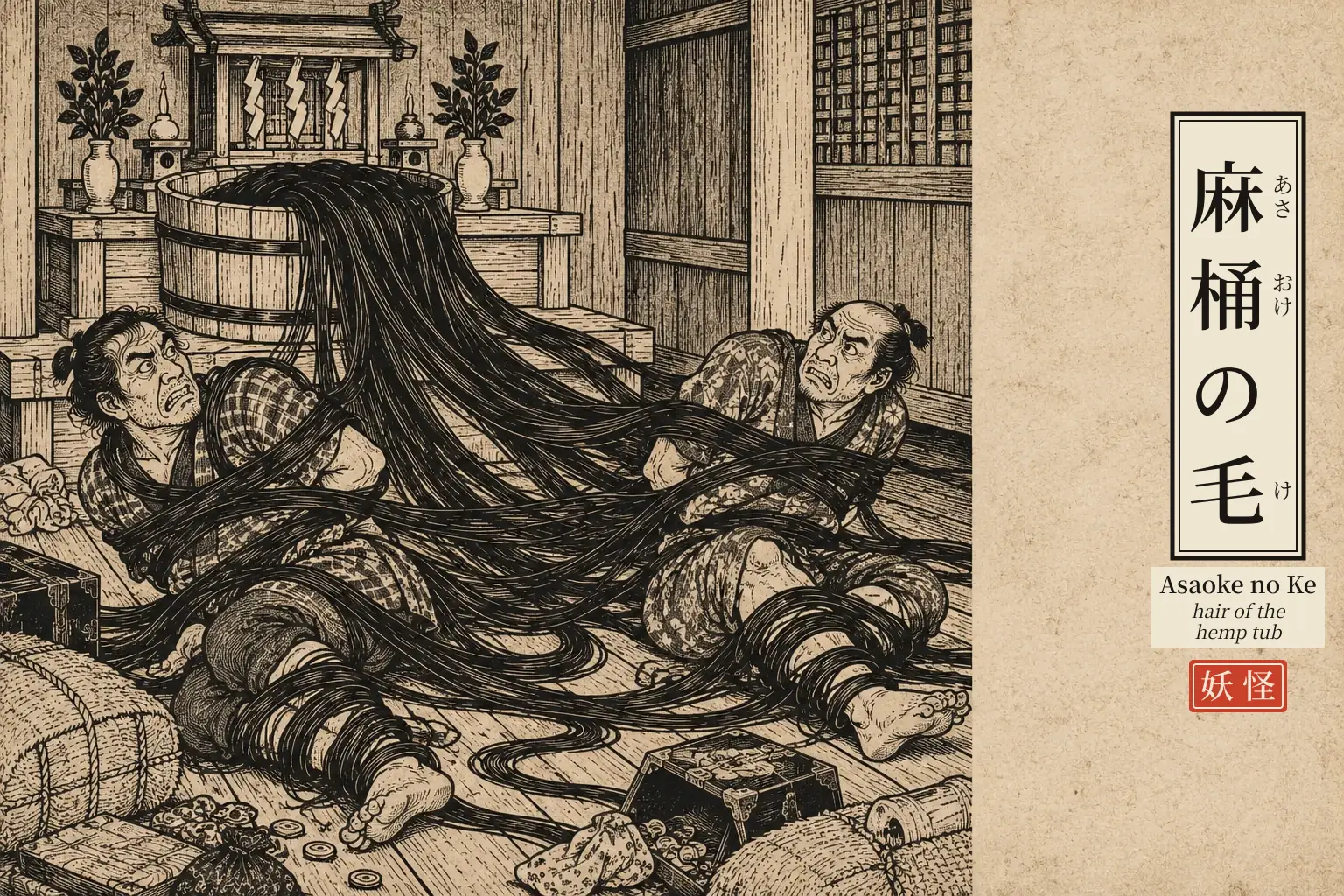
A band of thieves had been raiding villages near Kamo. One night they gathered inside the shrine's small hall to split their stolen goods. They did not notice the shintai stirring behind them.
The hair grew long in the dark. It pushed up the lid of the hemp tub. Then it split. One single strand divided into as many hairs as there were thieves in the room. Each hair caught one man and bound him fast.
The thieves could not break free. They stayed tied until morning. Pursuers finally caught up and took them all in.
A shrine's hair, kept and feared elsewhere too
Kamo's shrine is not the only one in Japan said to keep hair as its sacred object. At Kenaga Shrine in Soka, Saitama Prefecture, legend tells of a woman with six meters of hair. She drowned herself while praying for other people's happiness, and her hair became that shrine's shintai. It was kept in a box, until it was later judged unclean and washed away in a flood. Other tellings say the hair belonged to a younger sister of the god Susanoo. A third version says a different woman of the same town drowned herself nearby after a failed love, and her hair was later found in the river.
Further north, in Gunma's old Ueno village, a local shrine's shintai is said to be the pubic hair of Kurino Gongen or of Hashihime, which came down the Kanna River. In Chiba, the shintai of Susaki Shrine is also said to be hair.
None of these stories claim to share the same strand. Taken together, they point to something wider: hair, once cut away from its owner, was thought to carry enough of that person, or that god, to be worth enshrining — and worth fearing.
Where it comes from
No single explanation has settled the matter. But the shape of the Kamo story offers one way to read it. The hair only attacks when the kami's mood is unsettled. It does not act at random, and nothing in the record gives it a will of its own apart from the shrine. It behaves like a guardian responding to a disturbance, not like a monster hunting on its own terms.
Read that way, the hemp tub's hair is less a wandering yokai and more an angry shrine doing exactly what it was built to do: punishing the people who disturbed it.
Go deeper
Where Japanese ghosts come from.
- Yūrei: The Japanese Ghost →Zack DavissonWhere Japanese ghosts come from, told through old paintings, kabuki and ghost stories.
- Kwaidan: Stories and Studies of Strange Things →Lafcadio HearnThe classic 1904 collection of Japanese ghost stories that shaped how the West first met kaidan.
Some links are affiliate links; if you buy through them we may earn a small commission at no extra cost to you.
The hemp-tub hair today
Outside Tokushima, the creature sometimes appears under a different name. The yokai researcher and manga artist Mizuki Shigeru included a version of it in his 1994 encyclopedia, Yōkai Daizukan, under a different title: Mayuge. There, it is drawn as a large mass of hair attacking a person.
That picture is a 20th-century illustration. The Ashū Kiji Zatsuwa itself never describes the hair as a mass or gives it any shape at all. It only describes hair, growing out of a tub, splitting to bind as many hands as it needs.
No surviving source describes a modern festival or visitor site tied to the tub. What is left is the story the old book kept: a hall full of thieves counting out their loot, and a single strand that was not willing to let them finish.