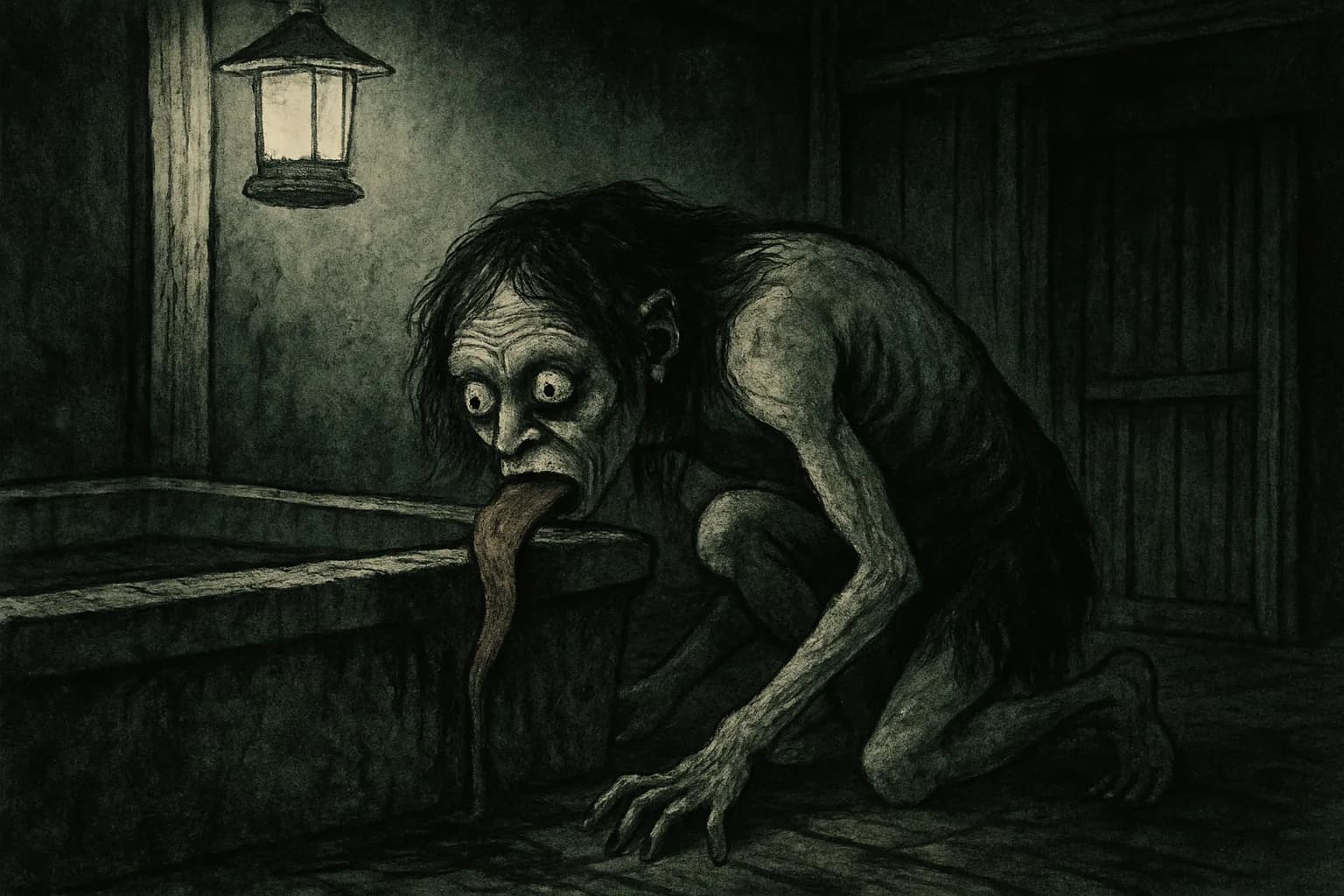
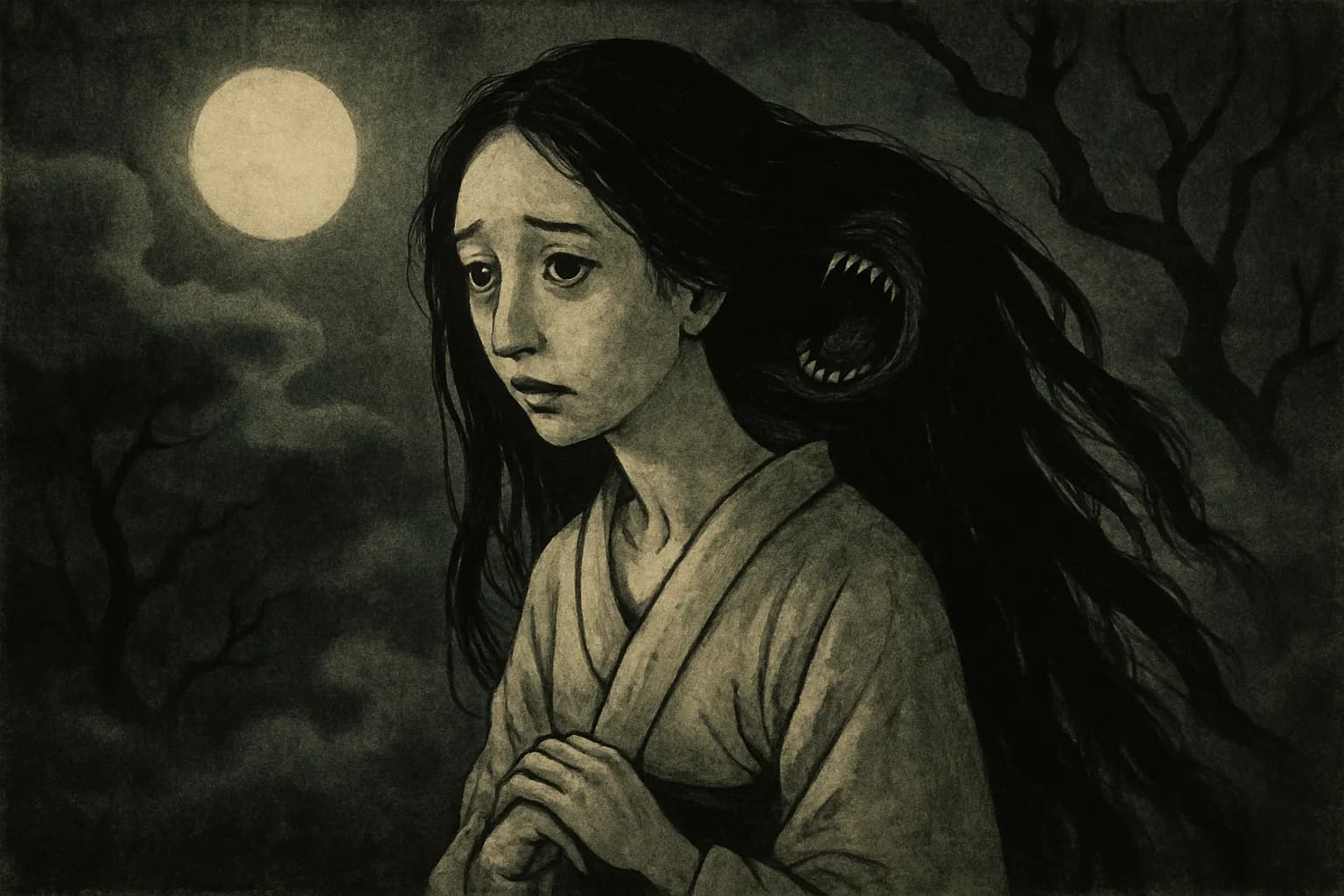
A bridegroom in old Awa Province got a strange surprise on his wedding night. His new wife started at his head and licked down to his feet. Her tongue felt rough, like a cat's. Disgusted, he fled the house at once. That short, odd story is nearly the whole reason anyone remembers name-onna (嘗女), the "licking woman" of Japan's yokai catalogues.
What does name-onna look like?
There is nothing monstrous to see. The record describes an ordinary young woman, and a beautiful one. She is the daughter of a wealthy family in Awa Province, now Tokushima Prefecture. Nothing marks her as inhuman until she opens her mouth. Her tongue is rough, like a cat's, and she uses it to lick a man's entire body, from his head to his feet. That single detail is the whole of her description. No horns. No extra mouths. No borrowed animal shape. Just a beautiful woman with an unbearable tongue.
The wedding night that named her
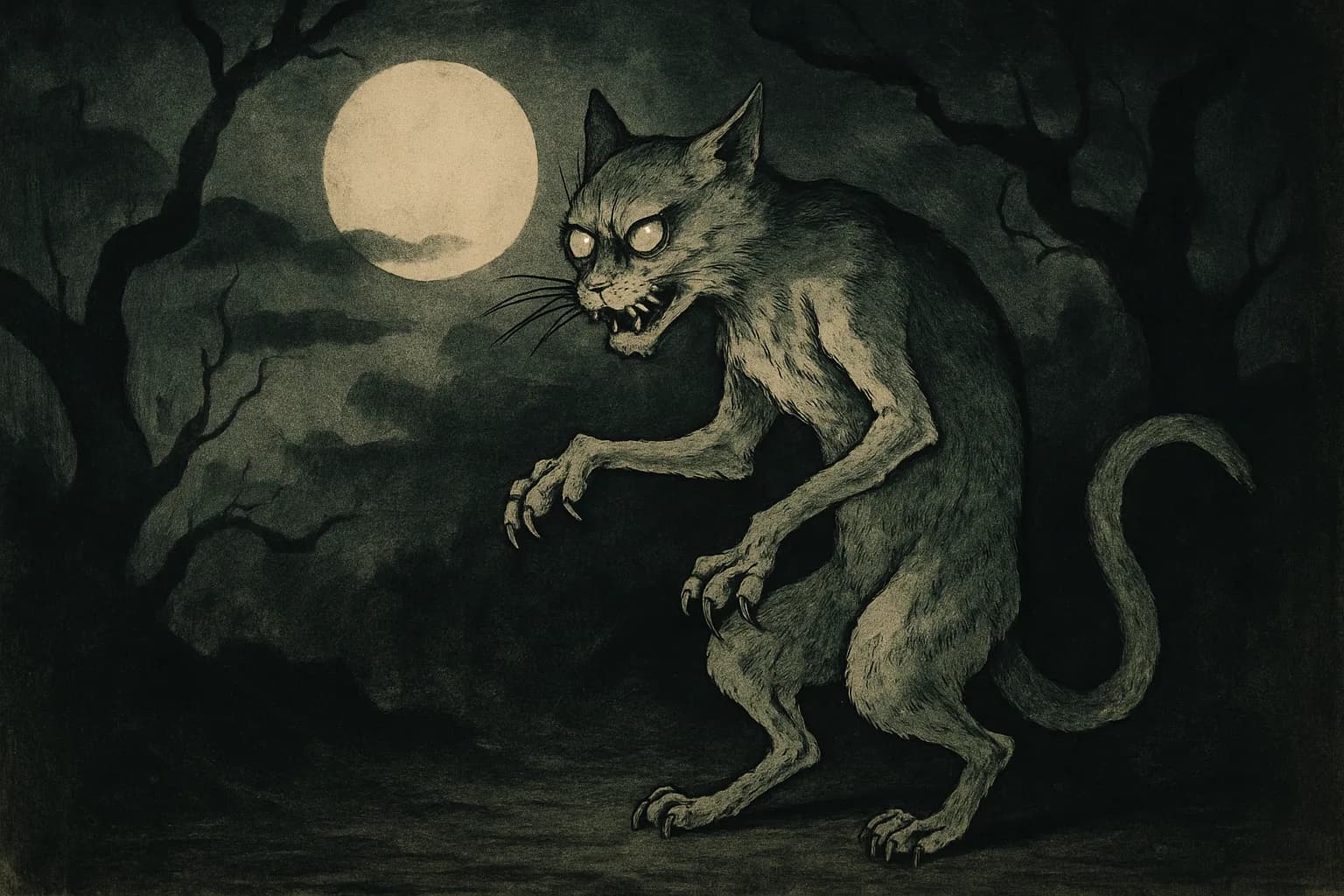
The earliest known version of her story appears in Ehon Sayo Shigure, an illustrated book from 1801. Hayami Shungyōsai wrote the text and drew the pictures himself. In volume five, under the title "Ashū no Kijo" ("The Strange Woman of Awa"), he tells of a rich family's daughter with an odd habit. She could not stop licking men's bodies. A young man, drawn in by her looks, married into the family as a muko (a live-in son-in-law). On their wedding night, she licked him from head to toe. Her tongue felt like a cat's. Disgusted, he fled at once, and from then on the household called her Neko-musume: "cat girl."
A name older than that story
The name is older than the wedding-night tale. A kibyōshi — an Edo comic picture book — called Kokon Bakemono Hyōban already used the name なめ女 in 1793. That is eight years before the cat-girl story was written down. A kyōka book, Kyōka Hyakki Yakyō, used the name again in 1830, spelled 舐め女. Modern yokai scholars later settled on a third spelling, 嘗女, the one used on this page. Murakami Kenji's Nihon Yōkai Daijiten (2005) and Mizuki Shigeru's Yōkiba (2004) both file her under that kanji. All three spellings share the same reading: name-onna. 嘗 and 舐め both mean "to lick"; 女 means "woman."
Is she even a yokai?
Even one early source that used her name had doubts about her. Kyōka Hyakki Yakyō is a comic-verse book about yokai, but it treats this "Name-onna" entry as something else — a person with a strange habit, not a true monster. One later reading, recorded in Mizuki Shigeru's writing, offers an explanation: people with sufficiently odd personalities were once treated much like yokai anyway.
A lamp-oil habit, explained
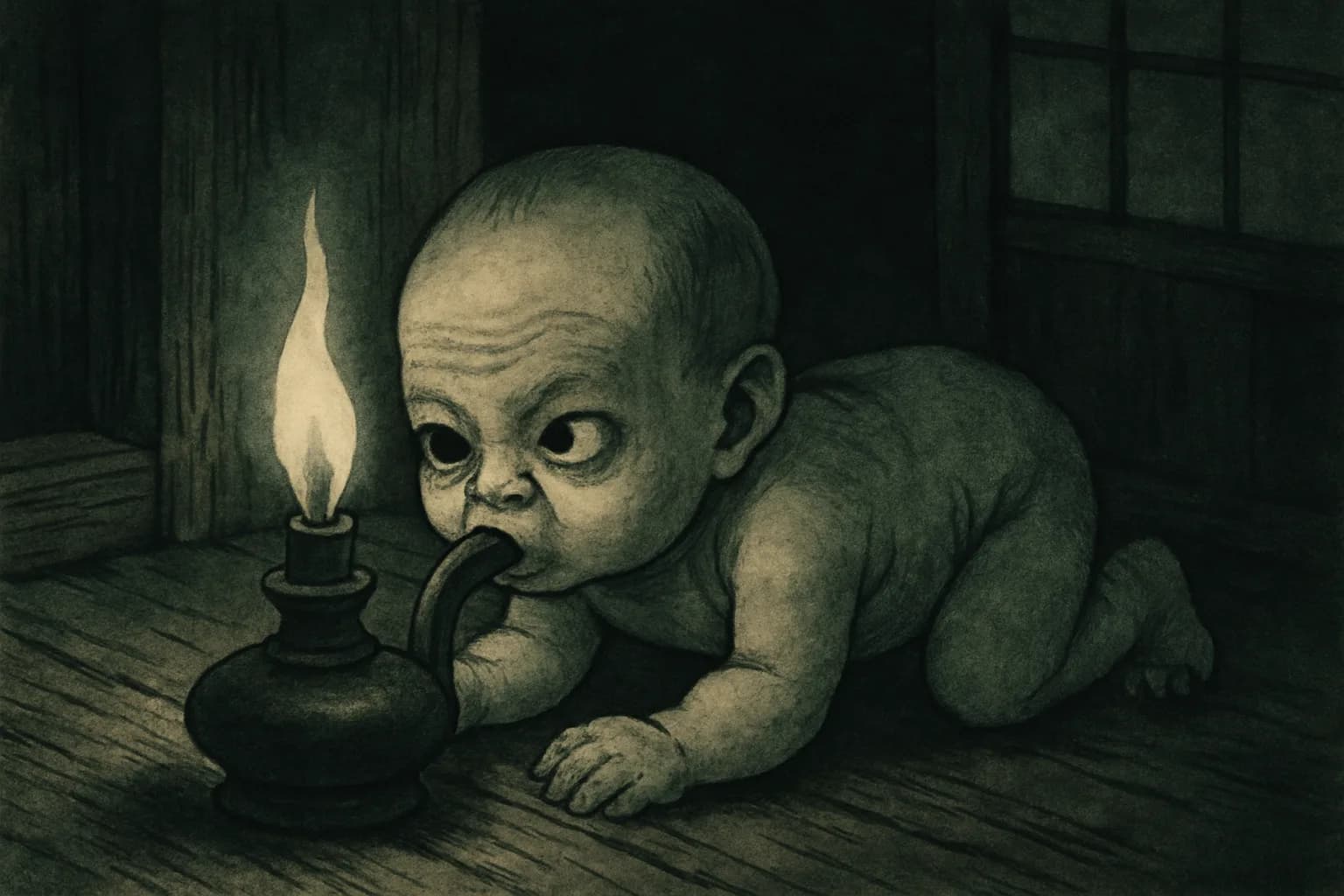
Licking turns up elsewhere in Edo writing, always tied to lamp oil. Kibyōshi of the period often show a child attendant who licks the oil from an andon, a paper oil lamp. Some think name-onna grew out of that stock character. A book from 1850, Sōzan Chokubun Kishū, tells of a Shinagawa serving woman with the same habit. Her story starts like a ghost tale. It ends with a practical note instead: warm lamp oil soothes a rough tongue, and a few people really do get hooked on licking it.
Where it comes from
Name-onna reads like Edo gossip about an odd neighbor, dressed up for a comic book. The habit itself had a down-to-earth explanation: a rough tongue, soothed by warm lamp oil. Writers of kibyōshi and kyōka turned that habit into entertainment. They gave it a yokai-sounding name years before anyone wrote a ghost story to match it. The 1801 tale of the frightened bridegroom gave the name its one memorable scene, and the family nickname, Neko-musume, that went with it. Twentieth-century yokai dictionaries did the rest. They filed a joke about a strange woman next to river spirits and mountain demons, cat-faced bakeneko and the ceiling-licking tenjoname among them, under one fixed kanji spelling. Whether she began as folklore or as satire is hard to say now.
Name-onna in the yokai books
Murakami Kenji's Nihon Yōkai Daijiten and Mizuki Shigeru's Yōkiba both catalogue her under the kanji 嘗女, with her older names and her one story intact. Japanese Wikipedia still files her under two categories: kaidan (ghost stories), and the yokai of Tokushima Prefecture.