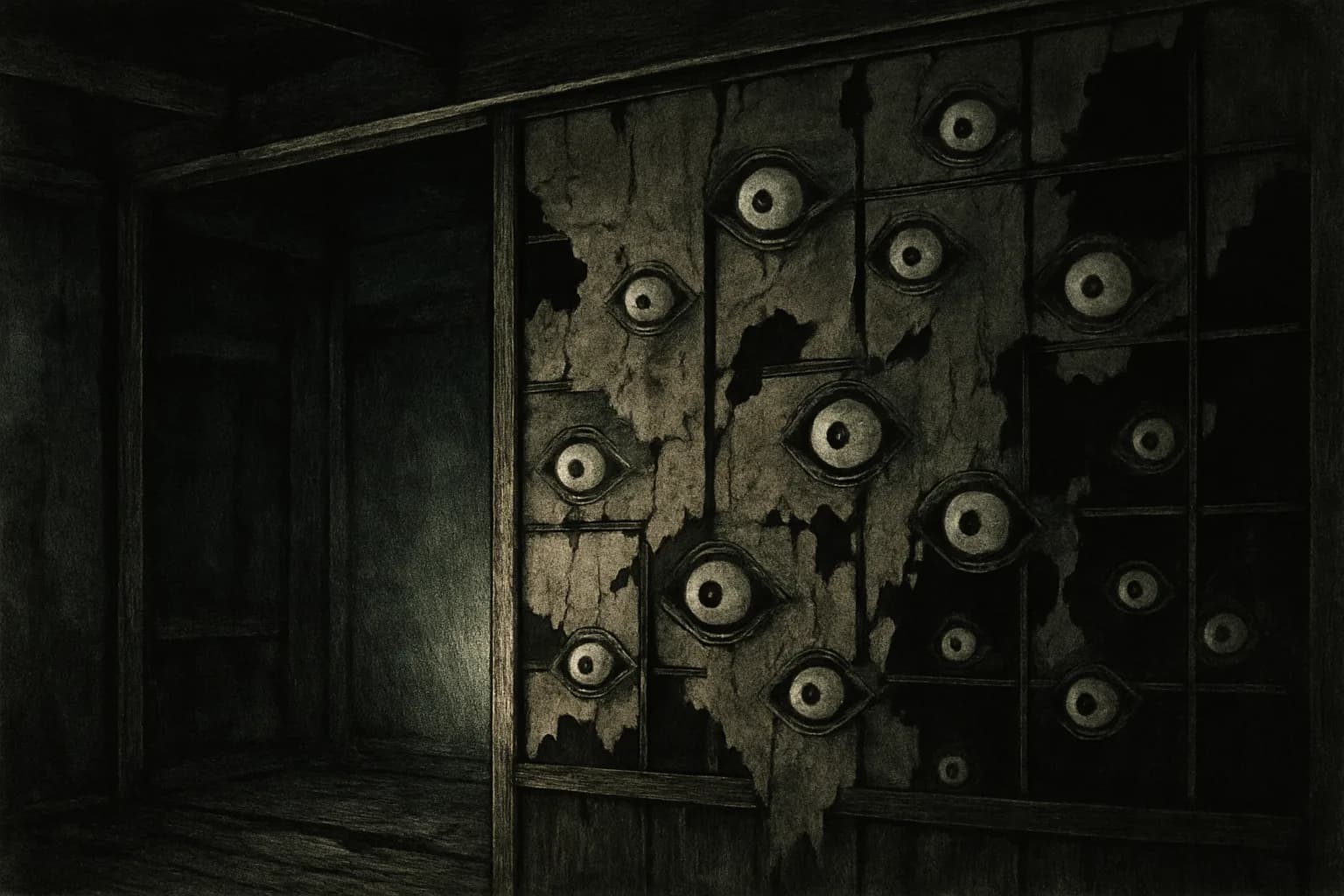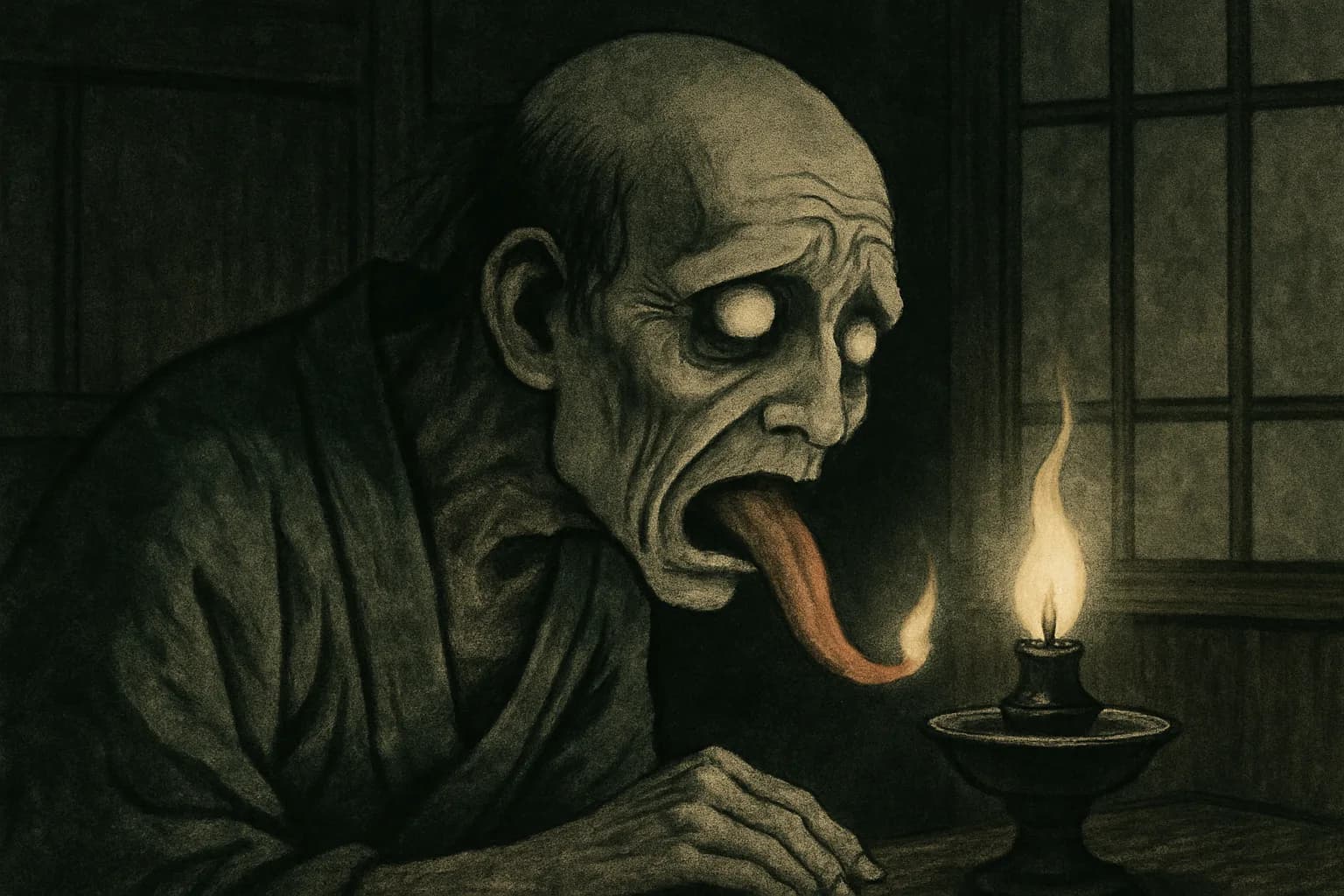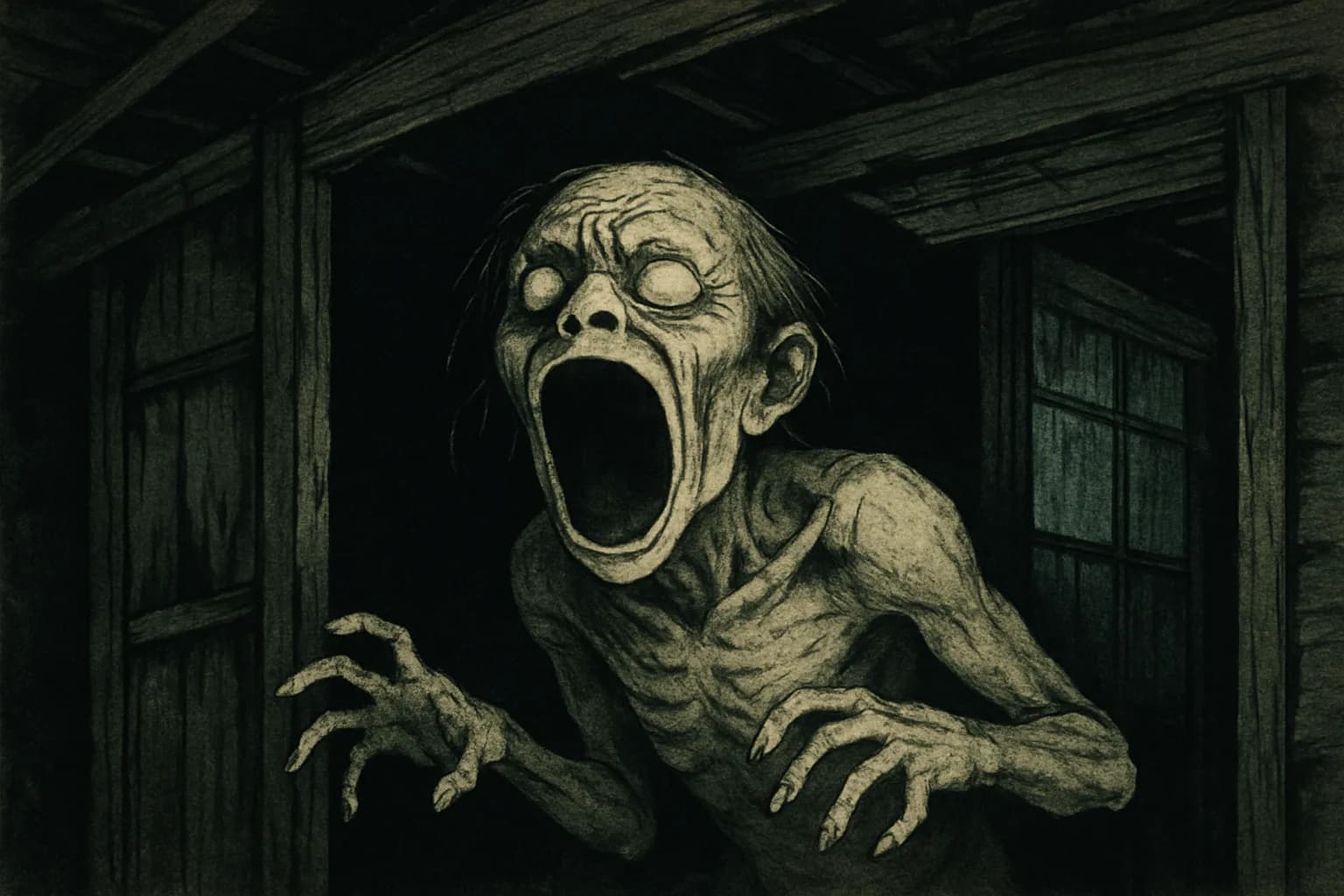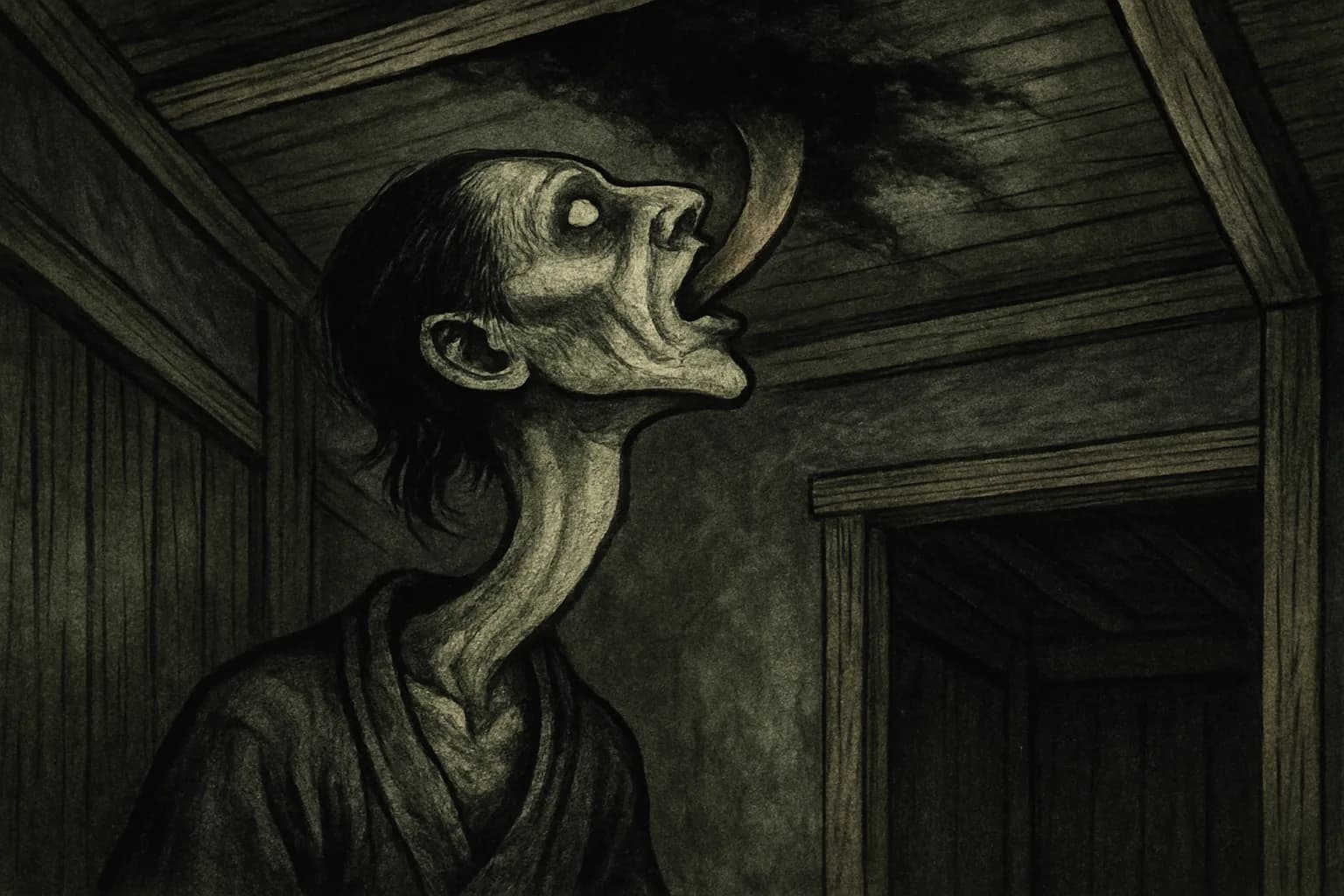
Look up in an old Japanese farmhouse and you'll sometimes find them: dark, blotchy stains spread across the wooden ceiling boards, the kind that never quite wipe away. Damp, smoke from the hearth, and decades of humidity are the boring explanation. The tenjōname is the other one — a thin, long-necked yokai that climbs into the rafters after dark and licks the ceiling with a wet, searching tongue, leaving exactly the kind of mark a household would otherwise blame on the weather.
What does it look like?
Toriyama Sekien drew the tenjōname in Hyakki Tsurezure Bukuro (百器徒然袋, 1784), his fourth and final yokai picture book, as a spindly, unsettling figure stretched vertically toward a ceiling beam, tongue extended upward. Where its better-known relative works low to the ground, the tenjōname is built for height: a long neck or an unnaturally elongated body, thin limbs, and a tongue long enough to reach boards well above head level. It isn't drawn with the theatrical menace of an oni or a tengu. It's drawn like a piece of household plumbing gone wrong — a mechanism for reaching somewhere a person can't.
Ceiling grime has its own yokai
The name states the job plainly. 天井 (tenjō) is the ceiling; 嘗 (name) is "to lick." Put together, it's the ceiling-licker, and its behavior doesn't extend past that description. It works alone, at night, moving across ceiling boards other households never think to clean, and it leaves behind the exact discoloration a family would later notice from below without ever seeing what caused it.
Sekien pairs this entry with a close cousin working the opposite end of the house: the akaname, which licks the grime out of neglected bathtubs. Between the two, an Edo-period household had a yokai answer for the two surfaces it was most likely to let go uncleaned — the tub nobody scrubbed and the ceiling nobody could reach.
A joke book of yokai
Hyakki Tsurezure Bukuro is a different kind of catalogue than Sekien's earlier, more famous Gazu Hyakki Yagyō. Its title puns on Yoshida Kenkō's classical essay collection Tsurezuregusa ("Essays in Idleness"), and many of its entries — including a run of tsukumogami, animate household tools — read less like transcriptions of village belief and more like an illustrator's private wit, inventing a face for whatever oddity a house or a language had lying around. The tenjōname fits that pattern closely: there's no recorded oral tradition of ceiling-licking spirits circulating before Sekien's book, no shrine or charm associated with keeping one away. It looks like a yokai built from a single observation — old ceilings stain — dressed up with a body and a tongue.
Where it comes from
That doesn't make it a lesser yokai, only a differently made one. Sekien worked as both an artist and a compiler, drawing on real regional folklore in some entries and inventing plausible-sounding creatures in others, and later scholarship generally treats Hyakki Tsurezure Bukuro's more obscure figures — tenjōname among them — as closer to the second category. The stains were real. Damp wood, soot from an open hearth, and poor ventilation genuinely do mark old ceiling boards over the years. What Sekien supplied was a character to stand behind the mark, in the same spirit that gave the dust bunnies under a bed, or a squeaky floorboard, a name and a shape.
Tenjoname today
The tenjōname never developed the following of a kappa or an oni — no proverb, no festival mascot, no cucumber-style tradition attached to it. Its afterlife runs through reference works rather than folk memory: yokai encyclopedias and art books that reproduce Sekien's four picture-book series in full, keeping minor entries like this one on the page long after any household actually blamed its stains on a creature in the rafters. It's the kind of yokai you meet by reading the whole catalogue rather than by hearing the story from a grandparent, which is exactly how Sekien's more inventive entries tend to survive — filed a few pages from the akaname, both still waiting on surfaces nobody looked at closely enough.