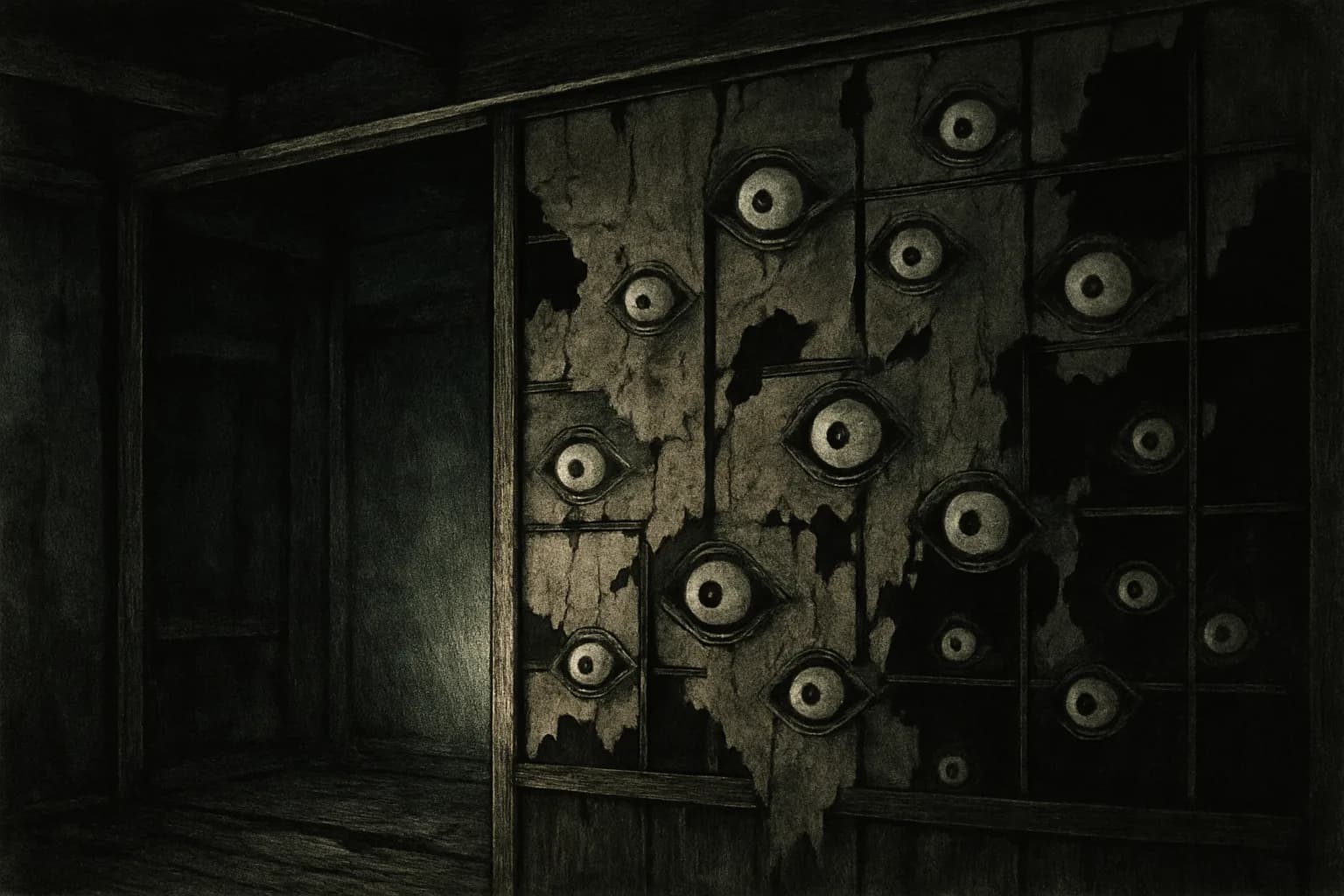
Leave a house empty long enough in old Edo, and the paper stops being paper. The shoji screens crack, then tear, then fill with ragged little holes where fingers or weather have gone through — and in the folklore of neglected homes, those holes are said to open at night into eyes. Not one eye. Dozens, scattered across every torn panel of the room, all looking at whoever is still inside. This is mokumokuren, whose name is built from almost nothing else: 目 (moku, "eye") repeated and strung into 連 (ren, "a row" or "a series"). A row of eyes. That is the whole creature.
What does it look like?
Mokumokuren has no described face, no limbs, no size. It is a condition a room falls into, not a body that walks into one. Toriyama Sekien's print shows a dim interior with a torn shoji screen, and where the paper has ripped away, eyeballs sit in the gaps looking back into the room — as if the tears themselves had learned to see. There is no count given, no fixed shape to the swarm; it is simply as many eyes as there are holes, and a house left alone long enough always seems to grow more holes.
A house that has stopped being cared for
Mokumokuren belongs to a small, distinctive class of Edo yokai that don't hunt or trick anyone — they are what happens to a space, not a person. The stories that carry it are less "monster attacks traveler" and more "someone stays too late in an abandoned house and notices the screens are staring." The dread is ambient. Nobody is chased. Nobody bargains for their life. The eyes simply accumulate in proportion to how far the house has fallen into disrepair, as though neglect itself were a kind of decay that eventually grows eyes instead of mold.
That makes mokumokuren unusually quiet as yokai go, and unusually specific: it needs paper, a frame, and abandonment. A well-kept home, its shoji mended and its rooms lived in, never produces it.
A yokai built from a pun on its own picture
Sekien compiled his four print series — Gazu Hyakki Yagyo, Konjaku Gazu Zoku Hyakki, and the Hyakki Shūi volumes — largely by looking for a visual joke or a piece of wordplay and then drawing the yokai that would justify it. Mokumokuren reads as exactly that kind of invention: take an ordinary, slightly unsettling household detail — torn shoji paper, the kind everyone in Edo had actually seen in a run-down house — and literalize the eye-shaped tears into real eyes. The "folklore" isn't a village legend passed down for generations so much as a print artist's gift for turning a mundane domestic eyesore into an image that a reader can't un-see the next time their own screens need mending.
That doesn't make it less effective. If anything, mokumokuren works on the same logic as pareidolia — the same reason a stained ceiling or a knot in old wood can look like it's watching you — pushed just one step further into folklore.
Mokumokuren today
Mokumokuren never made the leap into the small set of yokai — kappa, tengu, oni — that Japan turned into mascots and manga stars. It stayed where Sekien left it: a page in an 18th-century print book, reprinted in modern yokai encyclopedias and museum exhibitions of ukiyo-e, rather than reanimated for television. That's true of most of Sekien's quieter inventions; the ones that get remembered widely tend to have a clear action (steal, drown, transform), and mokumokuren doesn't do anything so much as it simply is a room you shouldn't be alone in. Its afterlife is mostly among people who go looking specifically for Sekien's rarer pages — which is, in its own way, fitting for a yokai about noticing details that a careless glance would miss entirely.