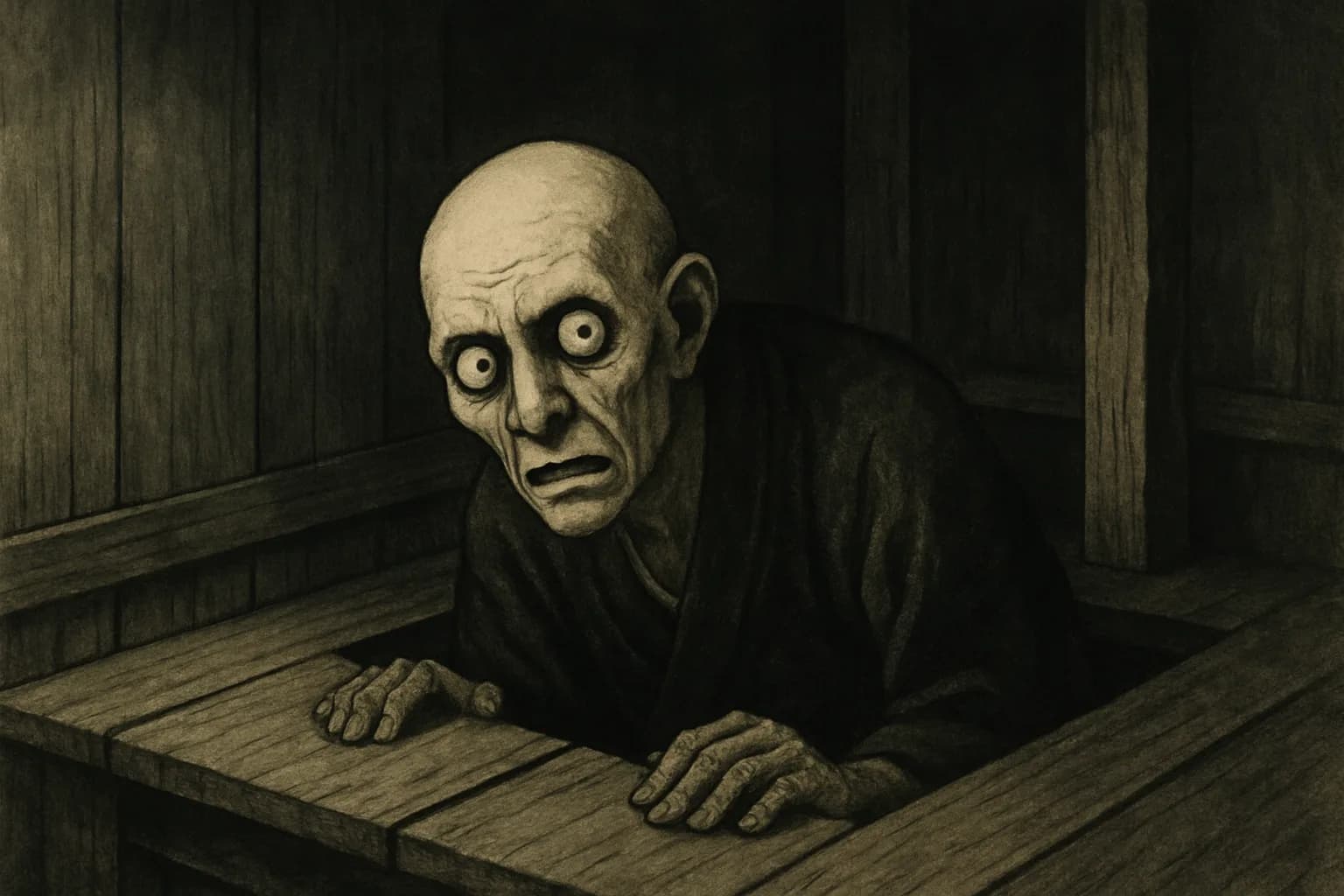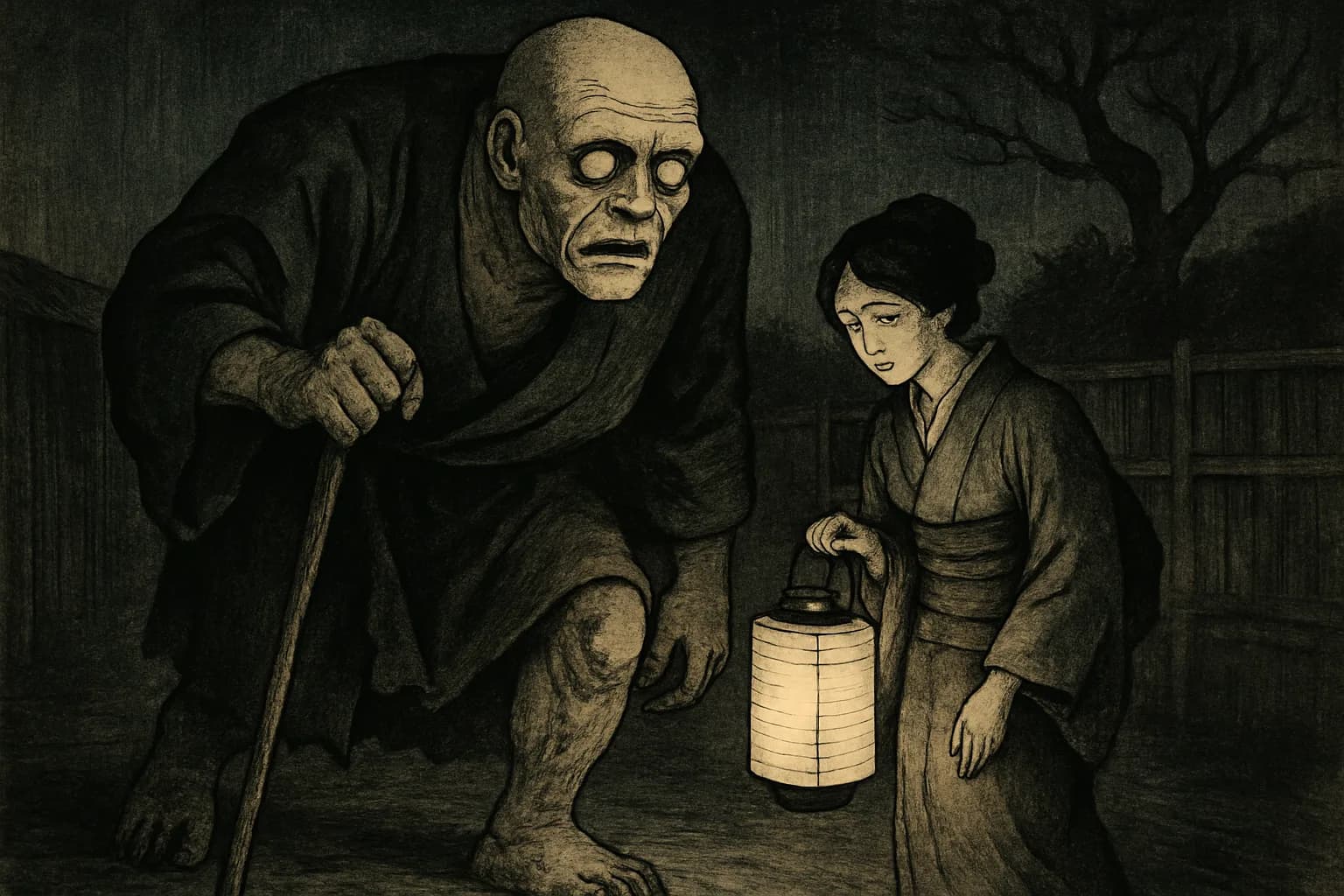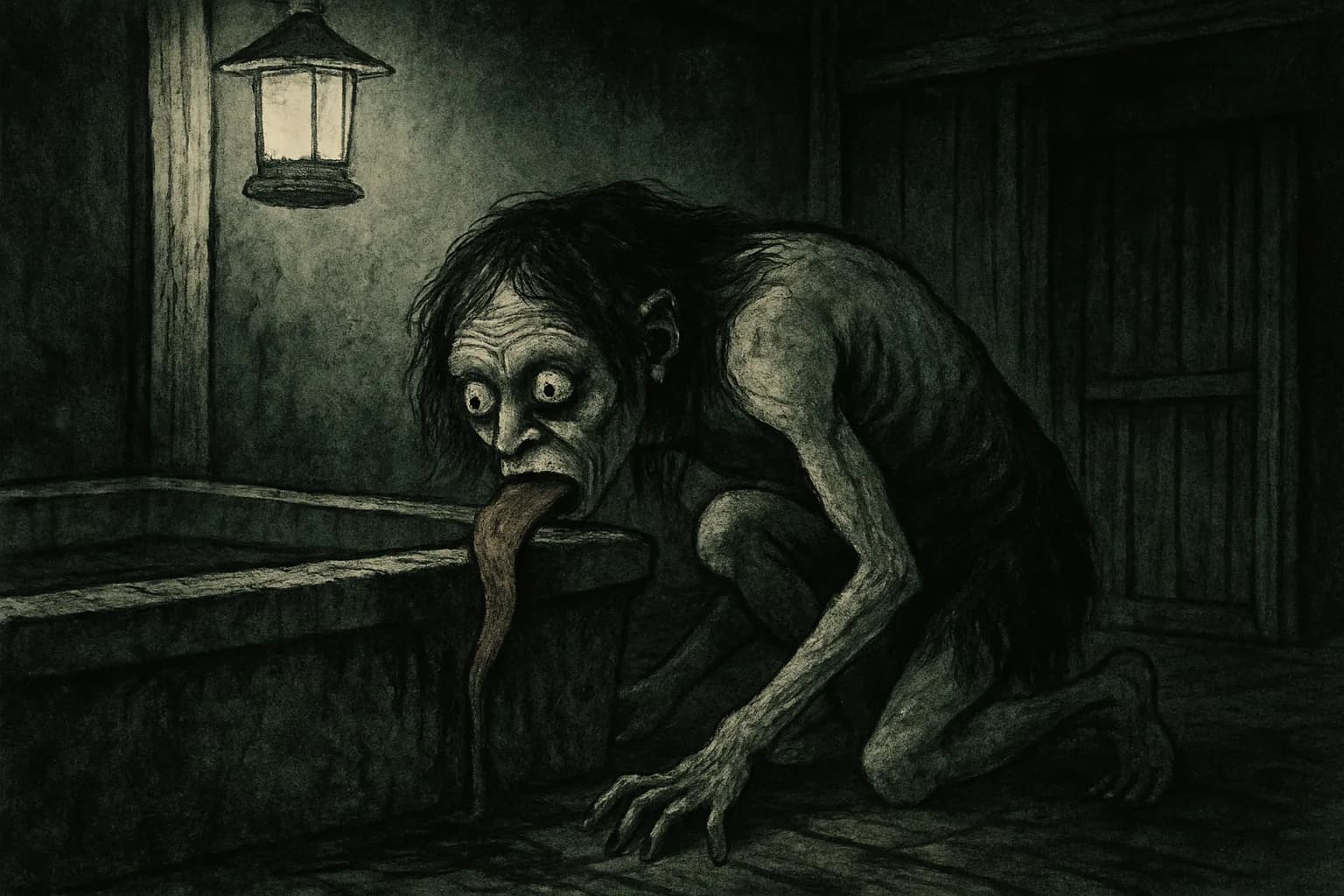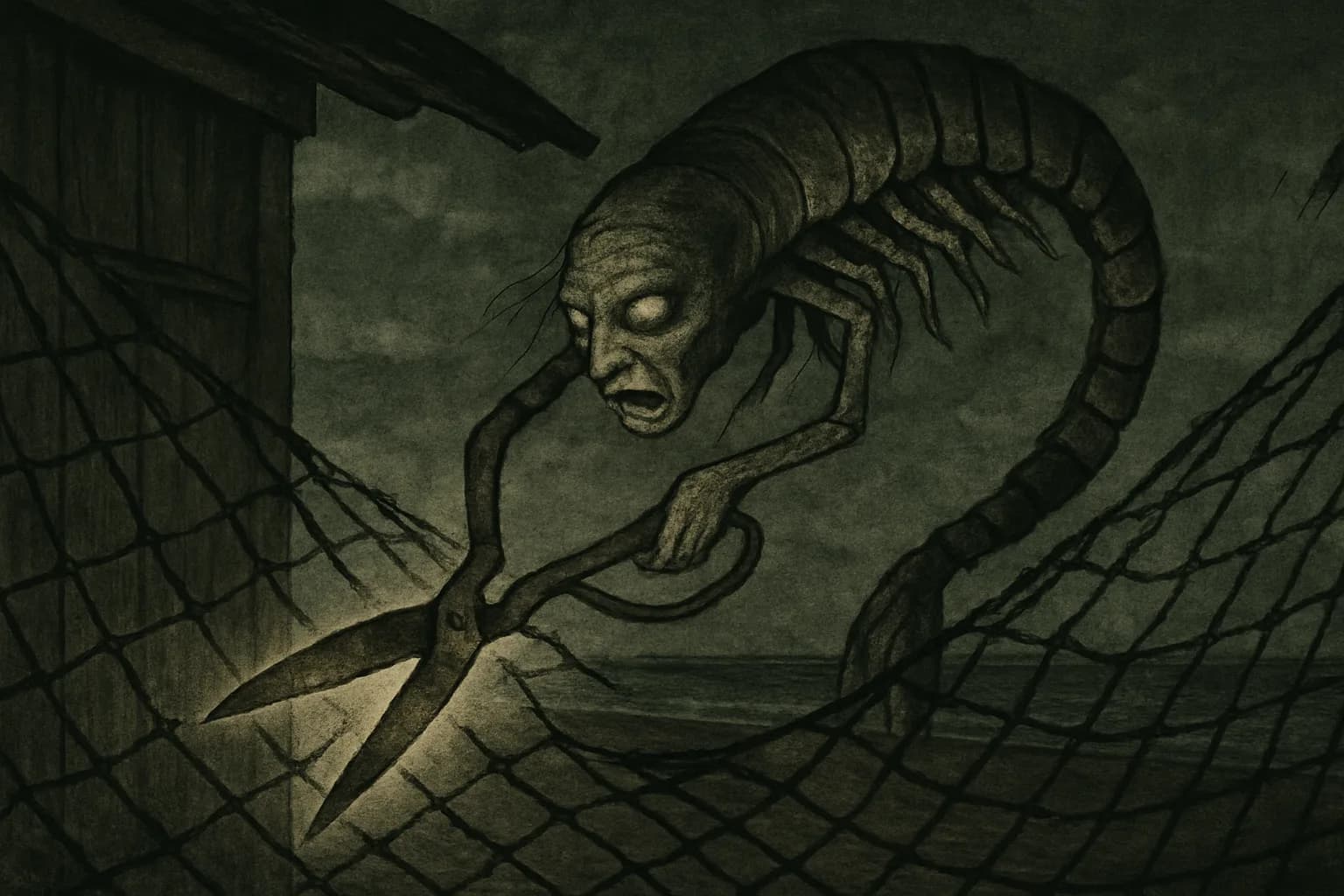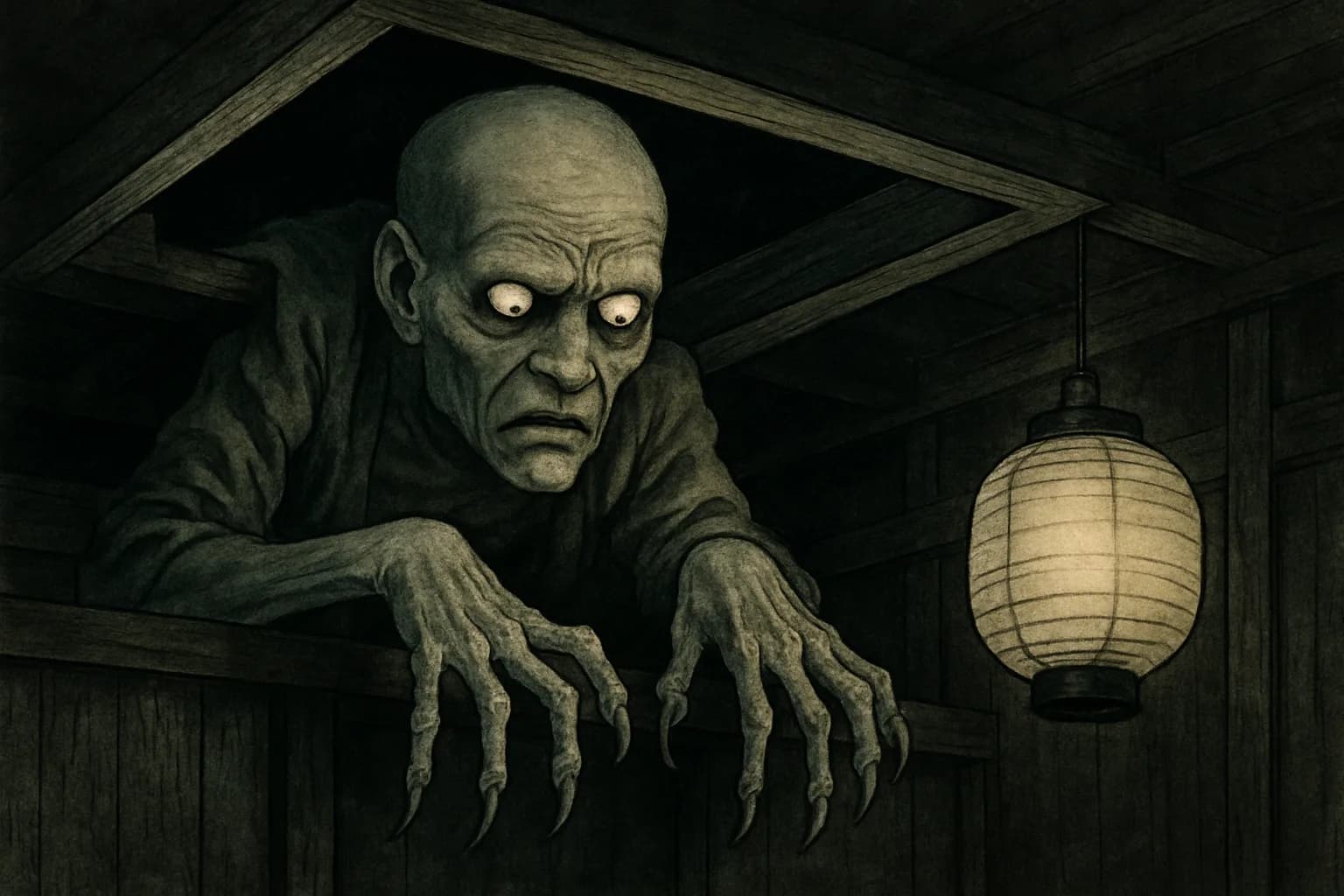
Toriyama Sekien gave this one no caption. In the "Wind" volume of his 1776 print collection Gazu Hyakki Yagyo ("The Illustrated Night Parade of a Hundred Demons"), a clawed face simply appears at a roof-set skylight, looking down into a darkened house. No text explains what it is or what it wants. The name written beside it is Shōkera — and to understand why it is looking in at all, you have to know what the people below were supposed to be doing that night: staying awake.
What does it look like?
Shōkera survives only as an image, in Sekien's print and in the earlier picture scroll Hyakkai Zukan, both of which show the same scene without a word of explanation — a face pressed to a skylight, watching a room below. What is consistent is the hand: three sharp, clawed fingers, drawn large enough to matter. Later readers have taken those claws as the point of the picture — this is not a passive watcher but something that could reach in and do harm to whoever it catches.
The night you are not allowed to sleep
Shōkera belongs to Kōshin-machi (庚申待), a folk vigil rooted in an old Chinese Daoist belief that reached Japan through Onmyōdō and Buddhist practice. The idea: every person's body houses three parasitic creatures called the sanshi (三尸), and on the night of kōshin — a date that recurs every sixty days in the traditional calendar — the sanshi wait for their host to fall asleep. The moment sleep comes, they slip out of the body, climb to Heaven, and report every sin the person has committed that cycle to the Heavenly Emperor, who shortens the sinner's life in response.
The defense was simple in theory and hard in practice: stay awake all night, every kōshin night, so the worms never get the chance to leave. Households and neighbors gathered together to keep each other up — talking, eating, praying — through what became known as a kōshin vigil.
Shōkera is read as the enforcer of that rule. Peering down through the skylight into the house below, it is watching to see who has actually stayed awake and who has given in to sleep — and those clawed fingers suggest what happens to the ones who failed.
What its name might mean
Nothing about Shōkera's origin is settled, including its own name. Because Sekien left no explanation, later yokai scholars have proposed competing readings: that "Shōkera" is simply another name for the sanshi worms themselves, or a single personification standing in for all three, or specifically a rendering of the "middle" of the three sanshi, sometimes described with animal features rather than human ones. None of these has become the accepted answer — the creature is, appropriately for something that only ever shows up as a face in a window, still being puzzled over.
Where it comes from
Kōshin belief was never confined to one region. Stone markers called kōshin-zuka, erected by vigil groups to commemorate a set number of nights kept, still stand in towns and villages across Japan, evidence of how widely the custom was practiced outside the capital. Sekien's contribution was narrower and more specific: an Edo print artist looking at an already-established religious practice and asking what its unseen enforcer might look like, then drawing it exactly where the practice was most vulnerable — the one opening in a house, the skylight, through which someone watching from outside could see whether the people inside had kept their eyes open.
Shōkera shares that household-surveillance logic with a handful of Sekien's other quiet inventions. Mokumokuren, the swarm of eyes that opens across torn shoji paper in a neglected room, and Ganbari-nyūdō, the hairy monk who watches from the privy on New Year's Eve, both turn an ordinary domestic space into somewhere you are, without warning, being looked at.
Shōkera today
Kōshin-machi itself has mostly faded from daily life, kept alive now by the kōshin-zuka markers still standing at rural crossroads and by scholars of Edo-period folk religion. Shōkera faded with it — it never became a mascot or a manga regular the way kappa or tengu did, and it survives mainly in reprints of Sekien's four print volumes and in the yokai encyclopedias that catalogue his rarer pages. It remains what it always was: a single unexplained image of something looking in through the one window in the roof, on the one night you were told not to close your eyes.