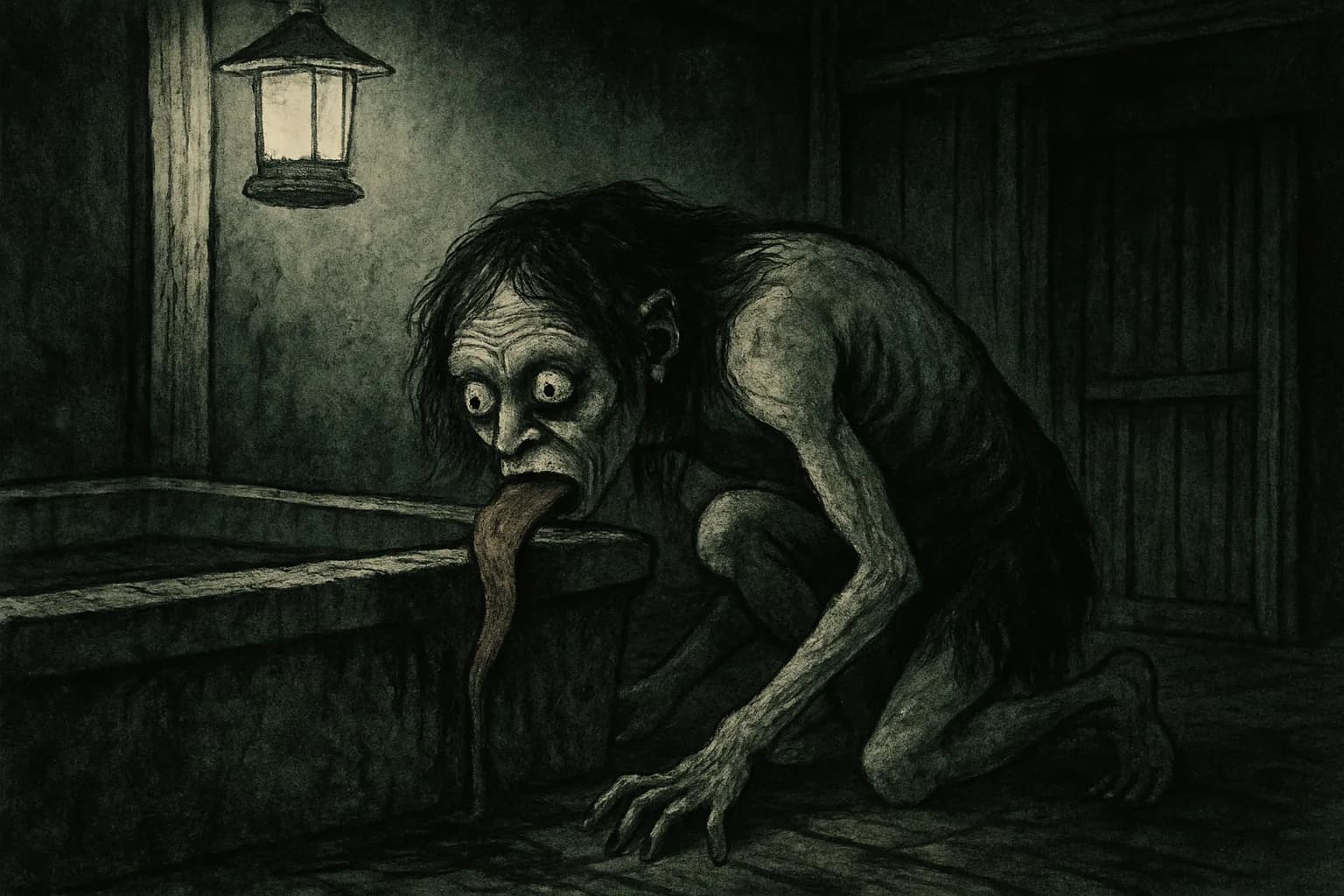
Toriyama Sekien filled his catalogs with yokai he never bothered to explain, and the amikiri is one of the odder blanks in that gallery: a picture of a creature stitched together out of a household nuisance. Its name is exactly what it does — 網 (ami, "net") and 剪 (kiri, "to snip") — the net-cutter. Whatever damage went unexplained around the house, this thing got the blame.
What does it look like?
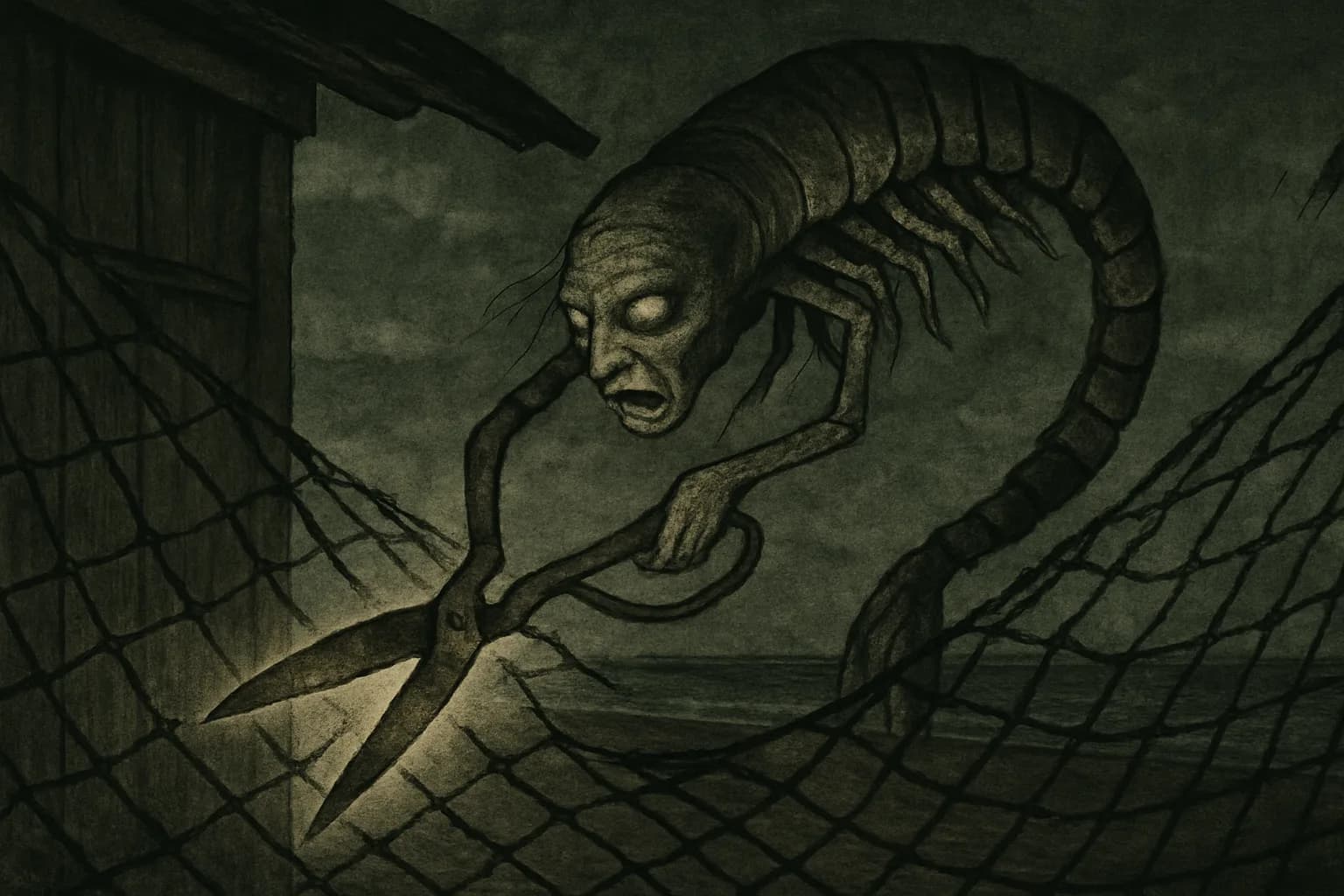
Sekien's drawing has no single animal behind it. Commentators have called it a cross between a serpent, a bird, and a lobster, with a pair of pincer claws borrowed from a crab or scorpion set on a body no one agrees how to classify. There's no accompanying text in the Gazu Hyakki Yagyo to settle the question — Sekien simply drew it and moved on, the way he did with a fair number of his more obscure entries. The claws are the point. Everything else about the body is negotiable.
A thing that cuts, not a thing that hunts
The amikiri isn't dangerous the way an oni or an ushi-oni is dangerous. Later Showa-era folklore writing describes it plainly as a yokai that cuts mosquito nets (kaya), bamboo sudare blinds, and nets or laundry left hanging out to dry — property damage, not bloodshed. It's a household pest elevated to monster, the kind of yokai invoked to explain why the net you hung up intact last night has a hole in it this morning.
One version of the story, recorded by the folklorist Norio Yamada in 1974, is set in a Shonai fishing village on the Japan Sea coast, where nets kept turning up shredded. A resident finally brought the nets indoors and hid to watch for the culprit — and the mosquito netting over the beds got cut instead, leaving the household bitten and no wiser. It's a good story, but it should be told with a caveat: the researcher Kenji Murakami later went looking for the same tale elsewhere in Yamagata Prefecture and couldn't find it repeated in any other source. It may be a single village's story rather than a widespread belief, which is fairly normal for a minor Edo-period yokai — most of them survive as one picture and, at most, one or two written accounts, not a nationwide folk tradition.
Where it comes from
The leading theory ties the amikiri to an earlier figure: kamikiri, the "hair-cutter" yokai that appears decades before it in Sawaki Suushi's 1737 scroll Hyakkai Zukan. Kamikiri was blamed for a real, well-documented phenomenon — people finding their hair mysteriously cut while they slept or walked the streets, an unsettling event that shows up in Edo-period records independent of any yokai explanation. Sekien's amikiri looks like a coastal, fisherman's-village variant of the same idea: something invisible with a blade for a mouth, relocated from hair to nets.
There's a second theory about the name itself, resting on wordplay rather than folklore: ami means "net," but it's also a homonym for a kind of small mysid shrimp. Sekien's fondness for puns is well documented elsewhere in his work, and a shrimp with scissor-hands would fit the joke neatly — except that mysid shrimp don't actually have pincer forearms, which is exactly the detail the amikiri is drawn with. So the pun theory explains the name better than it explains the picture, and neither theory fully accounts for the other. That gap is normal for a Sekien entry with no text attached; he left behind an image and let later readers argue about the rest.
Amikiri today
Unlike its cousin kamaitachi — the sickle-clawed wind yokai that has become genuine pop-culture shorthand for an invisible cutting wound — the amikiri stayed a minor figure. It shows up in yokai reference books and art collections that reproduce the Gazu Hyakki Yagyo in full, but it never picked up the kind of attached folklore, proverb, or modern mascot status that turns an Edo-period picture into a household name. What's left is the drawing itself: a body no one can quite classify, a pair of claws, and a chore — mending a net that shouldn't have needed mending — turned into a monster.