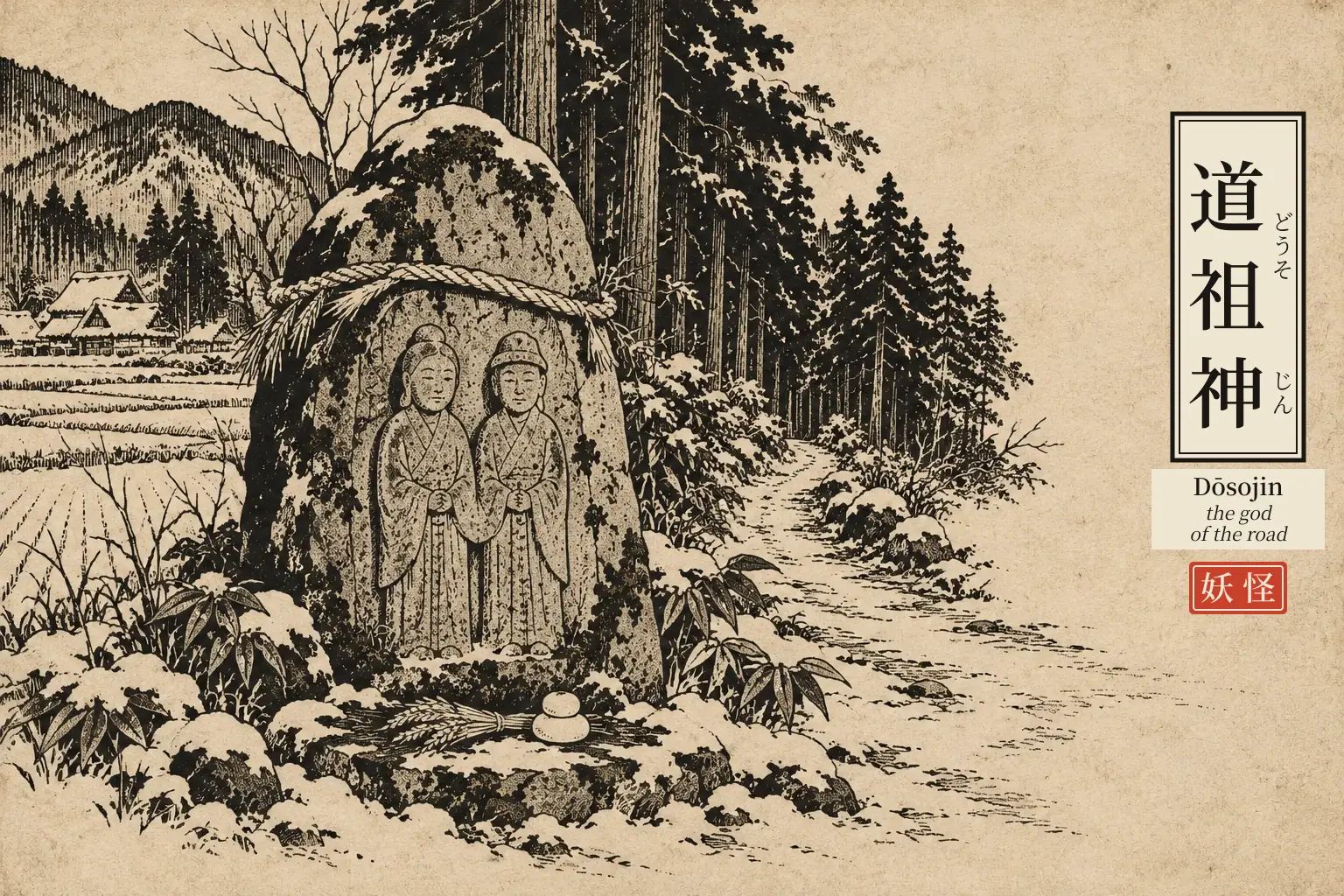
Walk to the edge of an old Japanese village and you will often find a stone. It stands at the last crossroads, or the mountain pass, or the spot where the rice fields give way to forest. Sometimes it is carved with nothing but its own name. Sometimes it is carved as a man and a woman, standing side by side, holding hands. Either way, people still bring it offerings at New Year. This is dosojin — written 道祖神, "road" plus "ancestor" plus "god," a deity whose job is simply to stand at the line and watch what crosses it.
What does it look like?
Dosojin has no single design, and that is itself the point. Some villages mark the spot with nothing carved at all: a bare rock, a wooden post, or a straw rope laid down to show the god is there. Others cut a plain stele, a flat stone with characters reading simply "Dosojin" or "Sai no Kami." Others still leave a round boulder in its natural shape, or carve a single figure dressed as a monk, a priest, or an armored warrior. A phallus-shaped stone is one of the two most basic forms named in a standard reference work on Japanese deities, the other being a stone carved with a figure or with text.
One well-known type pairs a man and a woman. They stand together, sometimes holding hands, sometimes with an arm around a shoulder, sometimes sharing a small cup of sake. The largest standing examples, found in Azumino, Nagano, reach about two meters tall. In Machida, on Tokyo's southwestern edge, a handful of dosojin are carved as tengu instead, carrying a feathered fan — a local mountain-worship tradition grafted onto the same roadside job.
A god nobody designed
No single text or painter standardized dosojin's look. No temple or court ever issued one official image, so every region simply carved its own, and gave it a different name besides: Dōrokujin, Sawari no Kami, Tamukenokami, and more, each a local way of saying the same job. A folklorist, usually romanized Itō Kenkichi, counted roughly 3,000 of the paired, human-shaped stones nationwide as of 1961. They cluster thickest in the mountains of Nagano, Yamanashi, Gunma, Shizuoka, and Kanagawa, and are thin on open plains and coastline.
What it guards against
Dosojin's main job was keeping disease and evil spirits from entering the village from outside. Beyond that, villagers asked it for almost everything that happens at the edge of a life: a safe trip, a good marriage, an easy birth, a child who stays healthy. Because the god was also called a protector of children, its festivals in most regions are built around them.
Dosojin blurs into other figures easily. It is often merged with Jizō, a Buddhist guardian of travelers and children, to the point that the same roadside statue gets called by either name depending on who you ask. It is also linked to Sarutahiko, a crossroads god from Japan's oldest myths, sometimes shown paired with his wife Amenouzume — the same married-couple shape as the stone itself.
The fire that renews the border
Once a year, in the hot-spring town of Nozawa Onsen in Nagano, the dosojin gets a festival built entirely around fire. Every January 15, the village's men who have turned 42 or 25 that year — both considered unlucky ages — take charge of building a tall wooden shrine to the god. Villagers attack it with burning torches while the chosen men defend it, and at the end of the night it burns to the ground anyway. The destruction is not a failure of the ritual. It is the ritual: the old year's bad luck goes up with the shrine, and the village starts the new one clean. It is one of Japan's three major fire festivals, and the government protects it as an Important Intangible Folk Cultural Property.
Where it comes from
The word shows up early, though not yet as a god. By the mid-8th century, "dōso" already appears as a place name and a surname. By 756, the same two characters named a Nara-period imperial prince in the chronicle Shoku Nihongi. He became crown prince that very year. In his name, though, the characters were read completely differently, as "Funado." The reading was not settled yet. The first text to use the characters for a deity, read the way we say it now, is the Wamyō Ruijushō. It is a dictionary compiled around the mid-10th century. About a century later, the Honchō Hokke Genki tells of a dosojin in Kii Province. The Konjaku Monogatarishū retells the same story in the early 1100s. It glosses the name as "sai no kami" — the barring god. The poet Matsuo Bashō mentioned roadside gods in his famous travel diary, which made the word widely known, though he showed no real interest in where it came from.
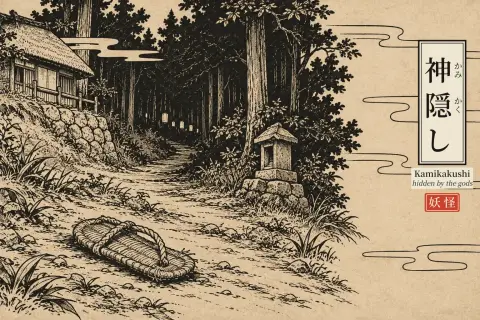
Most of the stones that still stand were carved far later than any of this, in the 1700s and 1800s, a period of active new rice-field and canal development across the country. A boundary still needs something standing on it, wherever it happens to fall. That is also why dosojin is not quite a monster to fear, the way kamikakushi is used to explain a child who wanders past where the village watches and disappears. Dosojin is the opposite idea: the thing meant to stop that from happening.
Go deeper
Books worth owning if this world pulls you in.
- The Book of Yokai →Michael Dylan FosterThe most readable scholarly introduction to yokai — where they come from, what they mean, and the major creatures.
- Japandemonium Illustrated: The Yokai Encyclopedias of Toriyama Sekien →trans. Hiroko Yoda & Matt AltThe complete Edo-period bestiaries that so many of these entries trace back to, in full English translation.
Some links are affiliate links; if you buy through them we may earn a small commission at no extra cost to you.
Dosojin today
Nagano Prefecture still has the densest cluster in the country. Azumino City alone counts about 400 stone dosojin, more than any other municipality in Japan, and nearby Matsumoto's old farm villages keep roughly 370 more. Few of them look like anything a visitor would call a monster. That, more than any single legend, is the history of the stone: a roadside god still given its New Year offerings.