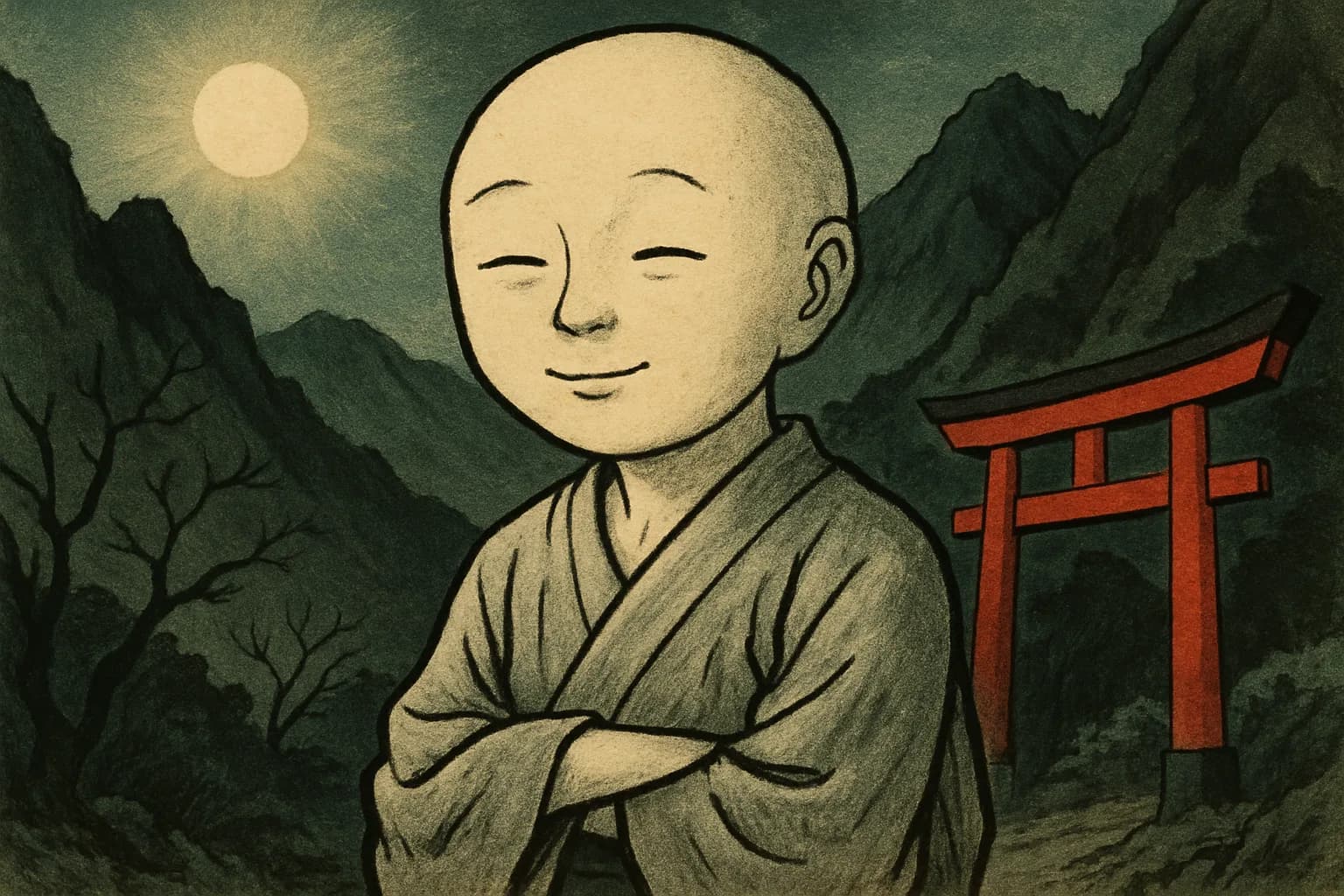
Toriyama Sekien's bestiaries are full of monsters with a job — something they steal, someone they frighten, a rule for surviving them. Then, in his 1779 volume Konjaku Gazu Zoku Hyakki (今昔画図続百鬼), he drew a shaggy shape standing on a mountain ridge under a clear sky and wrote almost nothing about it: it lives in the mountains of Hitachi province, and it shows itself only when the weather is fine. That is hiyoribō (日和坊), and its entire nature is contained in that one habit.
What does it look like?
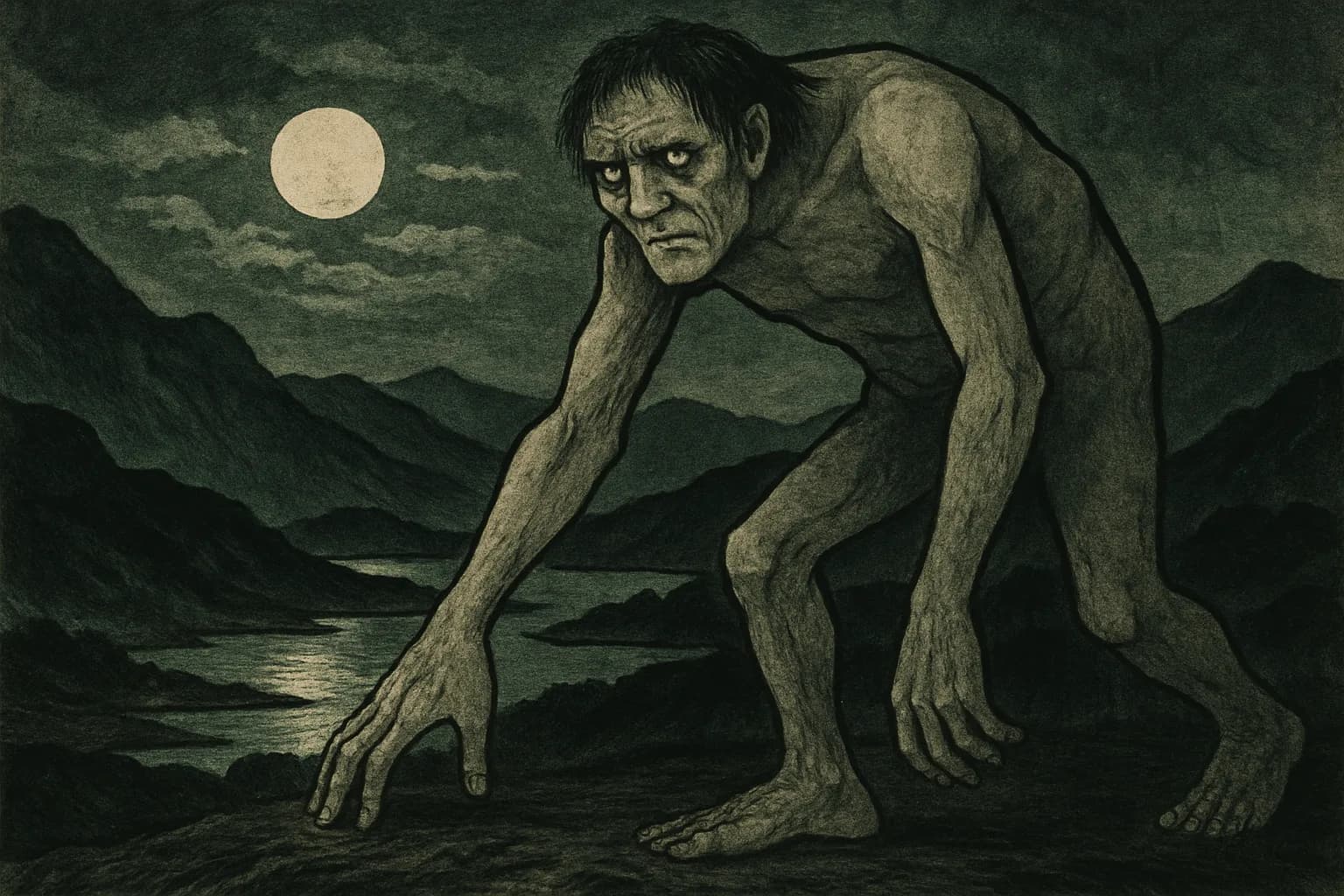
Sekien's print is deliberately hard to pin down. The figure is squat, round-shouldered, and shaggy, with a bald, monk-like head — the "bō" (坊) in its name is the same syllable used for a wandering monk or a temple boy — but no face is drawn in any detail, and the body reads more as a dark shape against open sky than as a creature you could describe to someone else. It stands alone on a peak, without shrine, staff, or companion. There is nothing to fight and nothing to steal; the whole picture is a mountain, a patch of blue, and something that happens to be standing there.
A creature that only exists in good weather
The one fact every source agrees on is also the only fact there is: hiyoribō comes out when the sky is clear, and disappears the instant clouds move in or rain starts to fall. It does not curse travelers, spoil crops, or drag anyone into a river. It simply cannot be seen except under the one condition it needs.
This makes it the natural opposite number to amefuri-kozō, the rain boy Sekien drew two years later in Konjaku Hyakki Shūi (1781) — a small attendant of a rain god who appears only in a downpour, umbrella in hand. Between the two, Japanese weather had a yokai for both of its moods. A third, harsher relative belongs to the same family of ideas: hideri-gami, the drought god blamed when clear skies stop being pleasant and start being a crisis. Hiyoribō never carries that threat. It is fair weather with nothing asked of it in return.
Where it comes from
Almost everything known about hiyoribō comes from that single Sekien entry, with no older oral tradition recorded under the same name. This is typical of the Konjaku Gazu Zoku Hyakki and the two catalogs that followed it: modern yokai scholarship, including Murakami Kenji's studies of Sekien's later work, treats a good number of these entries as Sekien's own inventions, built by giving a face and a mountain address to an existing word or turn of phrase, rather than as monsters villagers already told stories about.
The word he started from is hiyori (日和), plain Japanese for fine weather. The same root gives the language hiyorimi (日和見) — literally "weather-watching," and by long extension, sitting on the fence, waiting to see which way things go before committing to anything. Whether Sekien meant the pun, a mountain spirit that shows up only when conditions are agreeable and vanishes at the first sign of trouble reads like an illustration of the phrase.
The mountains named for it, in old Hitachi province, are today's Ibaraki, north-east of Edo — a stretch of the Kantō region better known for Mount Tsukuba, its twin sacred peak, than for any monster on its slopes. Tsukuba is visible for miles across the flat Kantō plain, and farmers in the surrounding villages long used it as a natural weather gauge: a clear, sharp outline against the sky meant the next day would hold fair, while a hazy or hidden peak was read as rain on the way. A spirit that shows itself only in exactly that clear air fits a landscape where people were already reading the sky off that same ridge.
Hiyoribō today
The word hiyori never went anywhere. It still turns up in ordinary Japanese — koharu-biyori, a warm, clear day in early winter, or ikkō-biyori, weather good enough for an outing — long after most people who use those phrases have forgotten Sekien's mountain spirit. Japan also kept a separate, more famous fair-weather charm: the teru-teru-bōzu, a small cloth doll still hung in windows the night before a school trip, meant to keep the rain away. The two traditions run in parallel rather than one growing out of the other, but they share the same wish — for the sky to cooperate, just this once — that Sekien gave a shape to on a ridge in Hitachi in 1779.