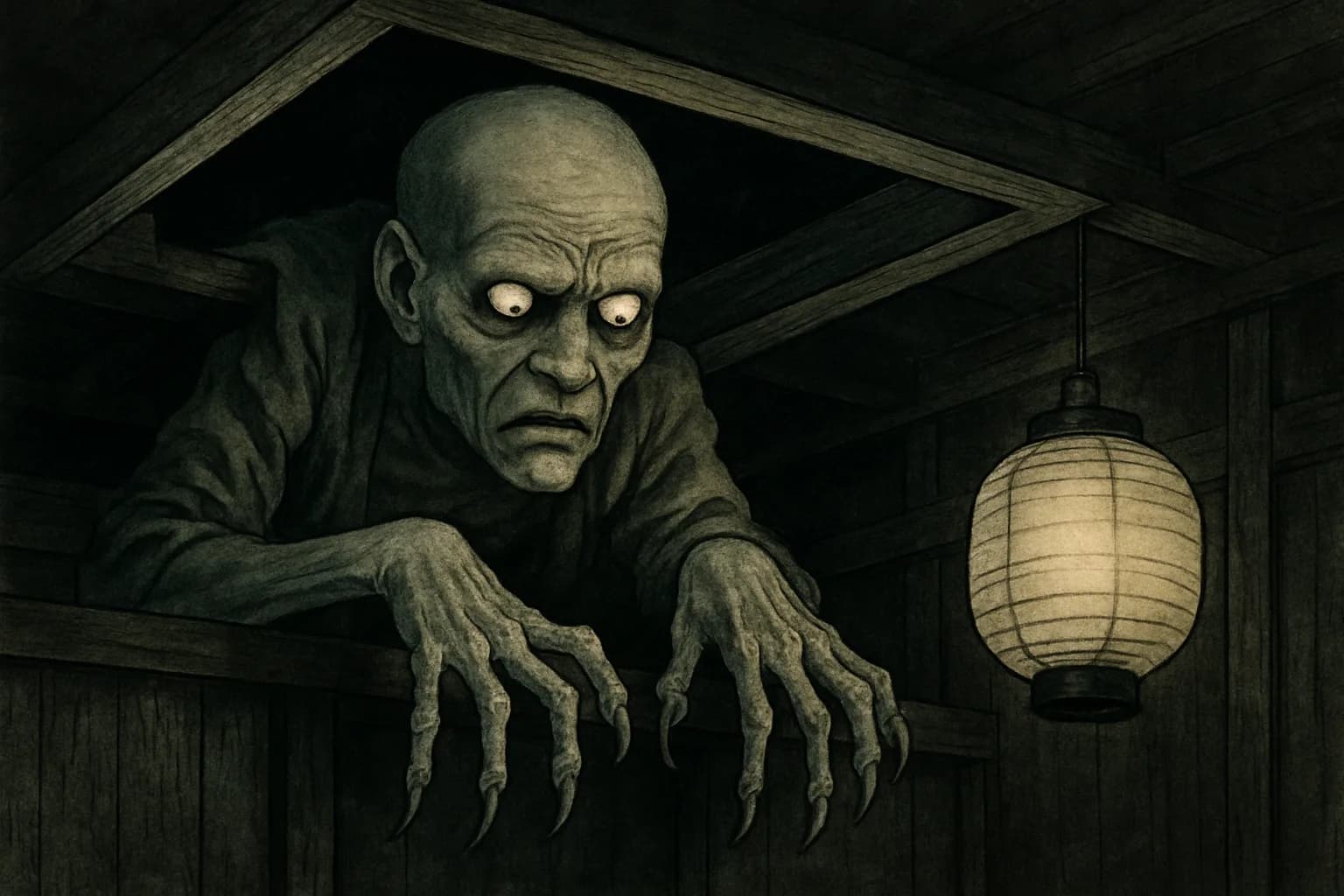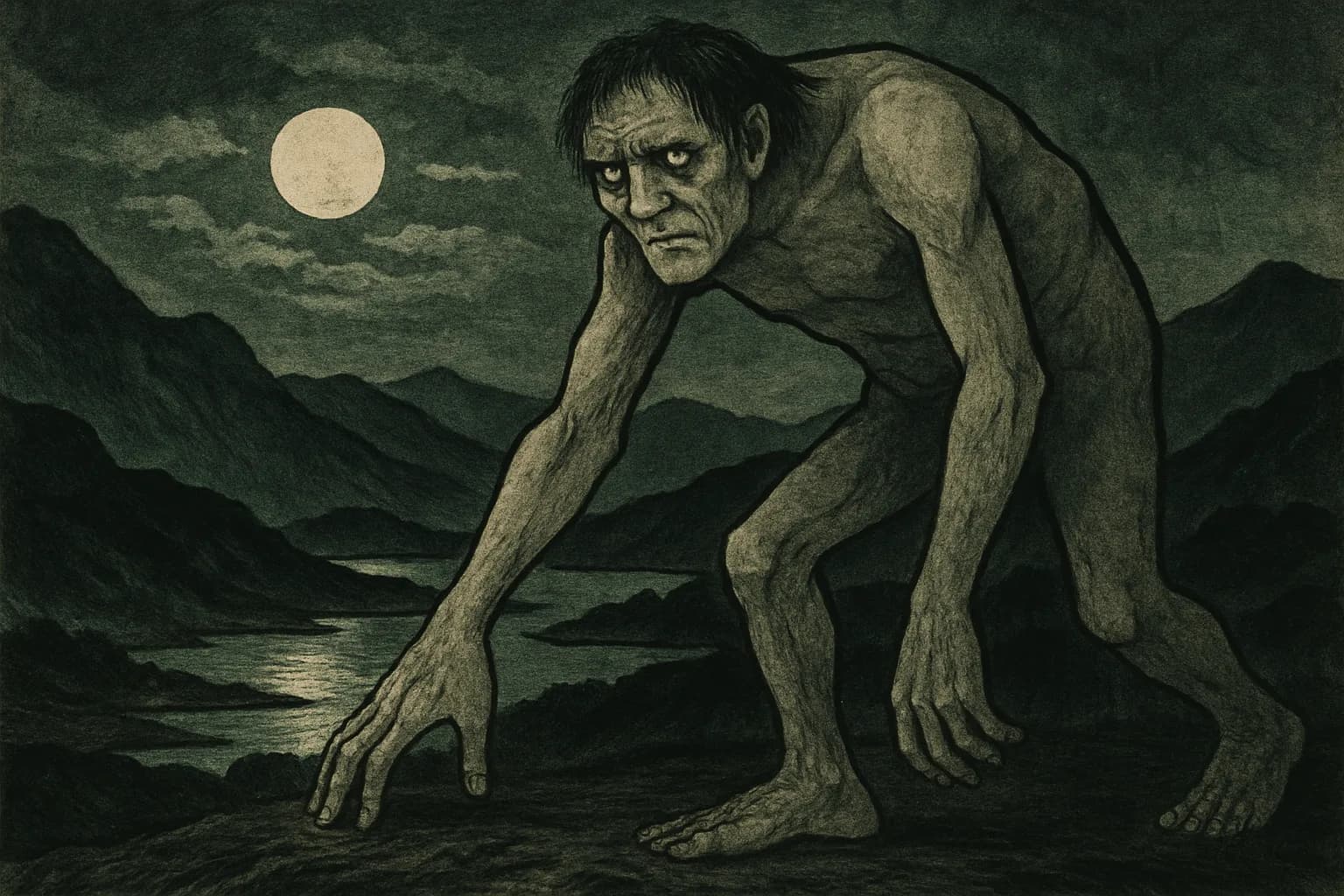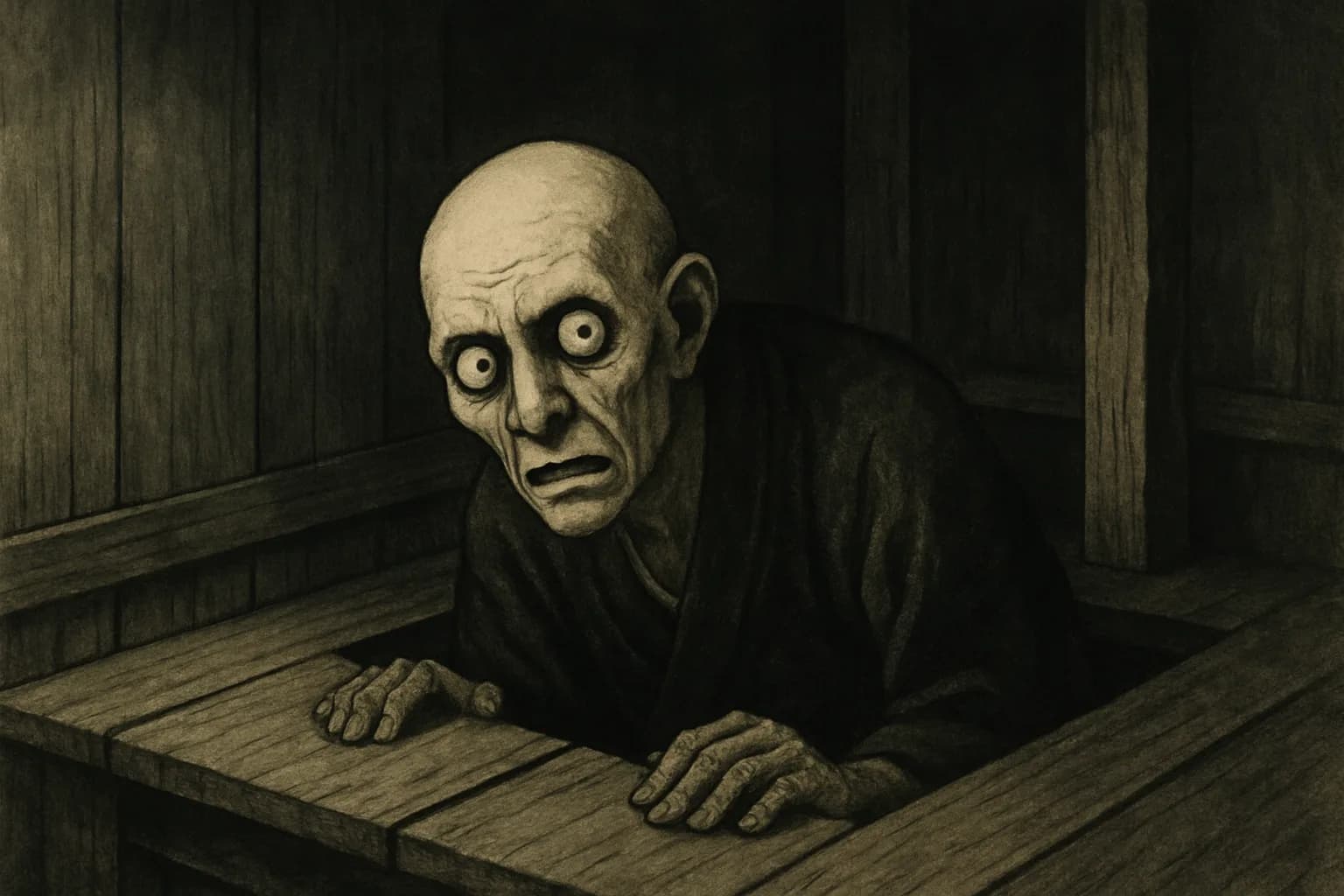
Old Japanese farmhouses kept the toilet outside, in a slatted wooden shed apart from the main building, and after dark it was not somewhere to linger. Toriyama Sekien gave that dread a face in his 1779 print collection Konjaku Gazu Zoku Hyakki ("The Continued Illustrated One Hundred Demons of the Past and Present"): a bald, tonsured monk, his body shaggy with thick hair, hunched at the edge of the privy and staring in at whoever crouches inside.
What does it look like?
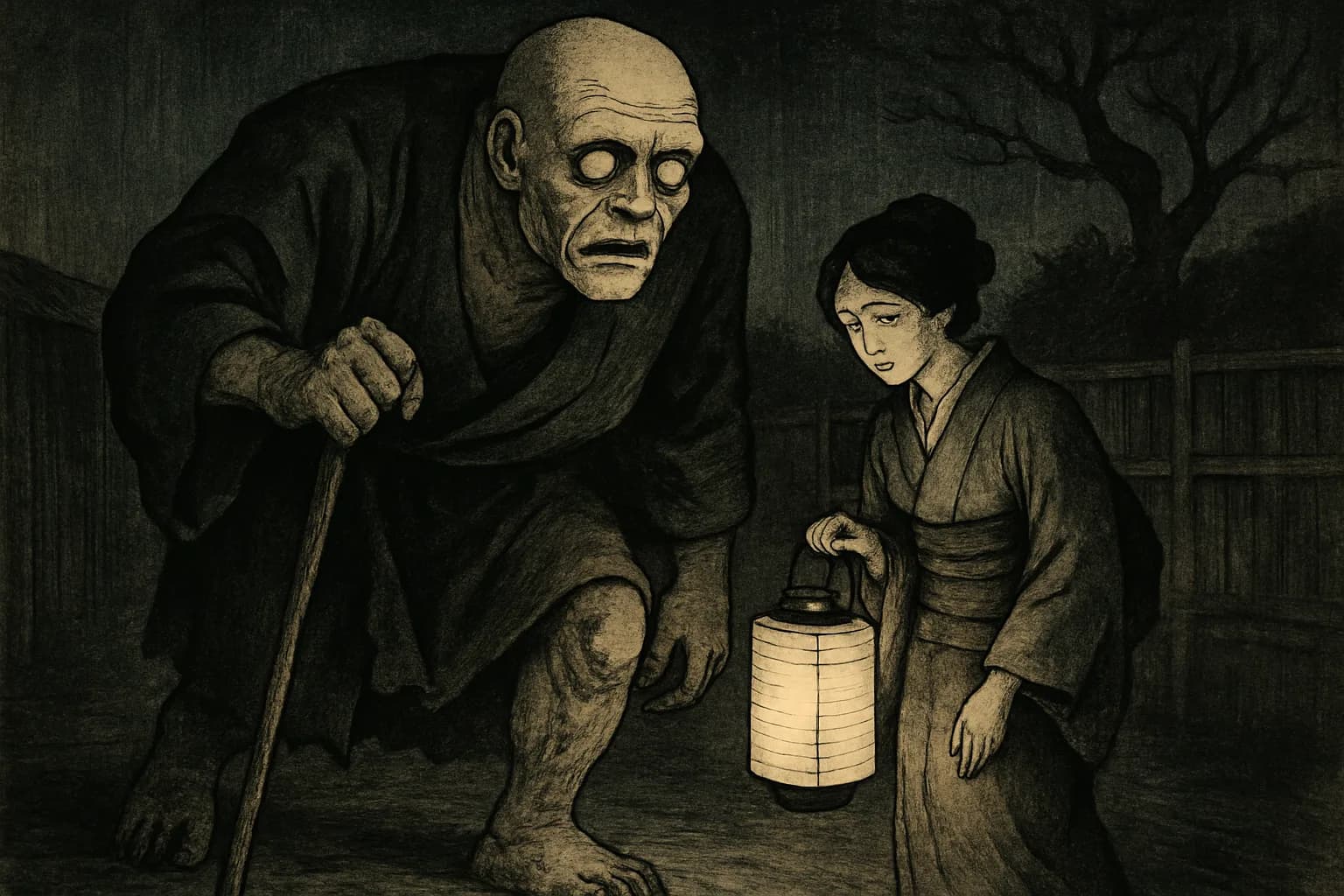
Sekien draws Ganbari-nyūdō as a nyūdō — a term for a lay Buddhist who has shaved his head and taken partial vows, a stock figure in yokai art for something monk-shaped but wrong. The face is human, the head is bald, and the rest of the body is covered in coarse hair, as though a beast had been dressed in a priest's outline. He does not attack or grab. He simply appears at the edge of the outhouse, watching, and the terror is entirely in being seen.
The one night he comes
Ganbari-nyūdō's whole legend hangs on a single date: Ōmisoka, New Year's Eve. Folk custom held that if you used the toilet that night without taking precautions, he might be waiting outside the window or crouched at the edge of the pit. Encountering him was reckoned bad luck for the year about to begin — the worst possible way to cross into January.
The protection was cheap and specific: recite the phrase "Ganbari nyūdō, hototogisu" while you were in there, and he would not show himself. Say it, and the coming year started clean.
A pun a thousand years wide
Sekien's own note traces the name to a Chinese toilet deity he calls Kakutō, a spirit said to hand out fortune or misfortune to whoever used the privy. The joke is buried in the kanji: the characters for Kakutō's name are close cousins of the characters for kakkō — the Japanese word for the cuckoo, or hototogisu. Chanting "hototogisu" at the end of the spell is not decoration; it turns the foreign toilet god's name into a birdcall, and singing the bird is what sends the monk away. It is a scholar's pun dressed up as folk magic, which is very much Sekien's style throughout the Hyakki series.
Not every region used his name. In Wakayama, the same figure was called Setchin-bō ("privy priest"), said to announce himself with a bird-like cry rather than a human voice — the same idea, told with a different mouth.
Not the only thing in the privy
Sekien's outhouse was crowded. The same unlit sheds were said to host akaname, the filth-licker who cleans the grime nobody scrubs, and shōkera, another watcher said to peer in and report a household's misdeeds to the heavens. A private moment in an Edo-period toilet was, by folk reckoning, rarely as private as it felt.
Where it comes from
The mundane explanation sits right under the supernatural one. A rural privy was a separate, unheated structure, often reached by a dark path, with a floor built over an open pit — a genuinely hazardous place to visit alone at night, never mind demons. Turning that walk into a story with a monster in it gave the danger a shape, and gave children and travelers a reason to be careful, or at least to bring a lantern.
The New Year's timing fits a broader pattern in Japanese folk religion, where Ōmisoka is treated as a threshold — a night when the boundary between the old year's grime and the new year's luck is thin, and household spirits of all kinds are settled, honored, or warned off before the count turns over. A privy-haunting monk who can be dismissed with the right words at the right hour belongs to that same housekeeping impulse: close out the year clean, everywhere in the house, including the outhouse.
The toilet ghost, still with us
Japan never really let go of the haunted bathroom. Walk into almost any elementary school today and you'll hear some version of Hanako-san, the schoolgirl spirit said to answer if you knock three times on a particular stall door — a story told by children, about a bathroom, with its own protective ritual for surviving the encounter. The shed has become a tiled stall and the lay-monk has become a schoolgirl, but the shape of the story — a watcher in the one room where you're briefly alone, and a phrase that keeps it at bay — is the same one Sekien drew in 1779.