Somewhere under a pond in Setagaya, or a shallow lake in Shiga, or a strangely round hill in Gunma, there is supposed to be a footprint. Not a fox's, not a bear's — a footprint the size of a rice paddy, pressed into the land by a giant so tall his head brushed the clouds. Japanese villages from Kanto to Kyushu have, at one time or another, pointed to a nearby pond, mound, or valley and said the same thing: Daidarabocchi walked here.
What does it look like?
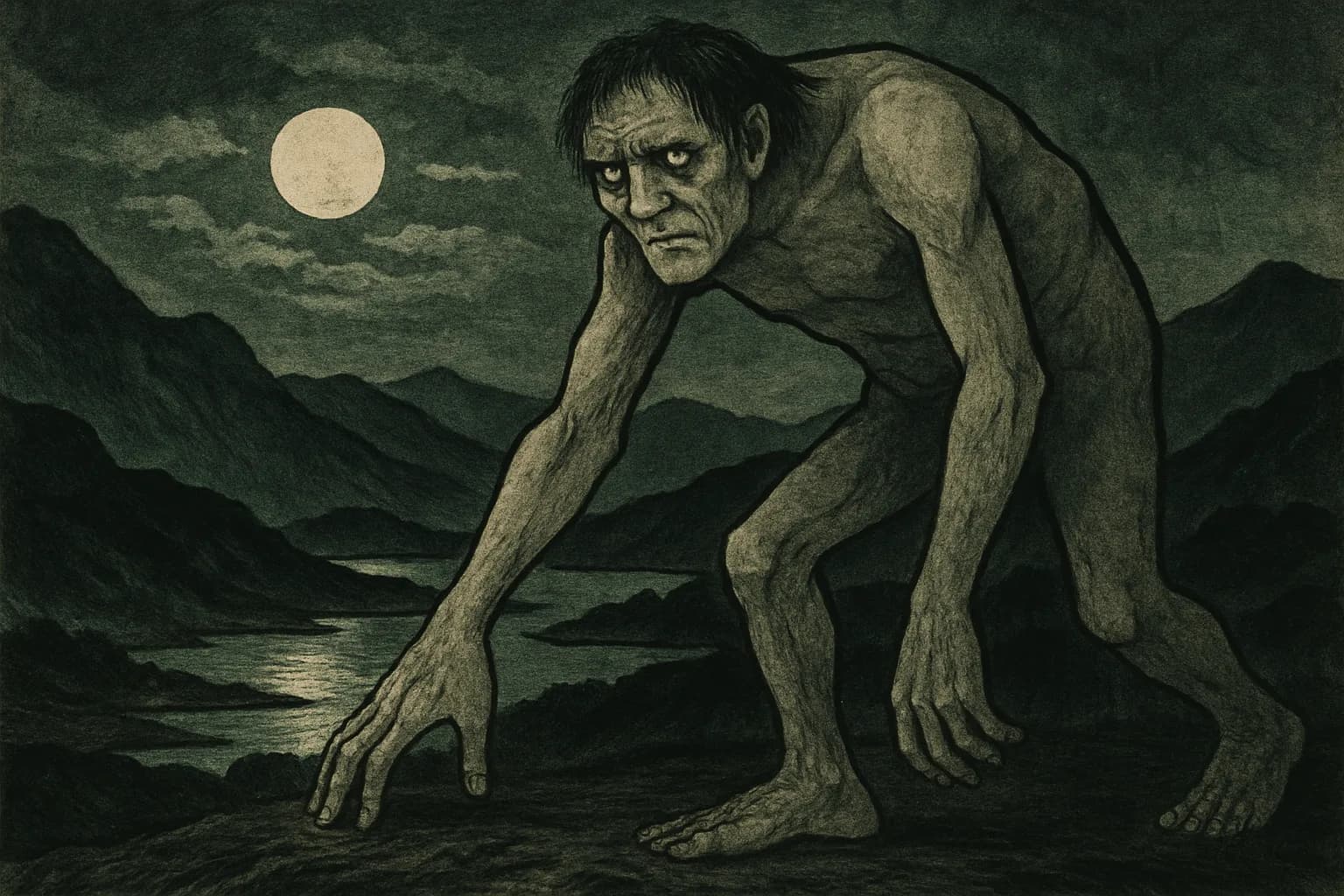
No one drew Daidarabocchi the way Toriyama Sekien drew the kappa or the nopperabo. He belongs to an older, vaguer category of folklore — the ōhito (大人), simply "giant person" — and descriptions are less about his face than his scale. He is a naked or lightly dressed man, impossibly large, sometimes said to be so big he could stand with one foot on one mountain and the other on a mountain across a valley, or crouch down and scoop up an entire hillside in his hands. Some tellings give him a straw rain-cape or a carrying pole slung over his shoulder, hauling baskets of earth like any ordinary laborer — just built on a landscape scale. He is rarely drawn as monstrous or threatening. He looks like work.
A giant who moves the earth
Almost every Daidarabocchi story is an origin story for something you can still go look at. He is Japan's great unintentional landscaper: mountains are earth he piled up, lakes are pits he dug or hollows his feet left behind, and oddly shaped hills are dirt that fell from his carrying baskets or shook loose from his sandals.
The oldest surviving account comes from the Hitachi no Kuni Fudoki, an 8th-century regional gazetteer of what is now Ibaraki Prefecture. It describes a giant so large he could stand astride two hills at once and reach down into the sea to dig for clams, leaving oversized footprints that filled with water and remained as ponds. That single passage — giant, footprints, ponds — became the template repeated in local legend for the next twelve centuries.
By the Edo period and after, the story had spread and multiplied regionally. A widely told version credits Daidarabocchi with scooping the basin that became Lake Biwa, Japan's largest lake, and piling the removed earth into a cone that became Mount Fuji — a folk explanation for two of central Japan's most striking features, even though the two sites are separated by real geological distance the story quietly ignores. It is the kind of tale that was never meant to survive a geology textbook; it was meant to give a shape to the horizon.
Reading the footprints
Because the legend is really a way of naming the land, you don't defeat or befriend Daidarabocchi so much as go looking for where he's already been. Villages across the country have their own "footprint" sites: round ponds too regular to be natural, paired depressions the right distance apart for a giant stride, hills that don't match the surrounding terrain. In Tokyo's Setagaya ward, the neighborhood of Daita (代田) is popularly said to take its name from ōashi — "big foot" — after a footprint the giant supposedly left there. None of this is provable archaeology; it's toponymy doing the work of memory, a community deciding that an odd bit of ground deserves a story.
The folklorist Yanagita Kunio took this seriously enough to study it as a body of evidence. In his 1927 essay on the Daidara giant's footprints, he catalogued dozens of place names scattered from the Kanto plain down toward the Kinki region — "Daidara," "Daita," "Deira," and similar variants — arguing they traced a once-widespread giant-creation belief that had splintered into hundreds of local, unconnected legends rather than one single myth.
Where it comes from
Unlike the kappa or the oni, Daidarabocchi carries almost none of the menace typical of yokai. He doesn't drown children or curse households; at worst he is clumsy, leaving a mess of geography behind him without meaning to. Folklorists generally read him as a relic of much older land-creation beliefs — a distant cousin of the giants and earth-shaping deities found in myth traditions worldwide — that survived in Japan not as scripture or shrine ritual but as the kind of story a farmer tells a child about the odd pond down the road. He is less a monster to fear than a myth doing geography's job before geography existed: an answer to "why is that hill shaped like that?" that predates surveying instruments by a thousand years.
Daidarabocchi today
The giant's clearest modern appearance is in Studio Ghibli's Princess Mononoke (1997), where the forest's deer-headed Shishigami transforms by night into a towering, translucent giant explicitly named Deidarabotchi in the original Japanese script — a direct nod to the old land-shaping giant, reimagined as a nocturnal nature spirit rather than a folk explanation for a pond. Beyond film, the footprint ponds themselves remain minor local landmarks: small signposted sites in Ibaraki, Gunma, and elsewhere still tell visitors, more or less seriously, that they are standing in a giant's footprint.