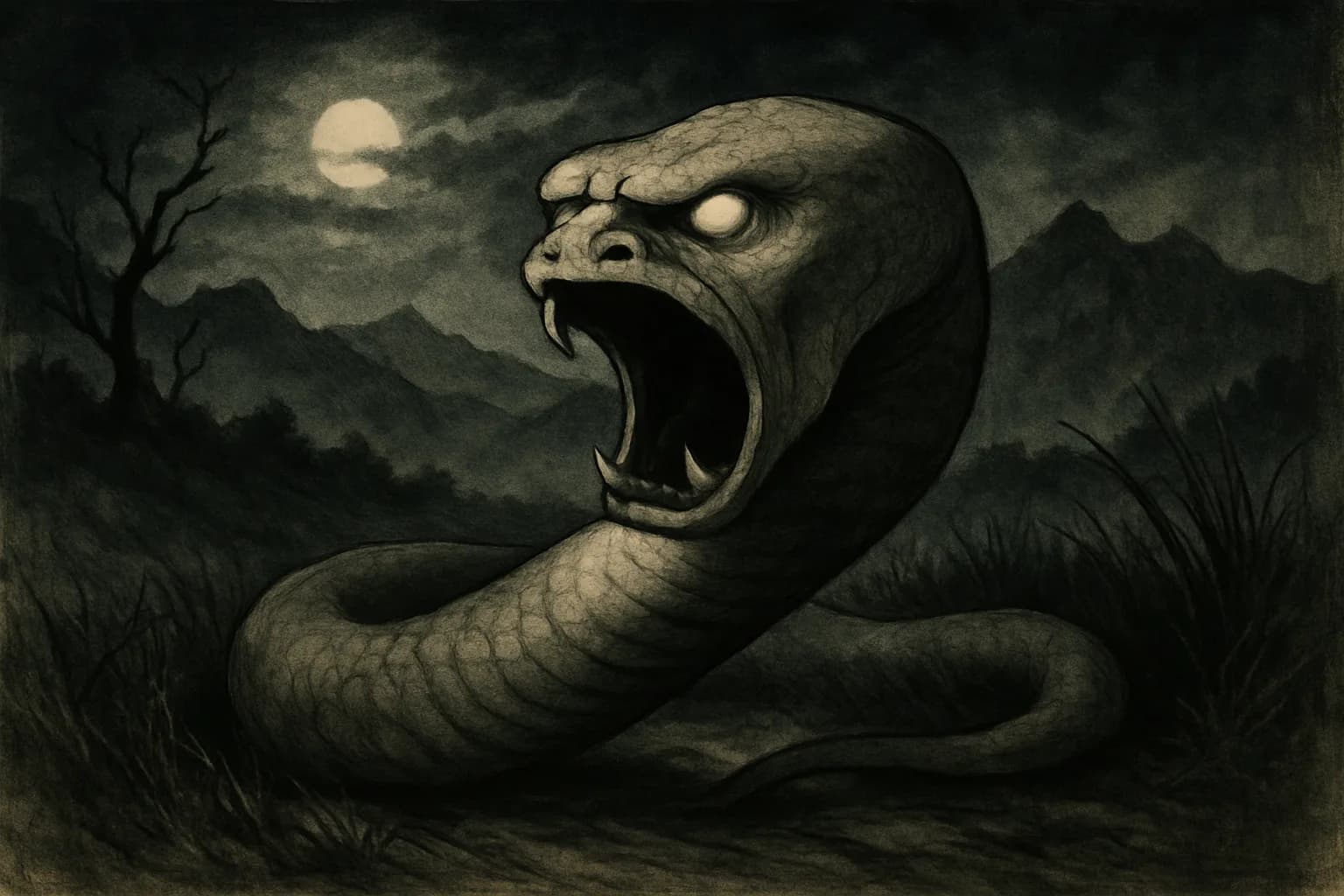
Hunters working the deep valleys of Nara and the Kii mountains told of a snake unlike any other in the undergrowth: no tapering neck, no narrowing tail, just a short, stout cylinder of a body, thick as a wine bottle from end to end. They named it after the tool it resembled — a tsuchi, a wooden mallet — and warned each other to keep their distance, because unlike an ordinary snake this one was said to come looking for you.
What does it look like?
Toriyama Sekien drew the nozuchi in his 1781 print collection Konjaku Hyakki Shūi (今昔百鬼拾遺), showing a squat, blunt-headed serpent coiled in dead leaves at a forest's edge. Accounts describe a creature one to two shaku long (roughly 30–60 cm), uniformly thick along its whole body, with eyes so small they were said to be nearly invisible and a mouth that splits disproportionately wide — some tellings put the slit not at the very front of the head but partway down the underside, giving the impression of a blunt hammerhead with a hidden trap-door jaw. It has no legs and, in most versions, is not credited with the sinuous crawl of a normal snake.
Behaviour: an ambush from above
The nozuchi's habitat is consistently mountain forest and rough field land, and its method of attack is what set it apart from every other snake in the folklore. Lacking a snake's usual means of getting around, it was said to hurl itself, or roll, down slopes at anyone passing below — striking with startling speed for something with no limbs — and to bite. Travelers were told that the only real defense on a mountain path known for nozuchi sightings was to climb, since the creature's whole method of attack depended on gravity working in its favor.
Some regional tellings add that it can call out with something resembling a human voice, luring a traveler off the trail before it strikes — a detail that turns up in stories about other legless mountain apparitions of the same era, but is far less consistently reported for the nozuchi than the rolling ambush.
Where the name comes from
The word no-zuchi is far older than Sekien's illustrated bestiaries. It appears in the eighth-century Kojiki as an alternate name for Kayanohime, a kami of grasses and open fields born to Izanagi and Izanami — a guardian spirit of cultivated land, nothing like a monster. By the time hunters in the Kii mountains were describing a stout, biting snake with the same name centuries later, the two figures had clearly diverged: one a benign deity of the fields, the other a thing to be feared in the forest. Whether the frightening snake borrowed its name from the old field-kami, or the name simply resurfaced independently for a creature that lived in the same "no" — open country beyond the village — is not settled by the sources; what the record shows is the word itself outlasting any single meaning attached to it.
The nozuchi today
The nozuchi's closest modern relative is not a cartoon mascot but a cryptid: the tsuchinoko, a short, thick-bodied snake said to be spotted in rural Japan to this day, with a head distinct from its tail and a body noticeably fatter in the middle than an ordinary snake. Japanese folklorists and yokai researchers routinely trace tsuchinoko reports back to nozuchi accounts like Sekien's, treating the cryptid boom as an old mountain legend re-told in cryptozoological language. Several towns, including Nabari in Mie Prefecture, still hold annual tsuchinoko festivals and post reward money for photographic proof or a captured specimen — a folk belief that never quite left the mountains, it just changed its name.