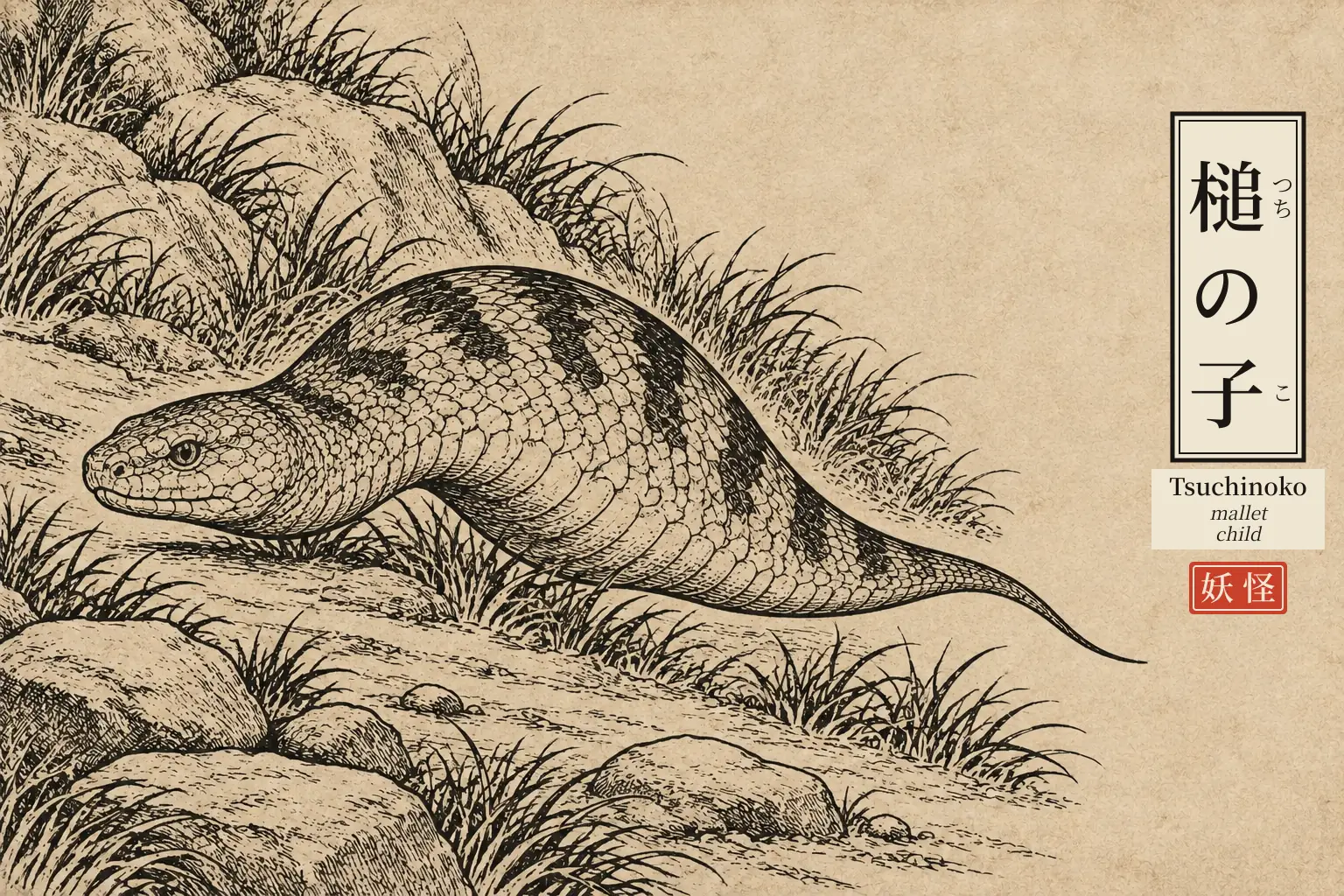
A snake thicker in the middle than at either end has been "seen" all over Japan. It is shaped like a stubby wooden mallet. No confirmed specimen has ever been produced. That has not stopped towns from putting up cash for proof. One town once offered 200 million yen. The animal is the tsuchinoko (槌の子, "mallet's child"). It may be Japan's most famous living cryptid.
What does it look like?
Witnesses mostly agree on the shape. It is short and heavy around the middle. Its tail tapers to a thin point. Unlike a real snake, it is said to have eyelids. Some say it moves fast and jumps about two meters. A few tellings push that further. One says five meters high, with a forward reach of two meters or more. Another says ten meters forward.
Its way of moving is strange, too. It is said to flex like a looper caterpillar. It can roll sideways like a log. It can bite its own tail and roll itself into a ring. On a slope, it anchors its front half. Then it swings its rear half side to side to climb. Going downhill, old accounts say, it is very fast. Going uphill, it is slow. Some say it is slow enough to outrun on foot.
A few more details round out the folklore. It is said to snore. It is said to cry out something like "chii." It is said to love the smell of burning miso, dried squid, or burnt hair. It likes sake, too. Some tellings add a dangerous bite. In a few accounts, the females have gapped teeth.
Forty names for one snake
Tsuchinoko carries about forty regional names. In Tōhoku it is Bachihebi. Elsewhere it has been called Nozuchi, Tatekurikaeshi, Tsuchinbo, Tsuchihebi, and Tsuchikorobi. In one Tokushima valley it is Tatekaeshi. That name comes from flipping over and over, like a dragonfly circling back. Another Tokushima valley calls it Gunze, "thick firewood." Local folklore there adds a twist. A Japanese mamushi viper gives birth to many young in one litter. The thirteenth or fourteenth born, it is said, becomes this venomous Tatekaeshi. In a few places, Nozuchi and Tsuchikorobi are kept as separate yokai. They are not treated as just other names for the same animal.
The word "tsuchinoko" itself started as dialect. It was spoken around Kyoto, Mie, and Nara, and in northern Shikoku. It compares the animal's shape to a yokozuchi, a wooden mallet used to beat straw or soften cloth. Write that comparison in kanji and you get 槌の子 — mallet's child.
An old name, long before the boom
The word is older than any sighting of the animal. The eighth-century Kojiki calls a field deity "Notsuchi." The Nihon Shoki, finished just eight years later, gives the same deity the same name, in different characters. Neither text describes a monster. Each names only a kami.
The 1712 encyclopedia Wakan Sansai Zue paints a clearer, scarier picture. It describes a "nozuchi-hebi" living deep in the mountains near Yoshino, in Nara. Head and tail are the same width, with no tapering tail, shaped like a mallet with no handle. Its mouth is large enough to bite a person's leg. It runs downhill fast and climbs uphill slowly. So slowly, the book advises, that running uphill is how you escape one.
A different book disagrees. The Shinano Kishōroku, drafted in 1834 and published in 1886, describes a nozuchi that rolls downhill in August. This one, it says, does nobody any harm. Its own author notes that this is not what the Wakan Sansai Zue says. The two sources do not agree on how dangerous the animal is.
The name "tsuchinoko," for an actual sighting rather than a kami's name, first turns up in 1799. The record is called Seijō Kaidan-roku. It describes something black and round, about 42 to 45 centimeters long, rolling along the ground.
How one year made it famous
For more than a century after that, no new sighting is recorded. Then, in 1959, the writer Yamamoto Soseki said he saw one. It was in the hills above Kyoto's Kamo River, near Kumogahata. He spent years afterward trying to catch one.
In 1972 the novelist Tanabe Seiko wrote "Subette Koronde," a story based loosely on Yamamoto's hunt. It ran in the Asahi Shimbun's evening edition. The following year NHK turned it into a television drama. That same year, 1973, the manga artist Yaguchi Takao began his own tsuchinoko manga. He said he had seen one himself. His series, "Maboroshi no Kaida Bachi-hebi," ran in Weekly Shōnen Magazine. The collected volume came out that December. The following year it shared the Kodansha Publishing Culture Award with Yaguchi's other manga, Tsurikichi Sanpei. In barely two years, an obscure dialect word for a local snake became a name the whole country knew.
Towns with a bounty on a snake
Reward money followed years later. Starting in 1989, the Gifu village of Higashishirakawa offered one million yen for a tsuchinoko. The prize rose by ten thousand yen every year, reaching 1.31 million yen by 2023. The village still holds an annual hunt each May, called Tsuchinoko Festa. It also runs Japan's only tsuchinoko museum, the Tsuchinoko-kan.
Other towns went further. The former Yoshii-chō in Okayama, now part of Akaiwa City, started at 20 million yen in 2000. It rose the same way, reaching 20.08 million yen by 2008. The former Chikusa-chō in Hyōgo, now part of Shisō City, once offered 200 million yen. That is the largest tsuchinoko reward on record. The offer ended only when the town merged into Shisō. Itoigawa, in Niigata, has run an annual search since 2006, with a reward as high as 100 million yen. Smaller offers have come from a Hiroshima town (3 million yen, 1989), a department store (up to 300,000 yen for a live capture), a nature publisher, and the magazine Mu. The Tajima area of Hyōgo alone has logged more than fifty separate reports.
Is it real?
No sources describe a confirmed specimen. The leading guesses all point to ordinary animals, misread. A blue-tongued skink has small legs that could pass for none, at a glance. It has been kept as a pet in Japan since the 1970s, and sometimes released — right when sightings began to rise. A matsukasa tokage, or shingleback skink, hides its legs in grass or under its own body. But its tail runs thick, where tsuchinoko's is usually said to be thin. A death adder or an Okinawan pit viper, both short and heavy-bodied, could explain a sighting far from where they actually live. Closer to home, a native snake could do it too. A tiger keelback or a Japanese mamushi, its belly swollen from pregnancy or from swallowing prey whole, looks remarkably like the shape people describe.
One specific case shows how these mix-ups happen. In the 1970s, in what is now Shizuoka City's Shimizu ward, a childhood friend of the manga artist Sakura Momoko said she had seen a tsuchinoko. It was at her own house. The two girls searched and found nothing. Years later, the friend said she might have mistaken a snake that had just swallowed a mouse. The story resurfaced in an episode of Sakura's manga and anime Chibi Maruko-chan.
A different, stranger tale aired on the Fuji TV show Kiseki Taiken! Unbelievable. It told of a tsuchinoko supposedly captured by the Japanese military in the Pacific War. The army was said to have studied it at a research institute. A blurry photograph is said to survive it. Its reported autopsy looked at the chemistry of its venom. The conclusion: only a subspecies of mamushi.
Tsuchinoko today
In 1999, Nintendo and Game Freak's Pokémon Gold and Silver introduced a Pokémon called Nokocchi. It was modeled on the tsuchinoko. The game added small wings and a drill-shaped tail of its own. An evolved form, Nokokocchi, followed in 2022's Pokémon Scarlet and Violet.
A quarter-century earlier, the manga Doraemon got there first. In 1974 and 1975 it ran two episodes about hunting for a tsuchinoko. Those stories were later exported with the rest of Doraemon to Taiwan. Many young readers there pictured the animal as that cartoon version.
Itoigawa's search team still goes out every year. The reward on offer, the last time it was posted, was 100 million yen.