Deep in the hill country of old Suō province, hunters told each other not to trust an empty clearing. Something waited there that never had to chase them. It just breathed, and the forest came to it.
That something is Suō-no-Ōgama, "the great toad of Suō." Its name is almost a description: 周防 (Suō, the old province, now part of Yamaguchi), 大 (ō, "great"), and 蟆 (gama, "toad"). No riddle, no trick name. Just a toad, and the word "great" doing a lot of work.
What does it look like?
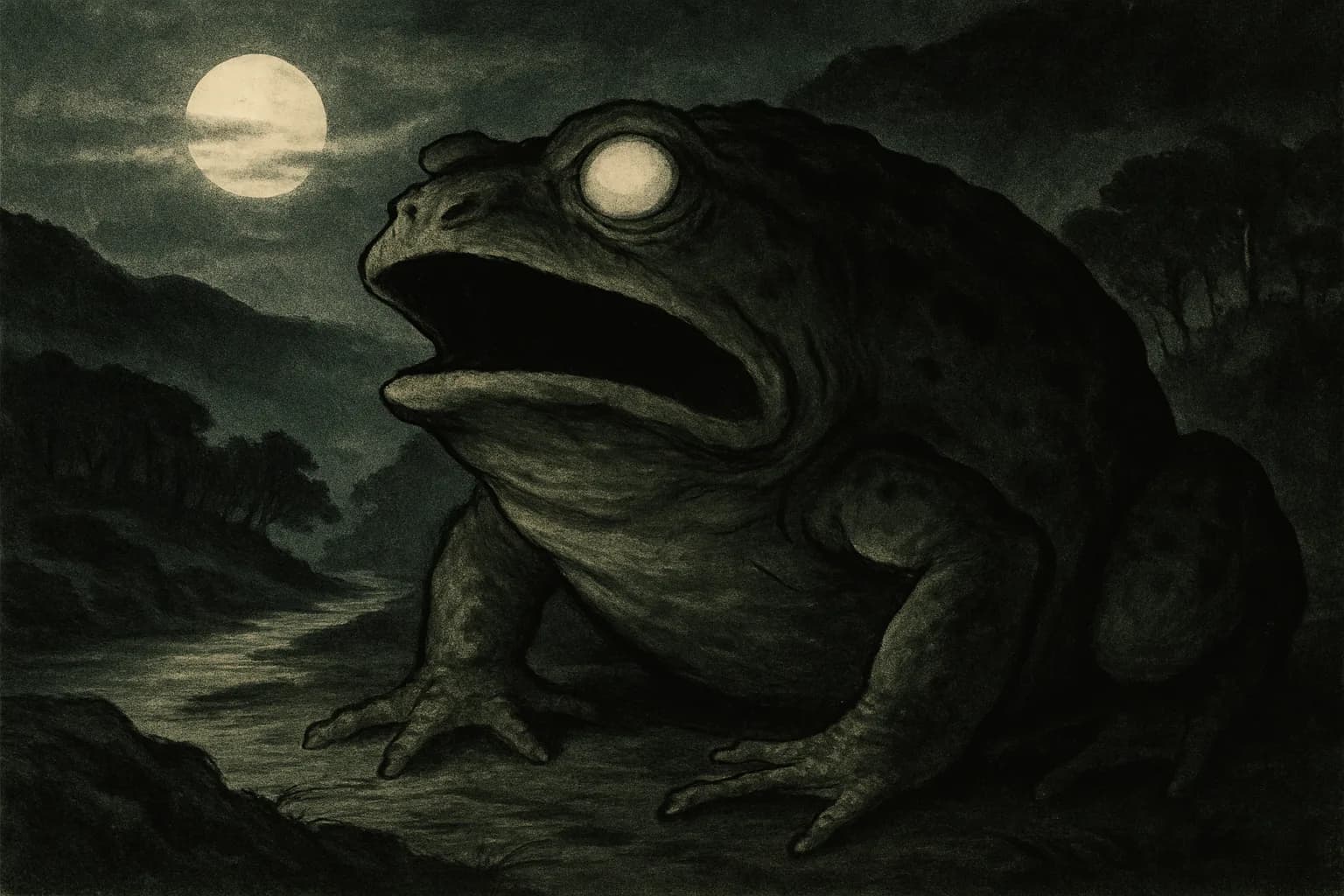
The Ehon Hyaku Monogatari records it as a toad grown to the size of a boulder, squatting half-hidden among rocks and undergrowth. Its skin is warty and mud-colored, built to vanish into a hillside. Most toads in Japanese folklore are slow and almost comic. This one keeps the slowness and drops the comedy.
It does not stalk, pounce, or corner anyone. It sits still. That stillness is the entire threat.
The breath that pulls you in
Hunters who wandered too close described a strange pull, like a wind moving the wrong way. Leaves, small animals, and eventually a man's own footing would drift toward a spot in the rocks. Only close up did the spot resolve into a toad's open mouth. By then the pull had already done its work.
This is Suō-no-Ōgama's whole method. It never lunges. It draws the world into itself by breath alone, the way some real toads flick prey in with a tongue, but scaled up until the "tongue" is the air itself. A hunter with a matchlock could aim at nothing, because nothing was coming toward him. He was going toward it.
A monster with no moral
Most Edo-period monster stories carry a lesson: don't be greedy, don't break a promise, don't laugh at a stranger on the road. Suō-no-Ōgama carries none of that. It punishes no bad behavior. A skilled hunter and a careless one meet the same end if they wander into its clearing.
That makes it closer to a hazard than a character — a labeled patch of dangerous ground, the way a swamp might be marked on a map. The story's real function was practical: it told people which hillsides to leave alone.
Where it comes from
Suō-no-Ōgama appears in the Ehon Hyaku Monogatari (絵本百物語, 1841), an illustrated collection of regional weird tales compiled by Takehara Shunsen. The book gathered monster reports from across Japan's provinces and gave each one a woodblock print and a short account. Suō-no-Ōgama is its entry for Suō, one province's answer to "what is out there in the hills."
Giant animals that swallow travelers whole are a common shape in Japanese folklore — the giant snake, the giant centipede, the giant spider all show up in similar roles. What sets this one apart is the mechanism. It does not attack. It simply exists, and the world falls toward it. That is a hunter's fear speaking plainly: the woods themselves can kill you without doing anything at all.
Suō-no-Ōgama today
Outside specialist yokai compendiums and reprints of the Ehon Hyaku Monogatari, Suō-no-Ōgama stayed obscure. It never picked up a defeat ritual, a lucky charm, or a festival the way kappa or tengu did. It remains what the 1841 woodblock print shows: a toad, half-buried in rock, waiting for nothing to change.
Yamaguchi's hill country is real, and so is the old habit of naming what makes a stretch of forest feel wrong. Suō-no-Ōgama is one province's name for that feeling, fixed in ink nearly two centuries ago.