Along the coast of western Japan, certain stretches of shoreline carried a bad reputation after dark — the rocky inlets of Iyo province, the tidal flats near the San'in coast in Shimane, the cliffs of Kii in Wakayama. What was said to wait there had an ox's head fixed to a body no two storytellers described the same way. This is ushi-oni (牛鬼), written with 牛 (ushi, "ox") and 鬼 (oni, "demon") — the ox demon, one of the few yokai whose name is also its most reliable feature.
What does it look like?
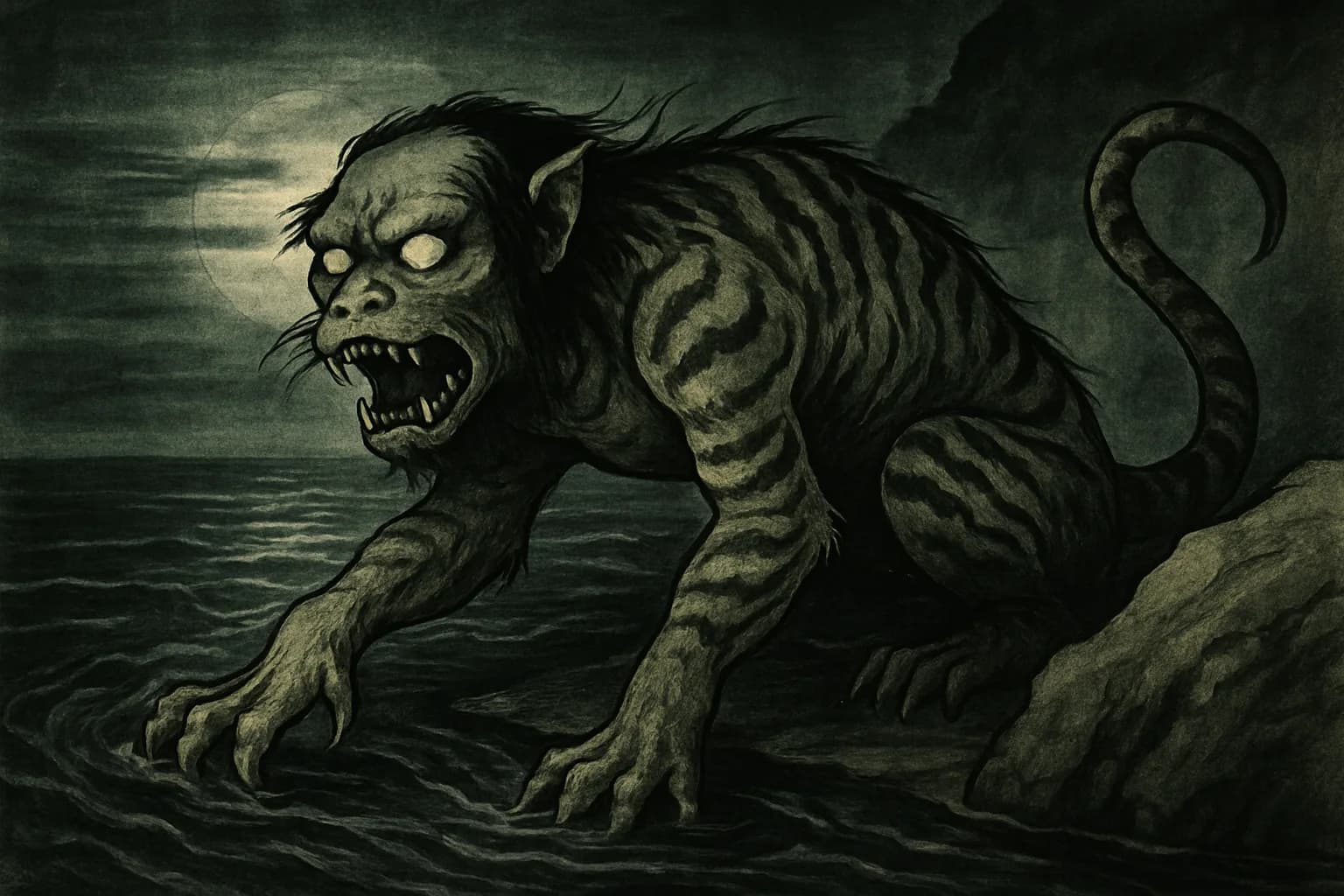
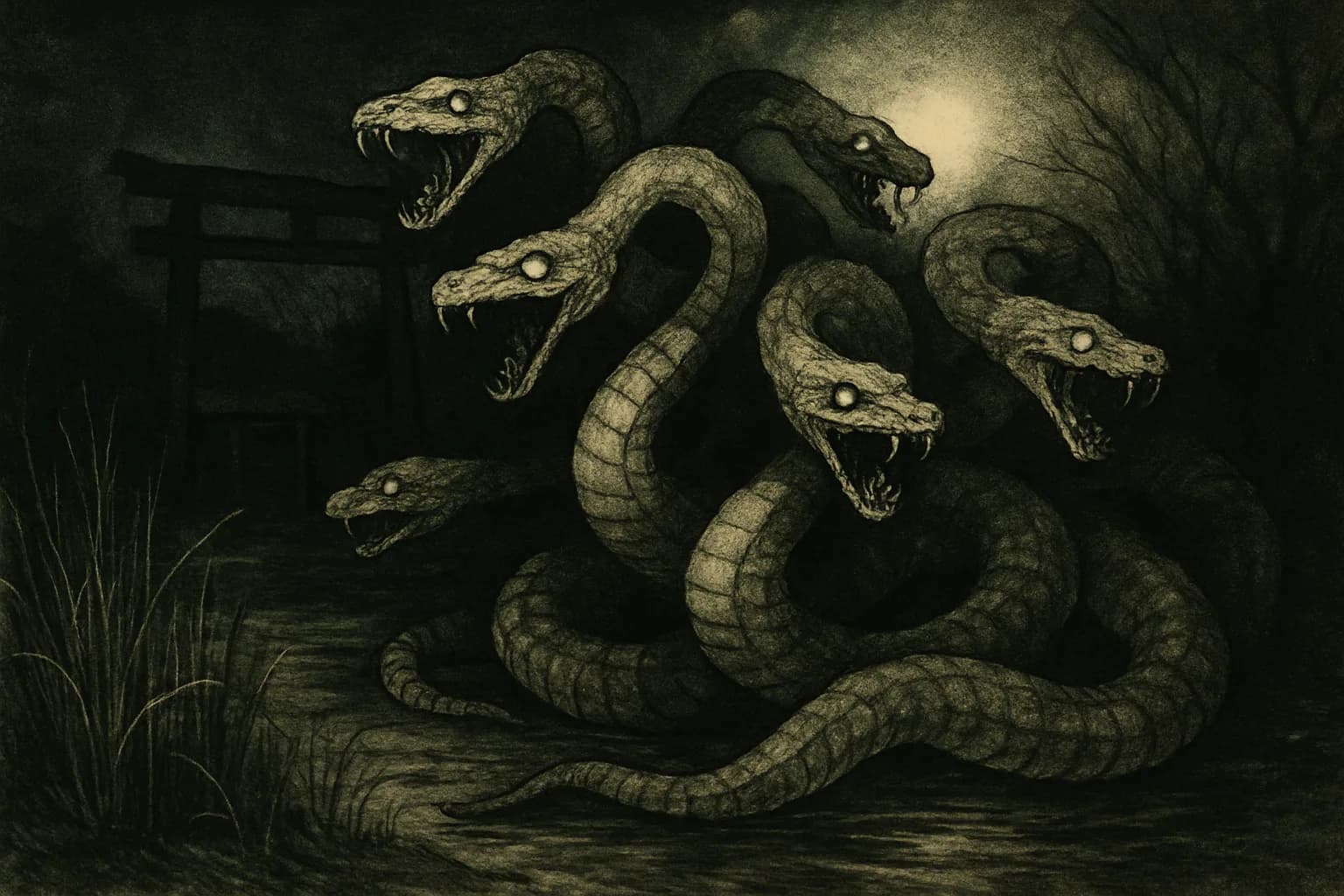
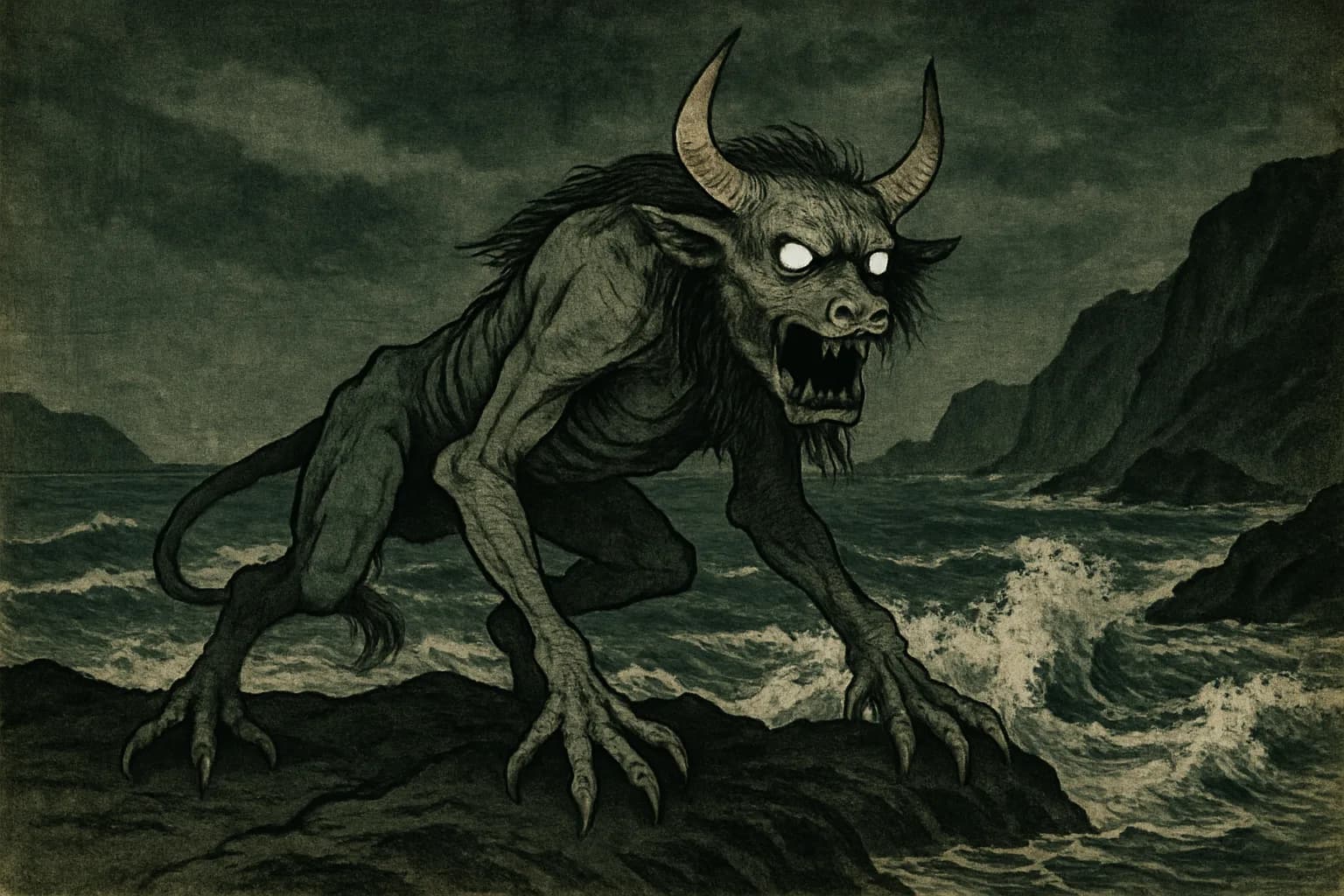
The head is the constant: a horned, bovine skull with a wide, fanged mouth, sometimes described as dripping or foaming. Everything below it changes by region. Along the San'in coast, storytellers gave it a huge spider's body, bristling with legs. In Iyo (modern Ehime), it appears with a crab-like shell or a heavy, reptilian tail suited to dragging itself over wet rock. Some tellings make it the size of a large ox; others swell it to something that can capsize a fishing boat with one blow. Toriyama Sekien drew it crouched and alert on a shoreline in his Konjaku Hyakki Shūi (1781), ox-headed and clawed, watching the water — and later ukiyo-e artists, including Utagawa Kuniyoshi, produced their own prints of warriors locked in combat with it, cementing the ox-headed monster as a subject fit for heroic battle scenes.
An accomplice in the shallows
The most-told version of an ushi-oni attack does not start with the demon at all. It starts with a woman standing at the water's edge, soaked through, holding what looks like an infant wrapped in cloth. She asks a passing traveler to hold her baby for just a moment. Kindness is the trap: the bundle grows heavier by the second, until it is unliftable and stuck fast to the traveler's arms — and by the time they understand why, the ushi-oni is already closing in from the water. The woman is nure-onna, and in San'in-coast tellings she and the ushi-oni are frequently described as hunting together, one luring, the other finishing.
Regional legends
The character splits along the coastline it haunts. In Shimane, local temple legend around the San'in shore tells of a monk who drove off a marauding ushi-oni after it had been killing fishermen and livestock, using prayer beads rather than a blade. In Wakayama, coastal tales cast it as a wrecker of small boats, rising beneath a hull on a calm night. It is Ehime, though, where the ushi-oni left the deepest mark — not as a threat to be defeated, but as a spirit to be honored.
Where it comes from
Folklorists generally read the ushi-oni as a coastal answer to the inland oni: a demon shaped by the hazards specific to a fishing and farming shoreline, where oxen worked the fields right up to cliffs that dropped into water full of real dangers — undertows, sea caves, sudden storms. Grafting a farm animal's head onto a predator from the deep gave those hazards a face. The pairing with nure-onna, a drowned or wronged woman turned dangerous, follows the same logic as many Japanese water yokai: the coast takes lives, and folklore explains the loss as something with intention behind it.
Ushi-oni today
The clearest living trace of the ox demon is not in a book but in the streets of Uwajima, Ehime, every July. During the Warei Taisai festival, teams of bearers carry giant ushi-oni floats — a carved wooden ox head with a hinged, snapping jaw mounted on a long body of red cloth, sometimes stretching five or six meters — through the town. The float lurches toward doorways and onlookers, jaws clacking, meant to butt bad luck out of the coming year before it retreats back toward the harbor it came from.
Why is Naruto's Eight-Tails called Gyuki?
Of the nine tailed beasts in Naruto, the eighth has the least invented name in the set. Gyuki is not a name that resembles the ox demon's — it is the ox demon's name. The characters 牛鬼 can be read with the native Japanese pronunciations, giving ushi-oni, or with the Chinese-derived ones, giving gyuki. Same two characters, same creature, different register: roughly the difference between calling something an ox-demon and calling it a bovine-daemon.
The design follows the same route. The eighth beast is an ox from the shoulders up and something else entirely below — in the manga an octopus, in the folklore a spider or a crab or an unspecified thing from the deep, depending on which province is telling it. Both versions are doing what the original did: welding a familiar working animal's head onto a body that belongs to the water, because the head is what makes the rest frightening. An unknown thing in the sea is merely unknown. An unknown thing in the sea wearing the face of the ox that pulls your plough is a different feeling.
What the manga changes is the ending. The ushi-oni of the coastal legends is a hazard — it comes ashore, it kills, it is driven off with arrows or prayers or a temple's relic, and the story closes. The eighth beast is captured and sealed into a man who learns to work with it. The folklore has no version of that, and neither does any other entry in this almanac; the closest the tradition comes is a fox pinned under a stone for centuries, still poisonous, still not done.