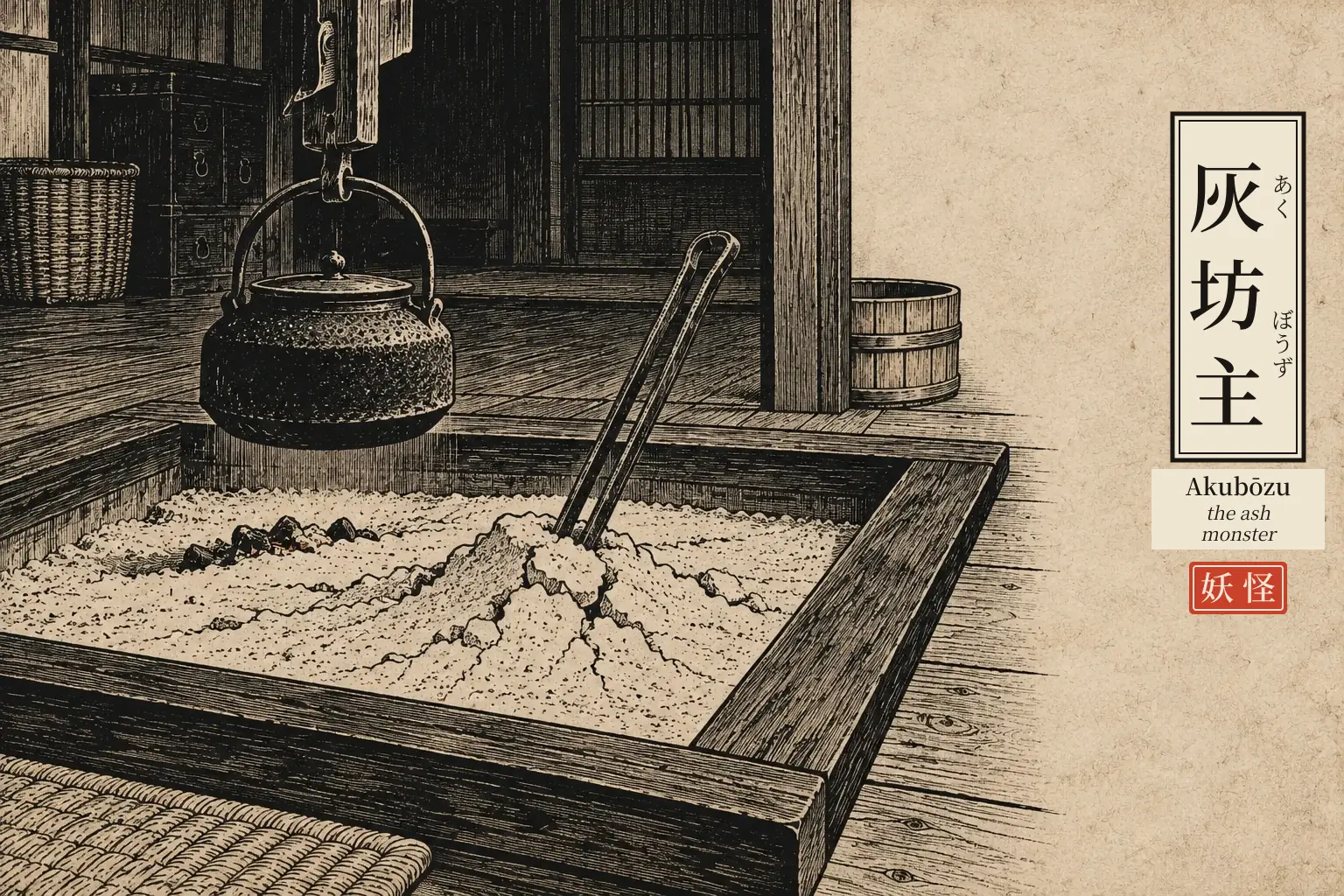
In parts of Akita and Iwate, the family hearth held more than embers. The irori, a sunken hearth set into the floor, was full of ash between fires. Dig too deep into that ash, and something was said to come out. People called it Akubōzu. No one ever described what it looked like. That silence was the whole warning.
What does it look like?
Nobody knows. Japanese Wikipedia calls Akubōzu a yokai "of unknown true form." No source gives it a face, a size, or a color. It is known only by what it does. It stays inside the hearth ash, and it comes out if the ash is stirred.
A name that isn't about priests
The word bōzu usually means a Buddhist priest, or a shaved head. Here it means something else entirely. The 1955 folklore glossary Sōgō Nihon Minzoku Goi uses bōzu for a monster, not a monk. That same book doesn't even write the name in kanji. It spells the creature "アク坊主," using katakana for the "aku" part. The kanji form used today, 灰坊主, shows up later, in a 1978 record called the Miyagi Kenshi.
Where it comes from
No one has ever recorded an actual sighting of Akubōzu. Folklorists read that absence as the point. These hearth-ash yokai look built to do one job. They keep people away from a working fire pit and its ash. A creature with no shape is cheap to invent and easy to repeat. It only needs a name people can say out loud.
Go deeper
Books worth owning if this world pulls you in.
- The Book of Yokai →Michael Dylan FosterThe most readable scholarly introduction to yokai — where they come from, what they mean, and the major creatures.
- Japandemonium Illustrated: The Yokai Encyclopedias of Toriyama Sekien →trans. Hiroko Yoda & Matt AltThe complete Edo-period bestiaries that so many of these entries trace back to, in full English translation.
Some links are affiliate links; if you buy through them we may earn a small commission at no extra cost to you.
What would call it out
In Senboku and Ogachi Districts, in Akita, Akubōzu lived in the hearth ash itself. Stir the ash, and it would appear.
In Kunohe District, in Iwate, three other acts were said to summon it. Bathing twice in one day was one. Eating rice set out for the household Buddhist altar was another. Walking into the outhouse naked was the third. All three carried the same warning: do this, and Akubōzu comes.
None of these acts have much to do with each other on the surface. What they share is someone doing something careless or a little bit rude. The yokai's job was to make each one feel watched.
Cousins across Tōhoku
Akubōzu was not the only thing said to live in the ash. Tōhoku folklore is full of yokai that rise out of a disturbed hearth.
In Ninohe District, also in Iwate, a figure called Amanesaku pulls ash-diggers in and eats them. Some writers treat Amanesaku as another name for amanojaku. In parts of Fukushima, the same role goes to a creature called Amanjaku instead. The folklorist Yanagita Kunio recorded a third version for the Tōno area, in his Tōno Monogatari Shūi: dig into the hearth ash there, and a yokai named Boko turns up.
Aomori has a more detailed cousin. Agubanba lives in the irori and has a second mouth on top of its head. In old Yuri District's Kisakata — now part of Nikaho City, Akita — people called the same figure Haibabaa, the "ash hag." She was said to snatch children who played in the ash and feed them through that extra mouth, and to take one young woman every year besides.