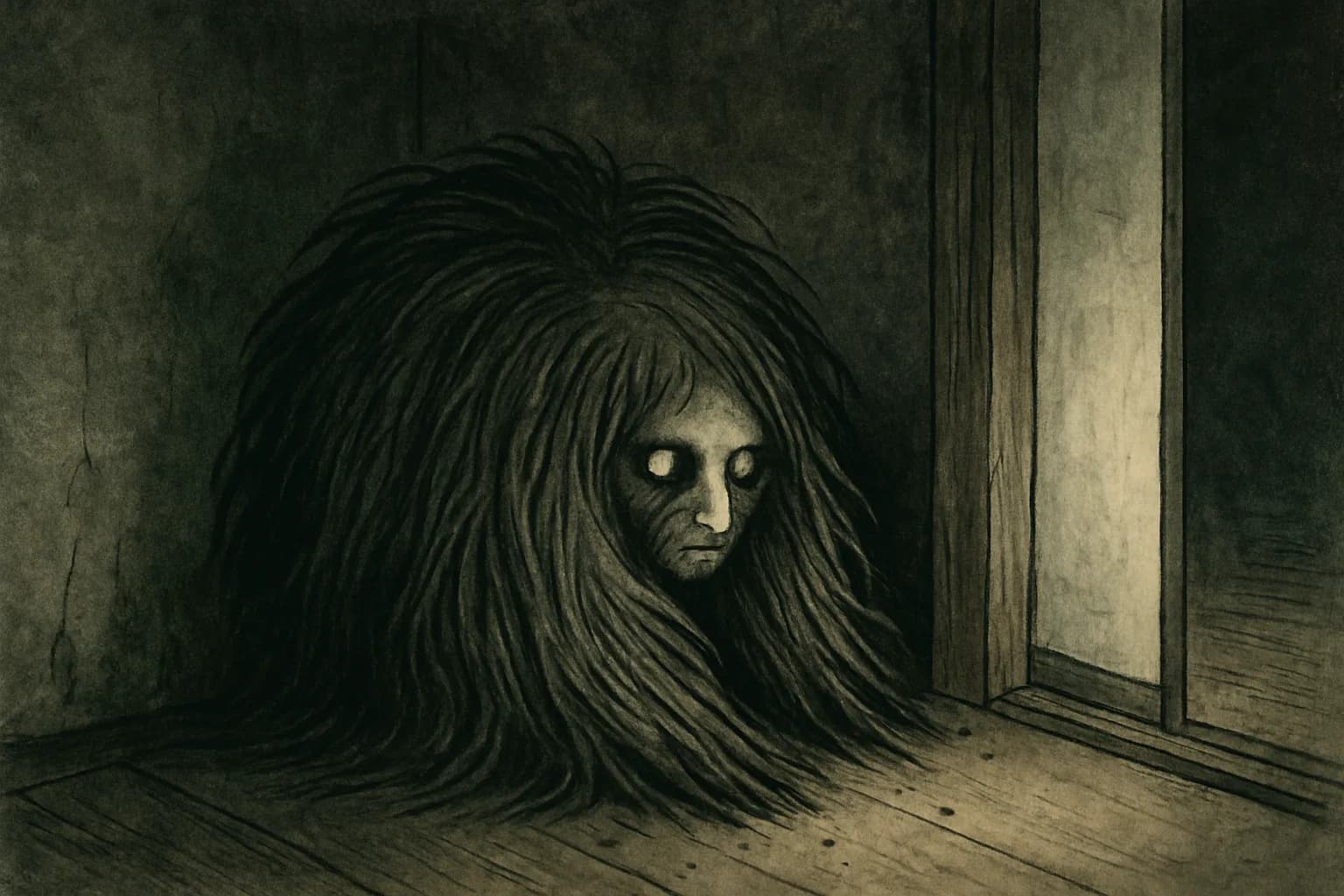
Most yokai announce themselves with a scream, a wet footstep, or a face at the window. Keukegen does none of that. It is a knot of long, matted hair about the size of a small dog, and the closest most households ever came to seeing one was noticing that someone in the family had gotten sick for no clear reason. By the time anyone thought to check under the floorboards, it was already too late to say for certain what had been living there.
What does it look like?
Toriyama Sekien drew the keukegen for his 1781 collection Konjaku Hyakki Shūi (今昔百鬼拾遺, "A Supplement to the Hundred Demons from the Present and the Past"), the third book in his four-volume run of illustrated yokai catalogues. The picture shows a low, four-legged shape entirely swallowed by shaggy fur, more mop or unwashed lapdog than monster, with no visible face and no weapon or claw to speak of. Nothing about the drawing looks dangerous. That is more or less the point — it is built to be mistaken for something harmless, or for nothing at all.
A creature nobody quite sees
Sekien's caption plays on the very sound of the name. Written with the standard characters, けうけげん (keukegen) means something like "the fluffy, hair-covered appearance." Swap in a different set of characters that sound almost the same, and it reads as 希有希見, "a rare thing, seldom seen." The pun does double duty: it describes the matted fur, and it excuses the fact that almost nobody in the source material claims to have actually laid eyes on one. A yokai whose defining trait is being rarely seen is a difficult thing to disprove, which may be exactly why later households found it a convincing explanation for trouble that had no other cause.
The sickness in the walls
The keukegen's territory is the unglamorous underside of a house: beneath the floor, in a neglected garden, in the mildew of a closet that never gets aired out. It favors homes that are already damp, cluttered, or falling out of good repair. Where it settles, tradition holds that the people living above will start to fall ill, one after another, without any obvious source of contagion. The creature itself does no visible harm — it doesn't bite, curse, or drag anyone away. It is simply present, the way mold or bad air is present, and misfortune follows it the way illness follows an unaired room.
That makes the keukegen unusual even among Sekien's more domestic yokai. Where the akaname is a monster invented to shame a dirty bathtub, the keukegen reads more like an explanation of last resort — the thing you blamed once every ordinary cause of sickness in the house had already been ruled out.
Keeping the house clean
Folk logic around the keukegen is straightforward, if not exactly reassuring: a clean, well-kept, sun-aired house has nothing to attract it, and a damp, neglected one does. There's no charm to recite or offering to leave out, no polite bow that sends it away the way one does a kappa. The only defense on record is upkeep — sweeping the corners, clearing out the closets, letting light into the rooms that tend to stay shut. It is folklore doing the work of a public-health notice, dressed up as a monster instead of delivered as advice.
Where it comes from
Little exists about the keukegen outside Sekien's own picture and its accompanying wordplay, and that scarcity is itself telling. Several volumes in Sekien's catalogues are read by folklorists as his own inventions, built to round out a set rather than transcribed from a village's oral tradition — a minor yokai assembled from a pun and a plausible-sounding habitat rather than handed down through generations of storytellers. Whether or not it began as a genuine household superstition before Sekien ever picked up a brush, by the time it reached print it had already taken the shape it kept: an unseen thing, blamed for the ordinary misfortune of getting sick in a house that needed airing out.
Keukegen today
The keukegen never became one of the marquee names of Japanese folklore — it has no cucumber trick, no famous battle, no shrine built in its honor. Its afterlife runs mostly through the same channel as Sekien's other minor entries: modern yokai encyclopedias and illustrated reference books that keep the full four-volume catalogue in circulation, giving obscure figures like this one a second life as an entry to look up rather than a story anyone still tells aloud. It remains, fittingly, exactly what its name promises — a rare thing, seldom seen, mostly known through the picture Sekien left behind.