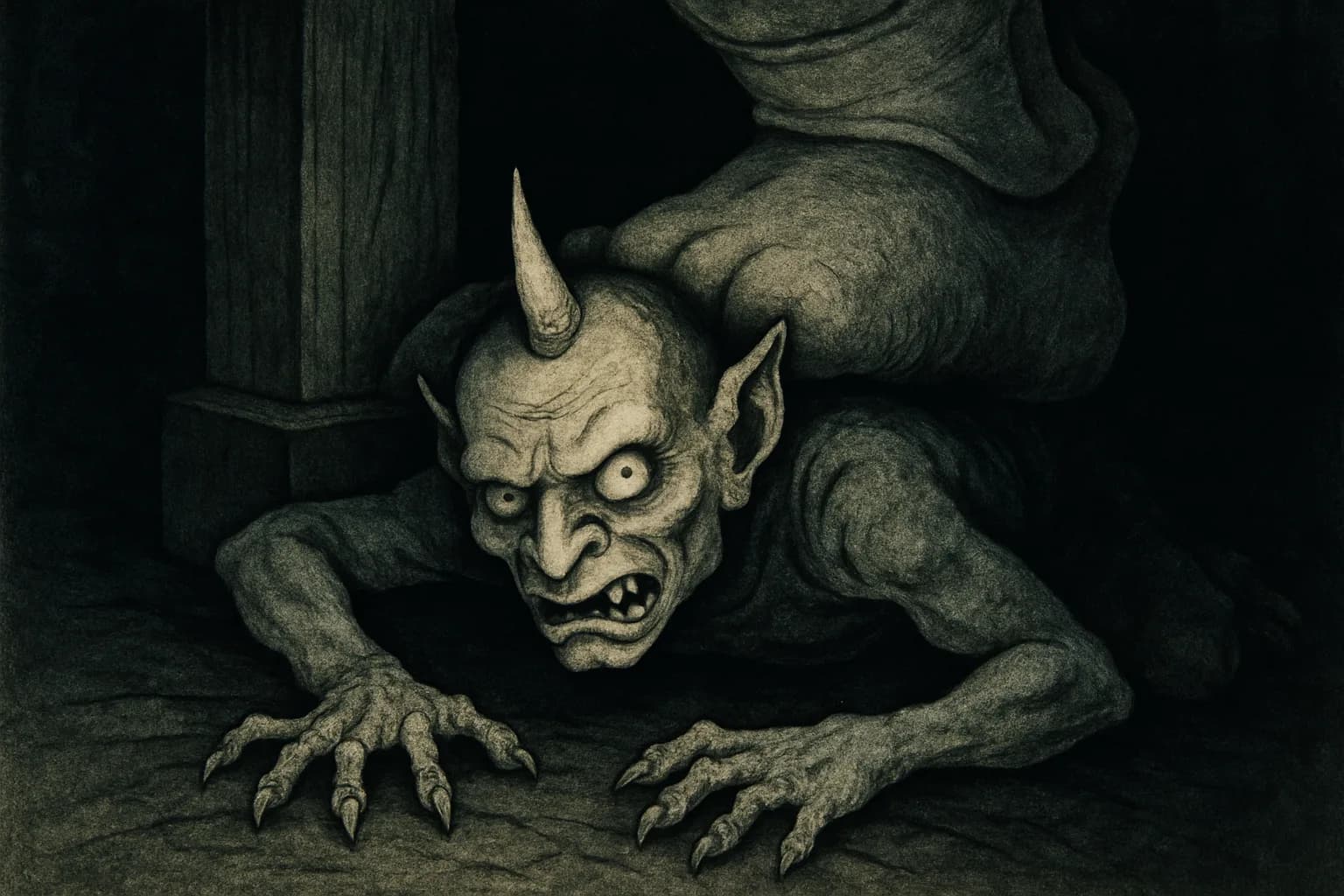
Visit almost any old Buddhist temple in Japan and look down at the feet of the guardian statues flanking the gate — the glaring Niō, or the Four Heavenly Kings standing over the main hall. Underfoot, twisted and pinned into the pedestal, is a small snarling demon taking the full weight of the guardian's sandal. That crushed figure is often labeled a generic jaki (邪鬼), but in living folklore it has a name and a personality of its own: the amanojaku, a demon whose one real power is talking people into doing exactly the opposite of what they intend.
What does it look like?
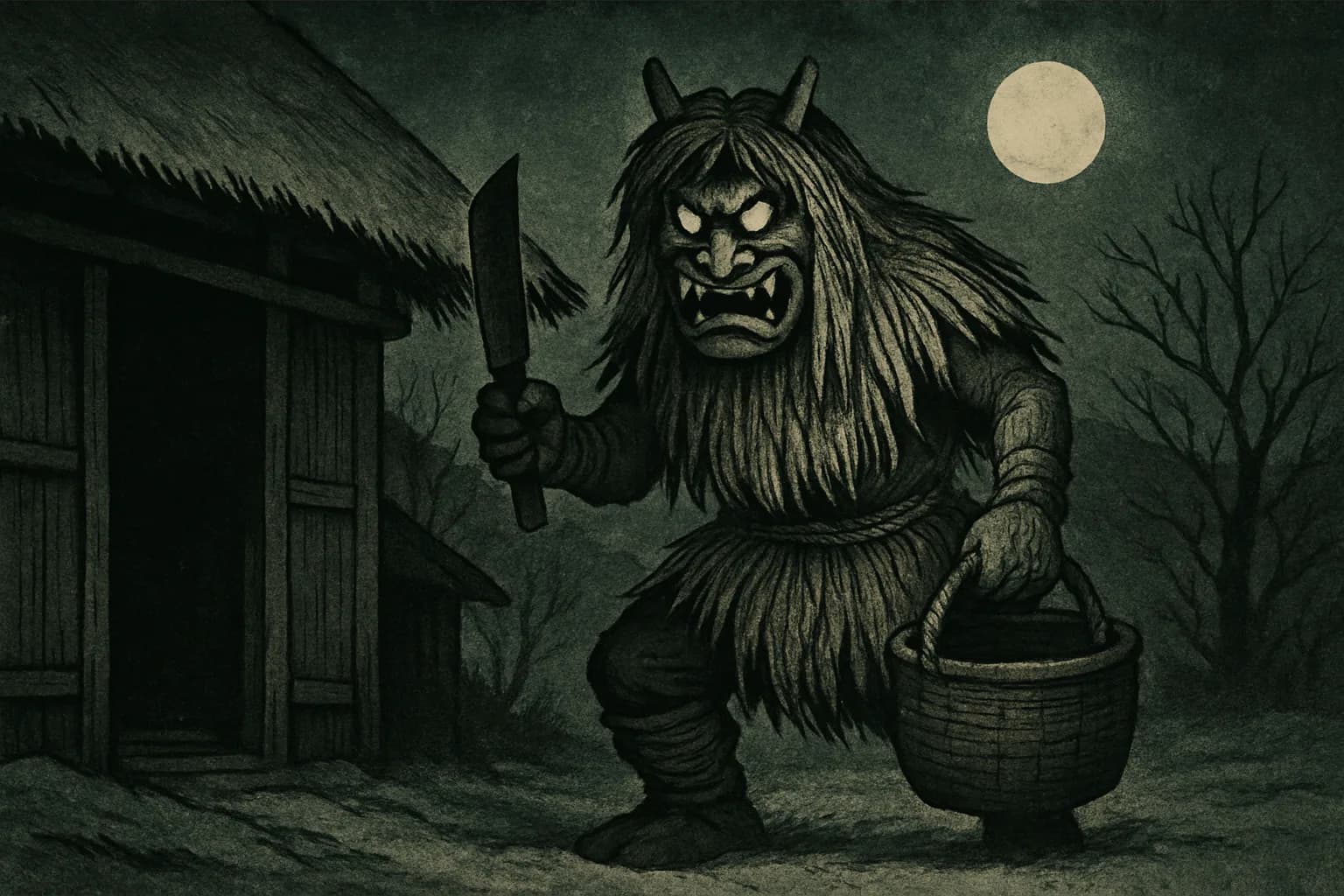
Where the kappa or the tengu have a single agreed-upon shape, the amanojaku is defined more by its posture than its face. In temple sculpture it's a compact, muscular little demon, bare-chested, scowling, caught mid-writhe beneath a guardian king's foot — punishment made permanent in wood and lacquer. In folk illustration and later retellings it's closer to a small oni: red or blue skin, sharp teeth, small horns, an expression somewhere between a smirk and a snarl. It's rarely drawn as frightening in scale. The amanojaku's danger was never its size.
A demon that reads your mind to defeat you
What makes the amanojaku distinct from a plain oni is its method. Folklore credits it with a kind of mind-reading: it senses what a person truly wants, says it out loud in their own voice, and by doing so provokes them into doing the reverse — refusing what they secretly wanted, or wanting what they should refuse. Village sayings describe the amanojaku as the reason a stubborn child says "no" to everything just to be contrary, or the small voice that convinces someone to take the one path they were warned against. It rarely fights. It talks, and lets a person's own contrariness do the damage.
This is also why the word survived the demon. In modern Japanese, amanojaku is an ordinary noun for a person who instinctively takes the opposite stance in any conversation — agrees when everyone objects, objects when everyone agrees — with no folklore attached at all. Most Japanese speakers who use the word day to day have never thought about the demon behind it.
Uriko-hime and the impostor in her skin
The amanojaku's best-known story is Uriko-hime to Amanojaku ("The Melon Princess and the Amanojaku"), an old fairy tale collected across many regions in slightly different forms. An elderly, childless couple find a melon floating down a river or growing in their field; inside is a baby girl, Uriko-hime, whom they raise as their own. She grows into a gifted, beautiful young woman — and an amanojaku, jealous or simply drawn to mischief, lures her out of the house alone, ties her to a tree deep in the mountains, and takes her shape to sit in her place, weaving at her loom or preparing to be married off in her stead. In most tellings the impostor slips, usually caught out by an animal, a bird, or some detail it gets wrong that the real Uriko-hime never would have — and is exposed before the wedding or the theft is complete. The tale was widely reprinted in twentieth-century Japanese folktale anthologies and later animated as one of the hundreds of regional stories retold on the long-running television series Manga Nihon Mukashibanashi, which is how most contemporary Japanese children still meet the amanojaku, not through a temple statue.
Where it comes from
Folklorists generally trace the name back to Amanosagume, a minor deity named in the eighth-century chronicle Nihon Shoki. In that episode, a heavenly pheasant is sent from the high plain of heaven to check on an earthly deity's loyalty; Amanosagume talks the pheasant into a fatal detour, undermining the mission she was meant to support — the first recorded instance of a heavenly figure working, through persuasion rather than force, directly against the outcome everyone else wanted. Over the centuries her name fused with ja (邪), "wicked" or "crooked," and with Buddhist demon iconography imported from the continent, producing both the household word for a contrarian and the specific little demon sculpted underfoot at temple gates — Buddhist art's way of showing that the guardian kings keep base impulse and stubborn wickedness permanently pinned down.
Amanojaku today
Outside the temple gate, the amanojaku has had one of the stranger afterlives of any yokai on this site: it survives less as a monster than as a personality type. Ask a Japanese speaker to describe someone who can't help arguing the other side, and amanojaku is very often the word that comes out, unprompted. The demon also shows up by name as a recruitable, catalogued entry in Atlus's long-running Shin Megami Tensei role-playing game series, alongside hundreds of other mythological figures the franchise draws on rather than invents. But its oldest and most public appearance is still the one nobody has to look up: the small stone figure being stepped on, right at the entrance, at temples most visitors walk past without ever learning its name.