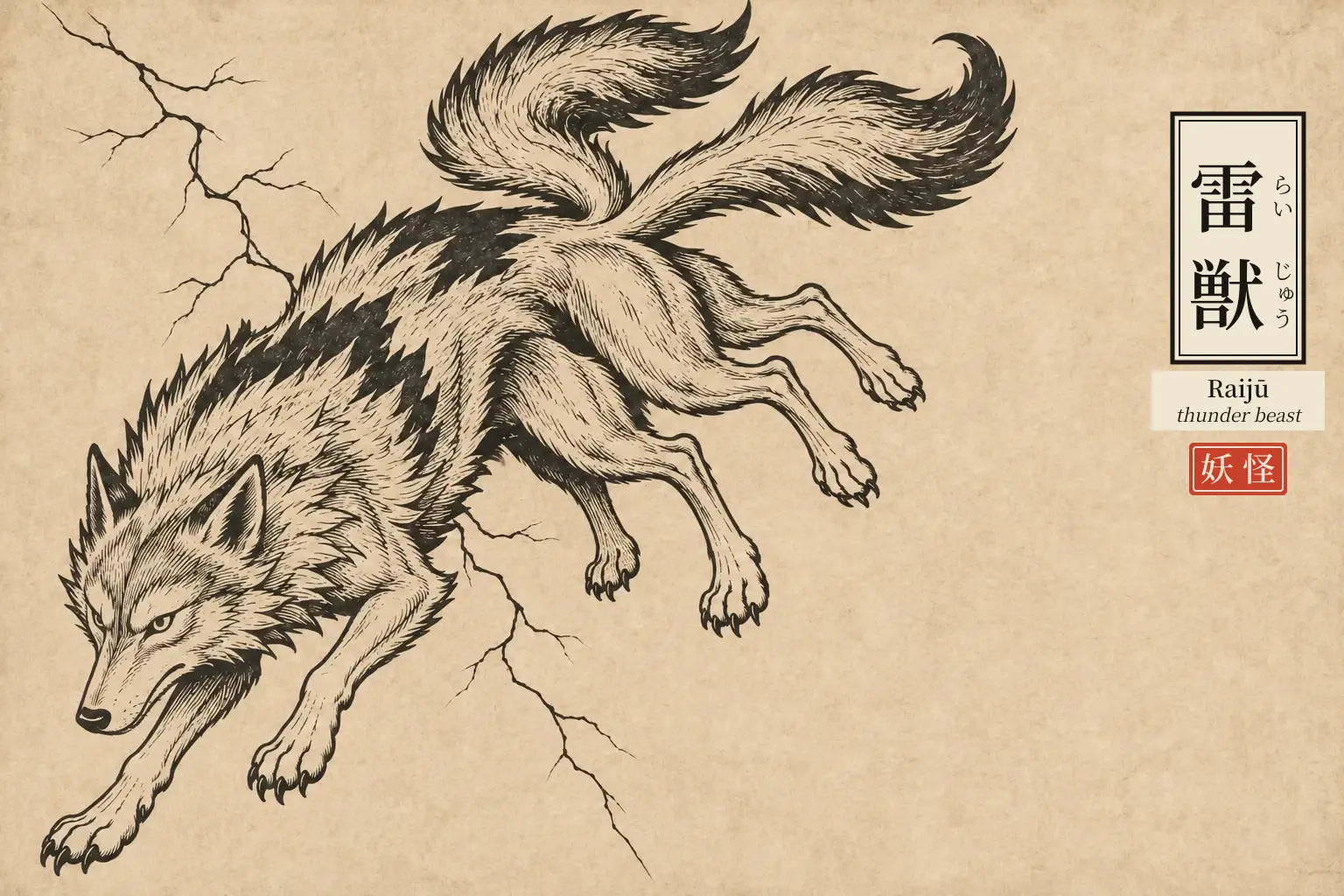
Before Japan had electric light, people argued about what lived above the clouds. Lightning struck, and something fell with it. They called this creature the raiju — written 雷 (rai, "thunder") + 獣 (jū, "beast"), the thunder beast. In the Edo period it was as famous as the kappa or the ningyo. Most readers today have never heard the name.
What does a raiju look like?
Painters and writers across Japan rarely agreed on its shape. Many drew different animals, and called them all raiju.
Kyokutei Bakin's essay collection Gendō Hōgen (1818–1820) draws it wolf-shaped. It has two front legs, four back legs, and a tail split in two. A gazetteer of Suruga province, now Shizuoka, describes a different animal. This one was recorded on Mt. Takakusayama. It was about 60 centimeters long. Its fur was reddish-black, its eyes round, its front toes webbed. Its claws curved sharply inward. Writers in Shinano, now Nagano, called their local raiju a gray puppy. It had a long head and claws as sharp as an eagle's. Other Edo-period essays compare it to a tanuki, or describe fur like a badger's.
West of Kyoto, the raiju changes completely. An 1801 record from Aki province, now western Hiroshima, shows something crab-shaped. Its limbs were plated in scales and tipped with huge pincers. It measured almost a meter long. One surviving caption calls its face "like a crab's" and its claws "like iron." Nothing here matches the gray puppy of Shinano.
Some think raiju was never one creature. It was simply a name for whatever fell from the sky in a storm.
When it fell
Several raiju "falls" were recorded with dates and pictures.
In 1801, one fell into an old well in Aizu, now part of Fukushima. The picture shows sharp fangs and four webbed legs. It measured about 46 centimeters. The next year, a similar creature fell near Chikubu Island in Lake Biwa. In 1806, one fell on the castle town of Akō, now in Hyōgo. That picture shows only the upper body. No one knows whether the artist left off the lower half, or drew it that way from the start.
The most detailed capture came later. In 1909, villagers in Minodani, Toyama, caught a raiju after a storm. A local newspaper, the Hokuriku Times, described a gray, cat-like animal. Loose skin under its forelegs worked like a bat's wing. It glided more than 90 meters. It ate eggs, and climbed trees with sharp claws.
Eighteen years later, in 1927, lightning hit Mt. Ōyama in Kanagawa. Witnesses saw an animal that reacted strangely to every clap of thunder. People said it had to be a raiju.
Catching one, and letting it go
Edo-period Japan had its own rules for a fallen raiju.
In the Kantō region, a lightning strike on a rice paddy meant one thing: raise bamboo. Farmers planted green bamboo poles around the spot and hung shimenawa, sacred straw rope, between them. People believed the bamboo let the raiju climb back to the sky.
One essay, Matsura Seizan's Kasshi Yawa, tells of a man who tried to catch a raiju that fell with a fireball. It scratched his cheek. He fell ill from what the book calls its poison, and took to his bed. The same book credits the painter Tani Bunchō with an odd cure. A servant struck senseless near a lightning strike recovered after eating cornmeal. Bunchō had heard that raiju liked corn too.
At Fuji Shrine in Higashiōmi, Shiga, the story ends differently. Lightning kept striking the village. A traveling yamabushi, a wandering mountain ascetic, blamed a raiju living nearby. He had villagers weave a huge net and set it in the forest. Black clouds gathered. Thunder cracked. A reddish-black, beaked animal appeared on the net. The monk beat it to death with an iron staff, then left. The lightning stopped. Villagers built a shrine on the spot. They first called it Fūjikome, "sealed in." The characters later changed to a homophone, Fuji.
Where it comes from
Before telescopes or aircraft, nobody knew what was above the clouds. One theory says that gap in knowledge grew the raiju legend. People imagined unknown animals living in the sky, falling to earth whenever lightning struck.
Modern writers have their own guesses about what people actually saw. Several note that the raiju's size, sharp claws, and tree-climbing match the Japanese palm civet — an animal too rare in Edo-period cities to have a common name yet. Others blame a startled flying squirrel, mistaken for something fallen from the storm rather than out of a tree. A Shinano showman's "thousand-year weasel," exhibited in Edo's Ryōgoku district, turned out to be an ordinary weasel or badger, altered to look stranger.
One telling of the Heike Monogatari has the archer Minamoto no Yorimasa shoot down a chimera, the nue, over Kyoto. A separate account argues that creature was actually a raiju.
Go deeper
Books worth owning if this world pulls you in.
- The Book of Yokai →Michael Dylan FosterThe most readable scholarly introduction to yokai — where they come from, what they mean, and the major creatures.
- Japandemonium Illustrated: The Yokai Encyclopedias of Toriyama Sekien →trans. Hiroko Yoda & Matt AltThe complete Edo-period bestiaries that so many of these entries trace back to, in full English translation.
Some links are affiliate links; if you buy through them we may earn a small commission at no extra cost to you.
Raiju today
The raiju never became a mascot the way the kappa did. But it left physical traces behind.
A temple called Saisho-ji, in Nagaoka, Niigata, keeps a mummy about 35 centimeters long, cat-shaped, fangs bared, on public display. Its origin is unrecorded. A similar mummy survives at a temple in Hanamaki, Iwate, labeled a raijin, "thunder god." Its limbs are unusually long for a cat, and its skull has no eye sockets.
Sakaiminato, a city built around yokai tourism, put up a bronze raiju statue along its Mizuki Shigeru Road. The novelist Kyōgoku Natsuhiko wrote the creature into a short story, "Kaminari," collected in his folklore-inspired Mae Kōsetsu Hyakumonogatari. Two centuries after Bakin drew his wolf-shaped version, descriptions still don't agree.