In the twenty-seventh year of Empress Suiko's reign, 619 CE, a fishing net in Ōmi Province pulled up something nobody at court could classify. The Nihon Shoki, Japan's second-oldest chronicle, records the catch in a single terse line — a creature that was neither clearly human nor clearly fish. No scales are described, no hair, no face; only the plain fact that it was hauled out of the water and nobody knew what to call it. That unresolved question is still the whole shape of the ningyo, thirteen centuries on.
What does a ningyo look like?
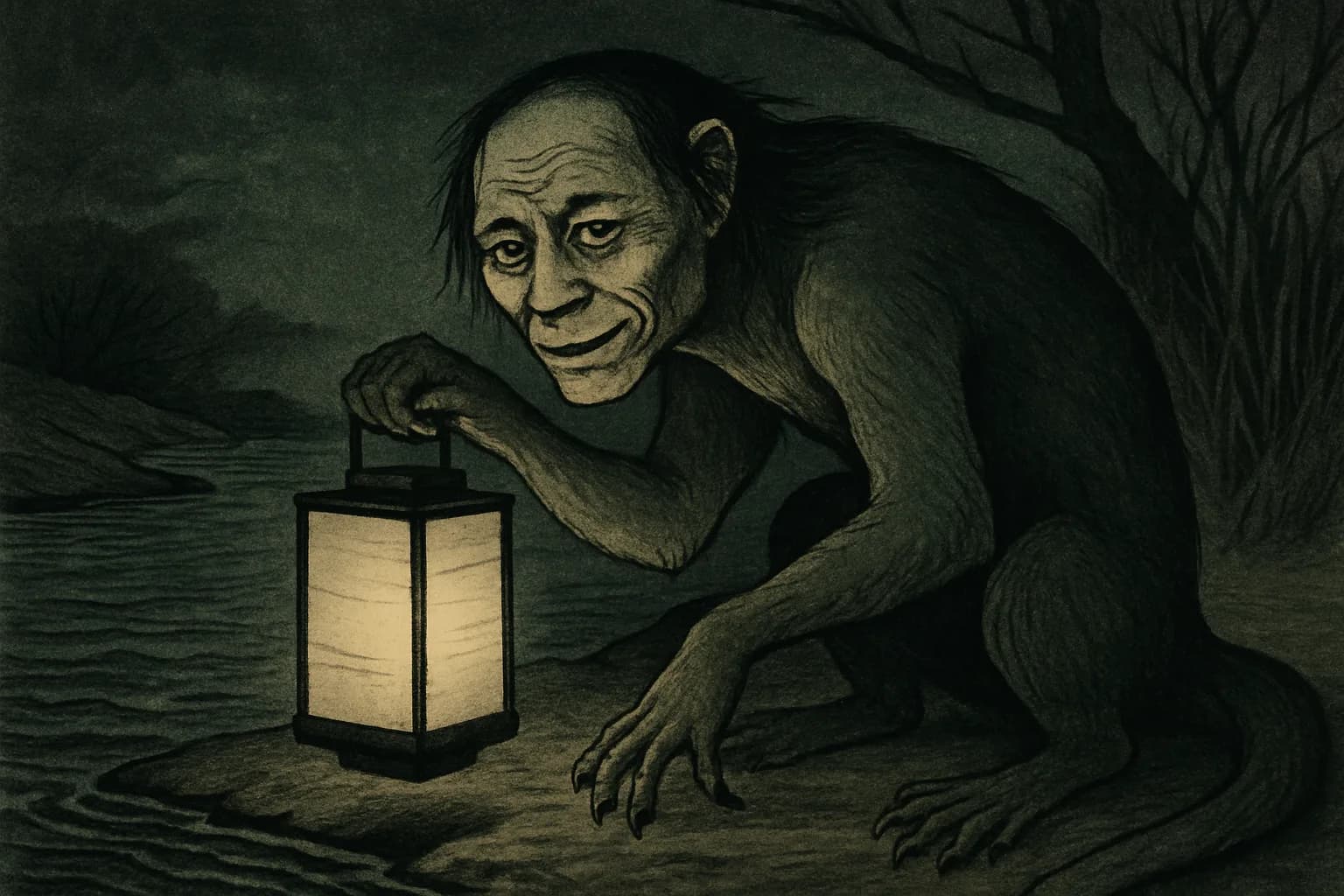
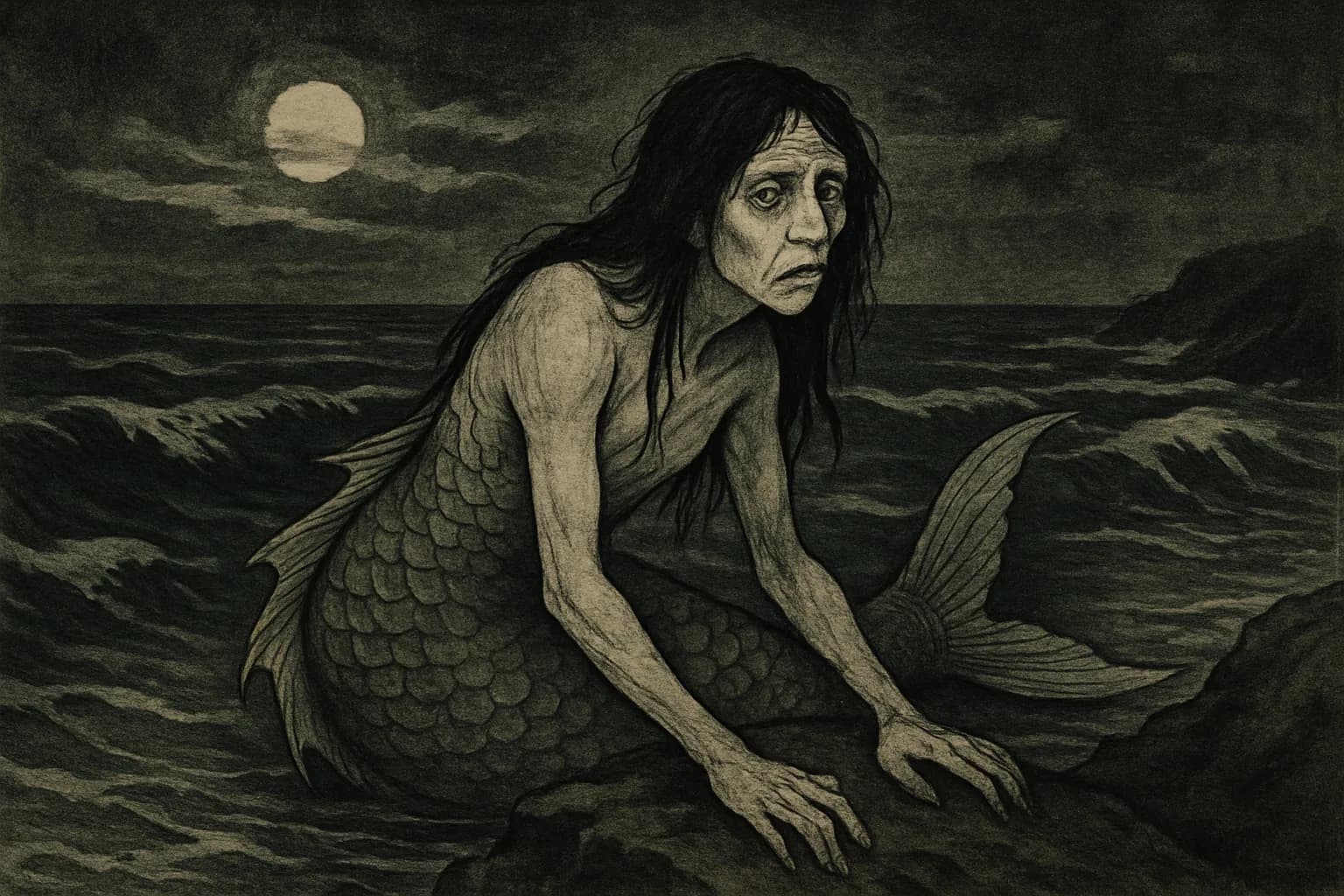
Later sources fill in what the Nihon Shoki left blank, and they don't agree with each other. The Edo-period encyclopedia Wakan Sansai Zue (1712), compiled by the physician Terajima Ryōan, describes and illustrates the ningyo drawing partly on Chinese natural-history texts that catalogued a "human fish" (ren yu) among real and legendary aquatic animals. Most Japanese accounts settle on the familiar shape — a human head and torso tapering into a fish's lower body and tail — but plenty of Edo-period sources reverse the emphasis, giving it a more monkey-like or beast-like face on a fish's body, closer to a deep-sea oddity than a beautiful maiden. Sightings were reported as fact, not fantasy: fishermen's logs and local gazetteers across the coastal provinces recorded ningyo as an actual, if rare, catch.
An omen wrapped in scales
Two contradictory beliefs attach to the same creature. In many fishing communities, netting a ningyo was read as a warning of disaster — storms, poor catches, or worse — and the customary response was to release it immediately and apologize to the sea. Some regional traditions go further, treating a ningyo's appearance the way Kudan's prophecy or Amabie's warning are treated elsewhere: as a sign that hard years are coming. But a second, older strand of belief runs the opposite way. Ningyo flesh, in this version, is not something to fear but something to eat — because it is said to grant an unnaturally long life to whoever consumes it.
The nun who lived eight hundred years
The best-known story built on that second belief comes from Obama, in Wakasa Province (now Fukui). A fisherman is said to have brought home a strange catch and served it at a banquet; his daughter alone ate a piece, not knowing what it was. She stopped aging. Her family and friends grew old and died around her while she remained young, decade after decade, until the weight of outliving everyone she loved led her to become a Buddhist nun. She is remembered as Yao Bikuni — the "eight-hundred-year nun" — and local tradition holds that she spent her long life traveling the country planting camellia trees before finally walking into a cave near Obama and never emerging again. Shrines and camellia plantings tied to her travels are still pointed to in several prefectures.
Mummies for sale
By the Edo period, demand for physical proof of ningyo had created its own industry. Craftsmen stitched together the upper body of a small monkey and the tail of a large fish, dried and reinforced the join, and sold the result as a genuine ningyo mummy — ningyo no miira. Temples displayed them as treasures and occasionally as objects of prayer; apothecaries sold shavings from them as medicine. The trade didn't stay in Japan. One such mummy, passed through Dutch traders and sailors, is widely reported to have eventually reached the Boston showman Moses Kimball, who leased it in 1842 to P.T. Barnum — who exhibited it as the "Feejee Mermaid," one of the most famous hoaxes in American entertainment history, its actual manufacture almost certainly Japanese.
Where it comes from
Folklorists generally treat the ningyo as a case where a real, if unfamiliar, sea creature — a dugong, an oarfish, a seal glimpsed at an odd angle — met an existing continental tradition of human-fish hybrids and was absorbed into it. The Wakan Sansai Zue's reliance on Chinese sources shows the borrowing directly: Japan already had its own reported sightings, like the 619 catch, but the vocabulary and expectations for describing a "human fish" arrived partly from the mainland and shaped how later witnesses described what they saw.
Ningyo today
In 2022, researchers at Kurashiki University of Science and the Arts ran a mummy long kept at Enjuin, a temple in Okayama Prefecture, through CT scans and forensic analysis. It turned out to be built from fish parts, mammal teeth, human hair, cotton, and paper, with no monkey remains at all — a slightly different recipe from the standard Edo-period pattern, but the same basic trick, still holding up as an object of study four centuries later.