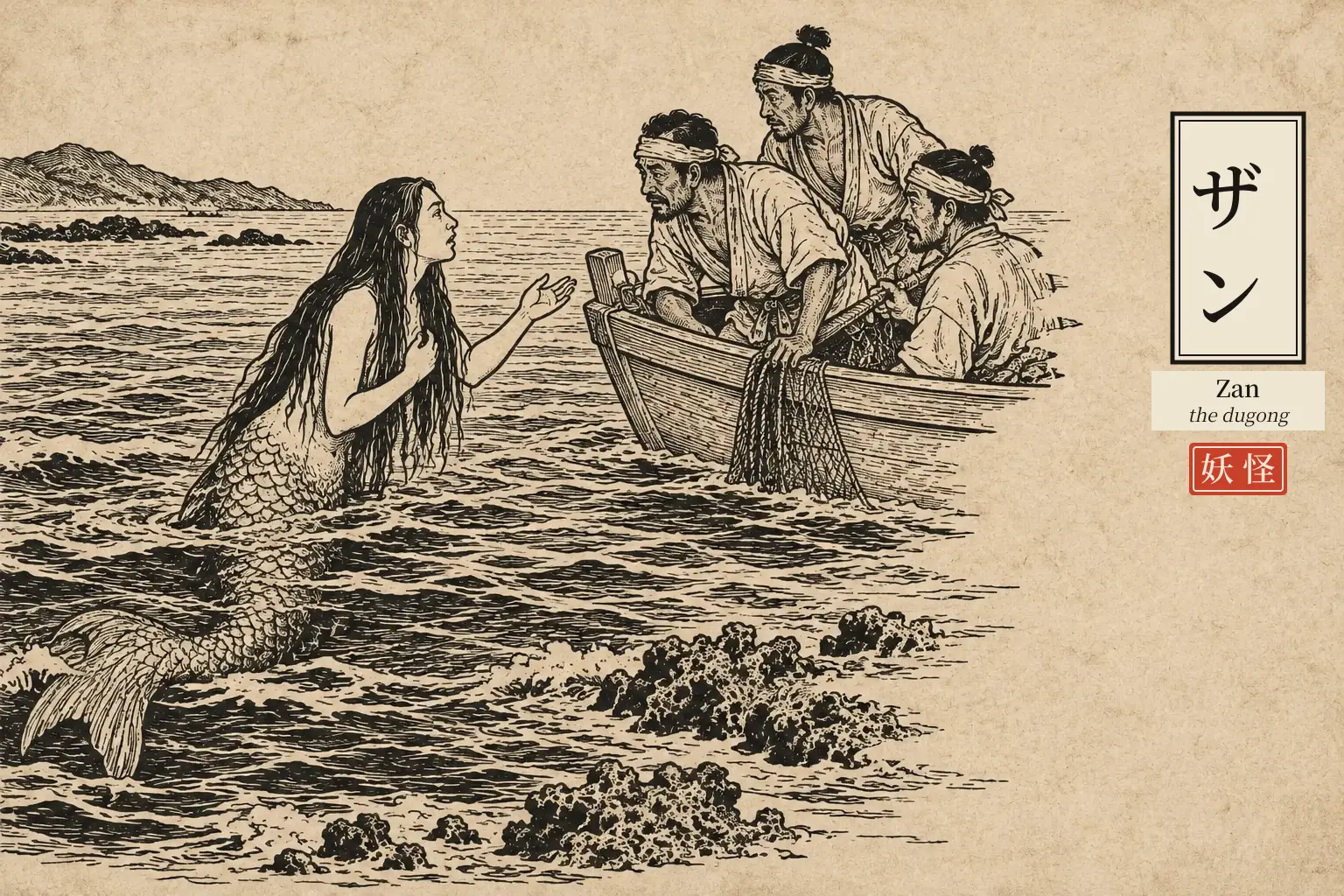
Off the reefs of Okinawa and the Amami Islands, fishermen once told of a creature that could do what no fish can: speak, beg, and warn. They called it zan (ザン). In most tellings it is simply a legendary fish, or the real-life dugong. In the islands' best-known story, it is a true mermaid, and the thing it is most famous for is saving an entire village from a tsunami — by warning it before vanishing back into the sea.
What does a zan look like?
Descriptions of the zan split into two layers. In everyday oral tradition across Okinawa, a zan is simply described as a fish, often identified outright with the dugong, the gentle sea mammal that still grazes seagrass beds in these waters. Older folklorists also recorded another name for it, zan no io — "fish of the zan."
But in the tsunami legend recorded on Ishigaki Island, the zan is a ningyo, a mermaid: the upper body of a beautiful woman, the lower half a fish's tail. This is the image the story needs. A dugong cannot speak. A mermaid can.
A related account from Amami Ōshima describes a fish with a face just like a human's that surfaces beside fishing boats, shows itself once, and sinks again — always followed by a storm. The Amami folklorist who recorded it called it chunchirayu and guessed, in his own book, that it might be a dugong or a mermaid. Later reference books, including a major yokai encyclopedia, treat chunchirayu as simply another name for zan. The sources do not fully agree on this; the two names may describe one creature seen two ways, or two creatures folklorists later merged.
A catch you cannot bring home
Okinawan oral tradition carries a strict rule about zan. If fishermen find one that has swum into the shallows and catch it, they must never carry it back to the house to cook. Breaking this taboo is said to kill the household's wife, or bring disaster on a family member at sea. The only safe way to eat a zan is to clean and cook it right there on the beach.
The rule treats the zan less like ordinary prey and more like something owed a debt. That idea becomes explicit in the islands' most famous zan story.
The night Nosoko village listened
The tale comes from the village of Nosoko on Ishigaki Island, now part of Ishigaki City, in the Yaeyama Islands. One night, young men — among them three fishermen — were out on the beach when they heard a woman's voice calling from across the water. The three fishermen rowed out the next morning to find out whose voice it was, and cast their net toward where it had come from. They pulled up a zan.
Delighted, they prepared to carry their catch home. But the zan wept and begged. It told them plainly: it could not live outside the sea. Moved, the fishermen let it go.
The zan did not swim off without a word. As thanks for its life, it warned the three that a tsunami was coming, and told them to flee to the mountains at once. Then it vanished beneath the waves.
The fishermen ran back to the village and spread the warning. Nosoko's people, however uneasily, believed them and climbed toward higher ground. In the neighboring village of Shiraho, no one believed the strange story, and nobody moved.
That evening, black clouds gathered on the horizon. Then a wall of water came in from the open sea. Nosoko's villagers, already on the mountainside, survived. Shiraho's did not.
Local tradition ties this story to a real disaster: the tsunami of the Great Yaeyama Earthquake, which struck on April 24, 1771 — the Meiwa Great Tsunami.
Where it comes from
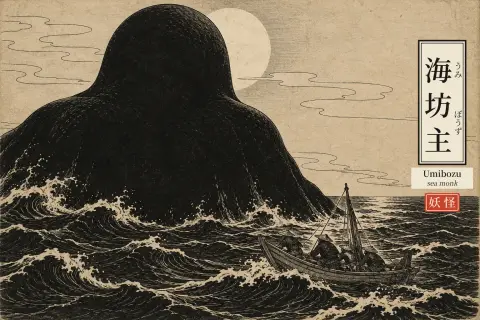
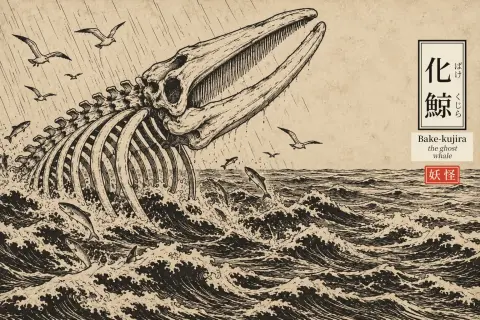
Coastal Japan is full of sea creatures that foretell disaster, from the surfacing umibozu that is said to swamp boats to the whale-ghost bake-kujira that drifts past ships trailing birds and misfortune. The zan belongs to this same family of ocean omens, but its warning runs the other way: instead of bringing harm, it prevents it, and only because someone chose mercy over a meal.
One way to read the Nosoko story is as a tsunami memory wearing a folktale's shape. Okinawa and the Yaeyama Islands sit on a coastline with a long history of tsunamis, and a story that teaches "listen to the warning, even an unlikely one" survives for practical reasons as much as spiritual ones. The zan, in that reading, is less a monster to fear than a go-between — a sea creature that pays its debts, if you let it.
The eating taboo points the same direction. A creature you must thank, release carefully, or never bring fully into the human world is a creature the community still half-reveres, even while treating it as ordinary seafood the rest of the time.
Go deeper
Books worth owning if this world pulls you in.
- The Book of Yokai →Michael Dylan FosterThe most readable scholarly introduction to yokai — where they come from, what they mean, and the major creatures.
- Japandemonium Illustrated: The Yokai Encyclopedias of Toriyama Sekien →trans. Hiroko Yoda & Matt AltThe complete Edo-period bestiaries that so many of these entries trace back to, in full English translation.
Some links are affiliate links; if you buy through them we may earn a small commission at no extra cost to you.
Zan today
Most of what survives of zan is oral tradition and a handful of twentieth-century folklore collections. One modern trace is musical rather than visual: in 2006, the singer Cocco named her fifth album Zansaian, blending zan with the English word cyan. The title is said to mean "the true blue a mermaid saw," and its cover uses mermaid and blue imagery Cocco assembled from cut Okinawan dyed cloth.
The dugong itself is a real animal that has outlived the legend built around it, grazing the same Okinawan seagrass beds it always has.