Every court needs a judge who cannot be lied to. Japan's underworld has one: Enma (閻魔), the king who presides over hell and tries every soul that reaches him. He is not originally Japanese at all. He arrived from India, by way of China, carried in on the back of Buddhism itself — and the Japanese afterlife has run on his verdicts ever since.
What does Enma look like?
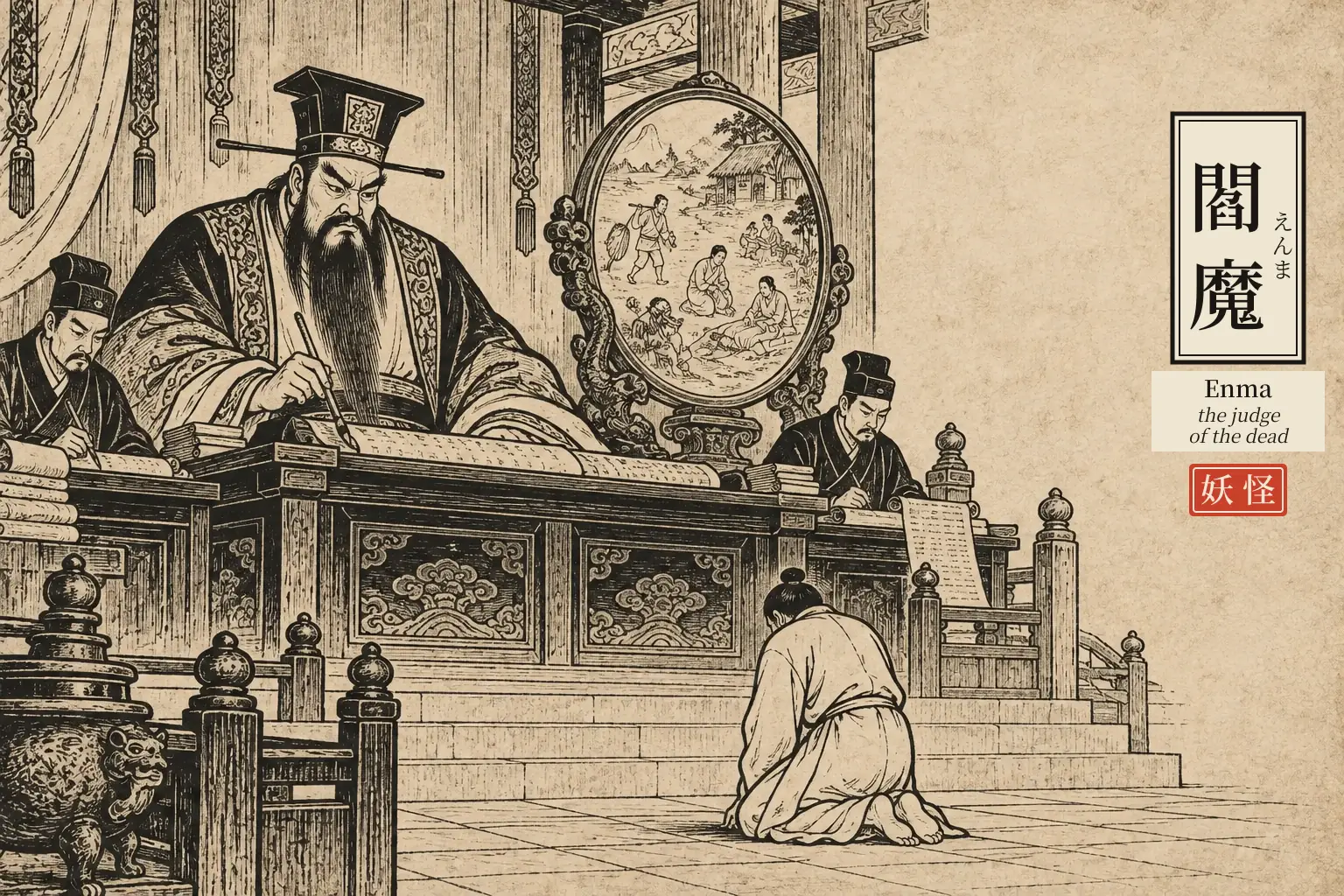
Enma holds court like a magistrate, not a monster. He sits in the robes of a Chinese government official, a style called a dōfuku. That look was fixed centuries ago in China, when Enma merged with Taishan Fujun, a Taoist judge of the dead who ruled over Mount Tai. The same robed hell-court shows up in chapter 3 of the classic Chinese novel Journey to the West, when the trickster Sun Wukong storms the underworld and crosses his own name off its register of life and death.
Two clerks sit at Enma's sides: Shiroku and Shimyō. They keep the records and assist his judgments. But his real instrument of judgment is a mirror, the Jōhari no Kagami. It plays back a dead person's whole life on its surface, like a screen. Lie to Enma, and the mirror shows the truth before you finish the sentence.
Not every Enma looks like this. In Tibetan Buddhism, the same deity is called Yama Dharmaraja, and he looks far fiercer: black-skinned, buffalo-faced, standing above a buffalo with a skull-topped staff in one hand and a lasso in the other. His consort Chamundi stands beside him, holding her own trident and a skull cup full of blood. Japan never took on that wrathful face. It kept the quieter one — a judge in an official's robe, flanked by paperwork.
A name that was never meant to mean anything
Enma's name hides a small trick. 閻魔 looks like two kanji chosen for their meaning — 閻 (en), which on its own means the gate of a village, and 魔 (ma), "demon." Nobody actually picked them for that. Enma is an ongyaku, a sound-only transliteration of the Sanskrit and Pali word Yama. Buddhist translators needed characters that sounded right, not ones that meant anything. The fuller, more formal name is Enma Daiō, "Great King Enma." Enra-ō and simply En are shorter versions of the same borrowed word.
From a Vedic god to the ruler of hell
In the old hymns of India, Yama was just the lord of the dead. Buddhism absorbed him, and by one account split him into two separate gods. One kept the dark underworld and became Enma. The other was given a bright heaven instead, and became a different figure called Enma-ten, despite the shared name.
The underworld half of Yama traveled east into China. There he merged with Taishan Fujun, and together the two became the core of a new cult: the Ten Kings, a panel of ten judges who rule on a soul's fate in stages after death. A Chinese apocryphal sutra from the late Tang dynasty wrote this belief down and made Enma one of its two central judges.
Where it comes from
Two books did the most to spread Enma's worship in Japan, a few centuries apart. Enma already appears in older Japanese tales, such as the Nihon Ryōiki. The first was Genshin's Ōjō Yōshū, written in 985. It spread a vivid fear of hell alongside a longing to escape it through rebirth in a pure land, reaching nobles and commoners both, and it shaped Japanese literature for generations afterward.
The second was the Jizō Jūō Kyō, an apocryphal sutra composed in the early Kamakura period. It made one striking claim: that the gentle bodhisattva Jizō was secretly Enma's true, underlying form. That idea did a lot of work at once. People could pray to the kind, child-protecting Jizō while still fearing the stern judge Enma, because the two were now understood as one being wearing two faces. Ten Kings worship, Enma included, spread much further after that.
Go deeper
Books worth owning if this world pulls you in.
- The Book of Yokai →Michael Dylan FosterThe most readable scholarly introduction to yokai — where they come from, what they mean, and the major creatures.
- Japandemonium Illustrated: The Yokai Encyclopedias of Toriyama Sekien →trans. Hiroko Yoda & Matt AltThe complete Edo-period bestiaries that so many of these entries trace back to, in full English translation.
Some links are affiliate links; if you buy through them we may earn a small commission at no extra cost to you.
Enma in legend
A few Japanese stories put a human face on Enma's courtroom. The Heian-period courtier Ono no Takamura was said to slip away at night and serve as an assistant judge under Enma, then return each morning to his ordinary post at the imperial court. Centuries later, the Sengoku-period warlord Naoe Kanetsugu left behind a stranger story still: a letter, addressed directly to Enma Daiō, asking for a dead man to be sent back to the world of the living.
His halls still stand. A set of Kamakura-period wooden statues at Hōshaku-ji, a temple in Ōyamazaki, Kyoto Prefecture, shows Enma seated in court with Shiroku and Shimyō beside him; it is a National Important Cultural Property. Across in Naniwa Ward, Osaka, Saihō-ji's Enma hall is said by tradition to trace back to Prince Shōtoku. It later became the setting of the kabuki and puppet play Sesshū Gappō-ga-tsuji.
Enma in Japan today
Enma's courtroom habits outlived the religious fear that built them. Japanese teachers still nickname the notebook where they log a student's grades an enma-chō — an "Enma ledger" — because it holds exactly the kind of permanent record kept in his courtroom.
He also still runs hell, just for laughs now. In the long-running manga and anime Hoozuki no Reitetsu, Enma Daiō is the boss, but the real story follows his chief aide Hōzuki, who manages an underworld worn thin by a postwar population boom and an endless supply of furious ghosts. The series leans on Enma's traditional role as hell's chief judge, then spends most of its time on the clerk who actually keeps that office running.