Look into an old mirror long enough, the thinking went, and it starts to remember. Every face it has ever caught stays behind the glass somewhere, and after a hundred years of catching faces, a mirror might decide it no longer needs yours. The ungaikyō (雲外鏡) is that thought given a body: a stand-mounted looking-glass, mischievous and a little smug, that has quietly stopped being a mirror and started being something that merely looks like one.
What does it look like?
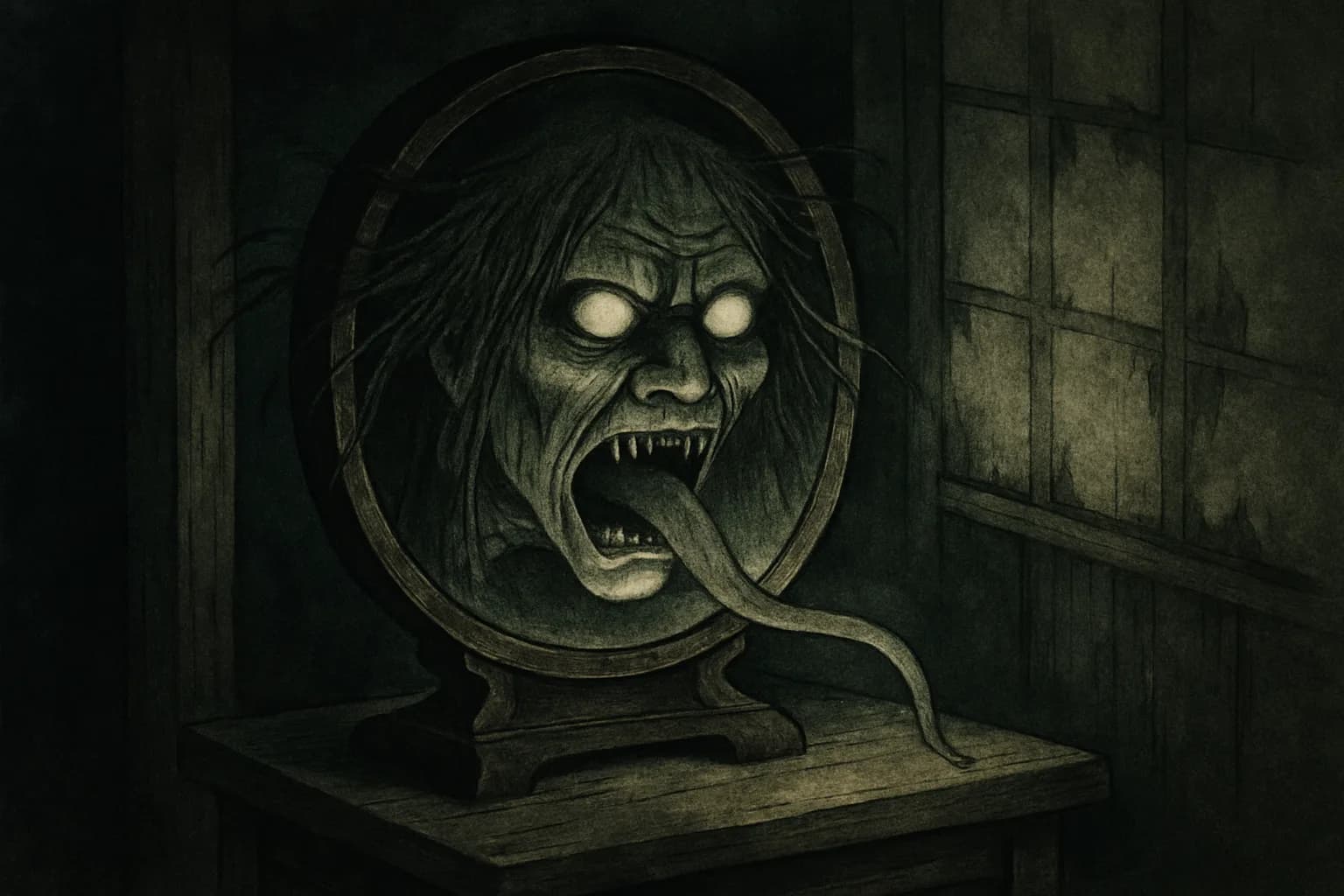
Toriyama Sekien drew the ungaikyō as an antique mirror on a slender wooden stand, exactly the kind of vanity fixture that would have stood in a well-off Edo household — except that its surface holds a face. Sekien gave it a sly, mischievous expression, tongue stuck out at the viewer, more prankster than monster. It doesn't grow limbs or crawl off its stand like some tsukumogami, the spirits of long-used tools; its whole menace sits in the glass itself; in what it chooses to show you and what it doesn't.
A mirror that remembers too much
The ungaikyō belongs to the tsukumogami — everyday objects that, after a hundred years of use, acquire a spirit of their own. Sekien collected it into his Hyakki Tsurezure Bukuro (1784), a book devoted almost entirely to household tools waking up: umbrellas, lanterns, sandals, and this mirror among them. But Sekien didn't just draw it and move on. He attached it to an idea already old by his time.
Chinese legend told of a shōmakyō — a "demon-revealing mirror" with the power to strip a disguise away and show a monster's true shape reflected back at it. The most famous story built around it concerns Daji, the favored consort of the last king of the Shang dynasty, whose reflection in such a mirror exposed her as a nine-tailed fox spirit wearing a human face. In the version of that legend that traveled into Japanese storytelling, the exposed fox fled across the sea and resurfaced centuries later at the imperial court as Tamamo-no-Mae.
Sekien's own note on the ungaikyō takes that legendary mirror as a starting point and asks a quieter question: what if a mirror held onto the monsters it once showed? His caption only wonders, as if in a dream, whether those reflected monsters stayed inside the glass. Later writers added the hundred-year idea. The demon-revealing mirror is the ungaikyō's distant, grander ancestor — not a myth it re-enacts, but a myth it grew out of by association, one reflection at a time.
What it does to whoever looks in
Sekien's caption describes no such behavior, but modern retellings say an awakened ungaikyō controls its own reflections. A person checking their appearance might find the glass showing them a warped, monstrous version of their own face, or a scene from somewhere else entirely, or the countless other faces the mirror has swallowed over its long life looking back out instead of their own. It doesn't lunge or bite; the unsettling part is that a mirror is supposed to be the one object in a room that tells the truth without opinion, and this one has opinions.
Where it comes from
Read against the broader tsukumogami tradition, the ungaikyō fits a pattern that runs through Sekien's four picture-book collections: a tool that has served faithfully and been looked into, opened, or handled for a century earns a kind of standing most objects never get, and starts acting with a will of its own. Mirrors carried extra weight in that logic. In Shinto practice a mirror can stand in for a kami's presence at a shrine, and the polished bronze mirrors of earlier centuries were valuable, rare, almost ritual objects long before glass ones became common furniture. An object treated with that much reverence for that long was exactly the kind of thing Edo-period audiences could believe might eventually reflect something back.
Ungaikyo since Sekien
The ungaikyō stayed a minor figure in yōkai art for most of two centuries, revived mainly through Sekien's own woodblock print and the reference books that reproduced it. It reached a wider audience in Daiei's 1968 film Yōkai Daisensō (Spook Warfare), though the version on screen there took considerable liberties — it appears as a tanuki-like creature that projects images from its stomach rather than Sekien's stand-mounted glass, a design choice from the film rather than anything found in the original woodblock print. The mirror as Sekien actually drew it — quiet, self-satisfied, and full of faces that aren't yours — remains the version worth knowing.