A koto left in a corner does not scream when it is forgotten. In Toriyama Sekien's print, it grows a face instead — a wooden zither warped into a fixed, staring expression, its own style of music slipped out of living memory. This is Koto-furunushi (琴古主), and its grievance is unusually specific: it isn't mourning neglect in the abstract, it's mourning the fact that almost nobody in Edo could still say what its music actually sounded like.
What does it look like?
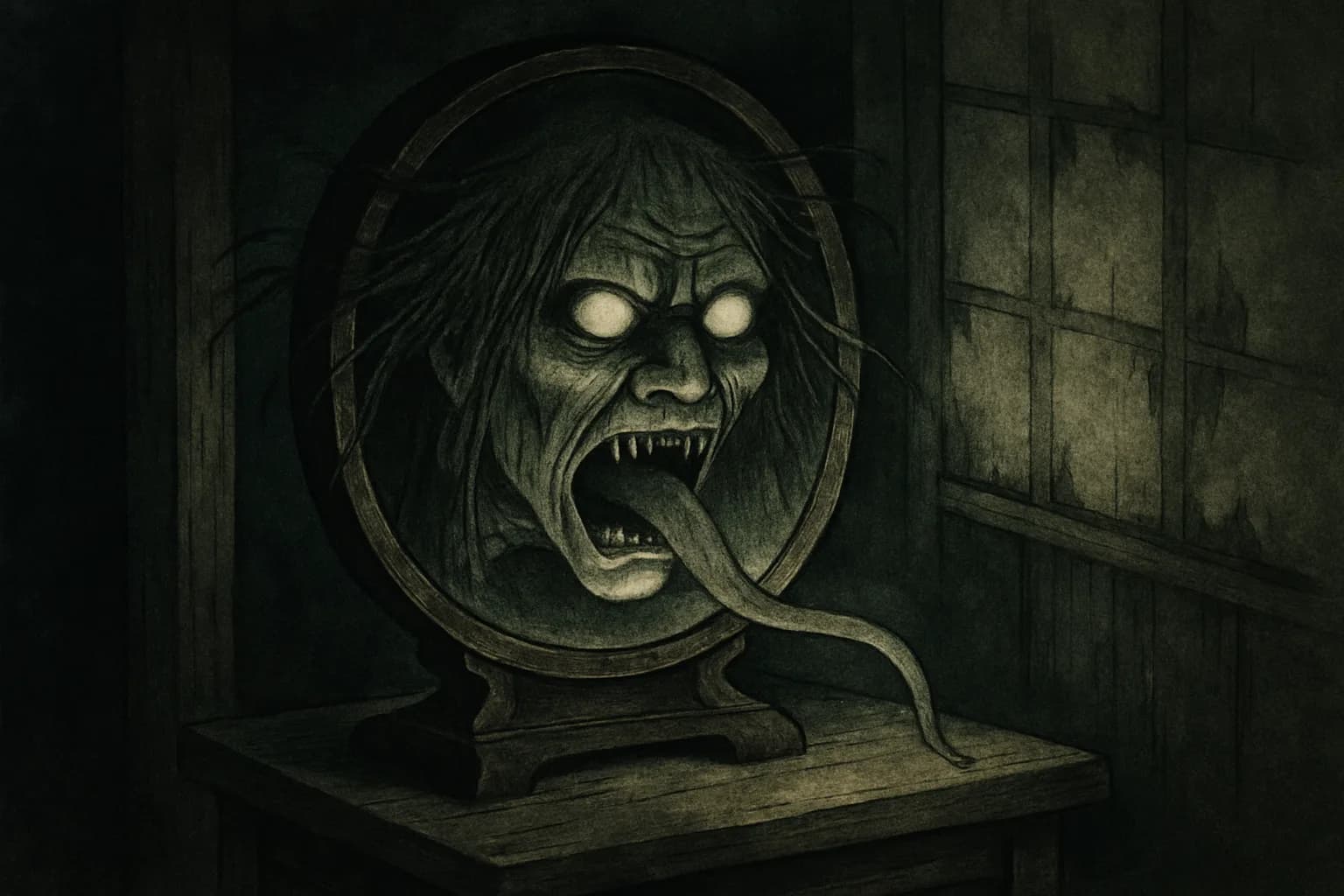
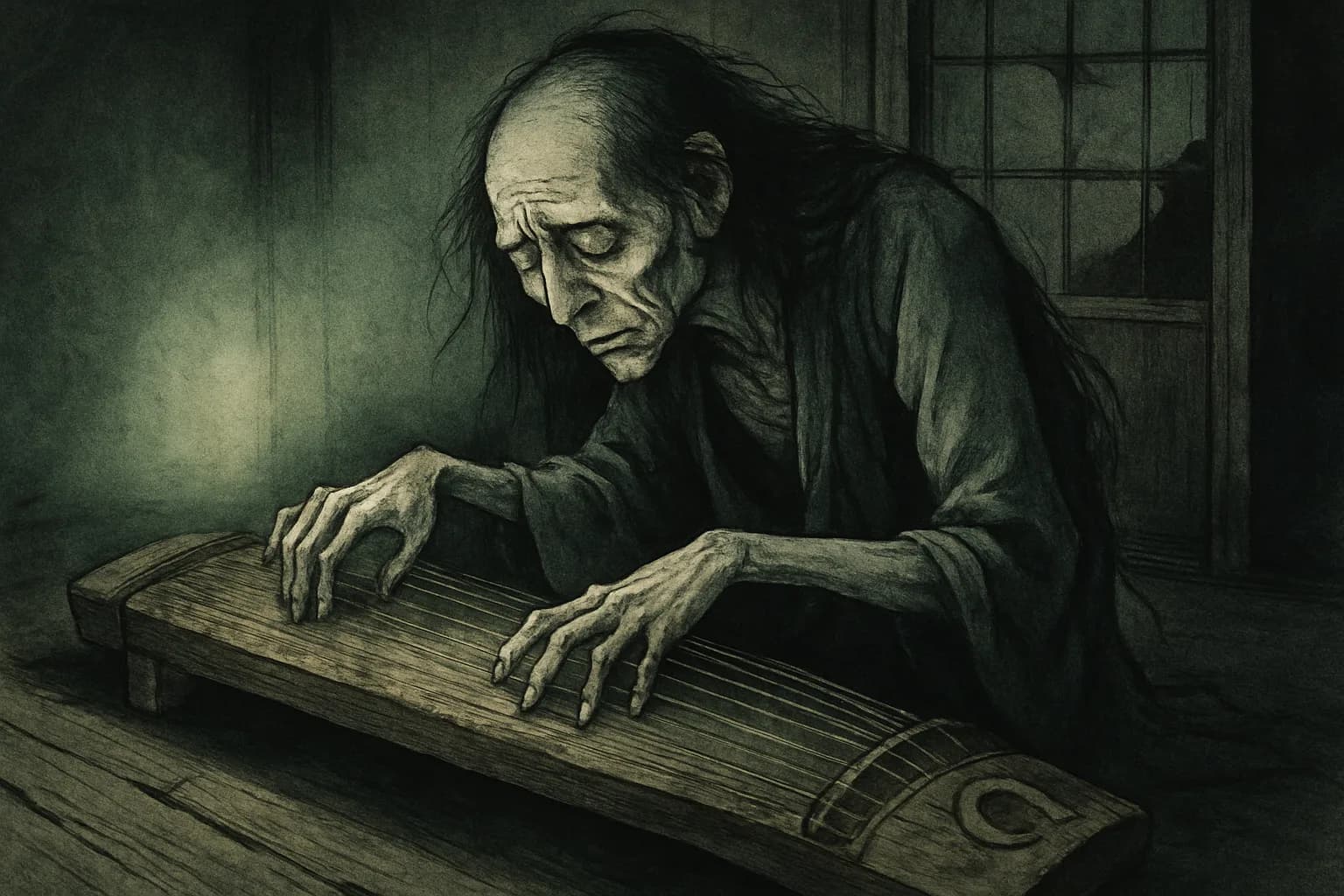
Sekien draws the instrument itself as the monster, with no human body grafted on. A pair of eyes and a mouth have opened up on the wooden soundboard of an old koto, and its thirteen strings, once carefully tuned, now splay outward in every direction like matted, uncombed hair. It has the look of something that used to be handled with care and has since been left to warp — an object still recognizably a koto, just wrong in a way that catches the eye before the mind places why.
A style that became a name only
Sekien's own caption explains exactly what this particular koto is grieving, and it is more precise than ordinary neglect. The instrument is a Tsukushi-goto (筑紫箏), tied to a specific school of koto performance rather than the instrument in general, and Sekien writes that it has become na bakari — "a name only" — because so few people left even knew its sound or character. The yokai's monstrous face is the resentment of a whole musical tradition, not just one abandoned object.
Tsukushi-goto was real. It was founded in the late sixteenth century by Kenjun, a Buddhist priest at a temple in Kurume, in what was then Chikugo province on Kyushu — "Tsukushi" being the old name for that part of the island. Kenjun drew on temple liturgical music and on koto technique he learned from a visiting Chinese musician to build a restrained, formal solo style, closer in spirit to court music than to entertainment. It should have been the foundation of koto music as Japan came to know it. Instead, one of Kenjun's own students, Yatsuhashi Kengyo, adapted and popularized the style into what became the mainstream Yatsuhashi school — the koto tradition still taught today — and the parent style it grew out of receded into obscurity. By Sekien's time, two centuries later, Tsukushi-goto was a footnote to its own successor.
An older pairing, revived
Sekien did not invent the idea of a koto-spirit from nothing. His own notes point to the Hyakki Yagyo Emaki, a Muromachi-period picture scroll of parading yokai, in which a koto-spirit already appears being led along by a biwa-spirit. Sekien revived that centuries-old pairing directly: Koto-furunushi and Biwa-bokuboku, the sorrowful lute-spirit, sit on the same page of the same volume, two forgotten instruments grieving side by side rather than one lone haunted object. Where Biwa-bokuboku mourns a specific silence — an owner who never came back — Koto-furunushi mourns something more like an extinction: a whole way of playing that nearly nobody could still recognize by ear.
Where it comes from
Koto-furunushi appears in Hyakki Tsurezure Bukuro (百器徒然袋, 1784), the fourth and final volume of Toriyama Sekien's yokai print tetralogy, in its second of three sections (jo, chu, ge). The book's title is itself a small joke: "hyakki," normally written with characters meaning "hundred demons," is instead written with characters meaning "hundred vessels," signaling from the cover page that this volume is devoted almost entirely to tsukumogami, the animate objects, rather than to gods or ghosts. Sekien was, by this point in his career, working from a well-stocked private library of older yokai scrolls and folk compendia, and Koto-furunushi is one of several entries in the book that reach back past his own century for source material rather than inventing wholesale.
Koto-furunushi since Sekien
Unlike Sekien's more famous inventions, Koto-furunushi never developed an independent life outside yokai reference books and print collections — there is no local shrine, no folk custom, no cucumber-offering ritual attached to it the way there is for the kappa. It survives mostly as a matched pair with Biwa-bokuboku, the two musical tsukumogami reprinted together in modern yokai encyclopedias much as they first appeared on Sekien's page. What keeps it interesting is less the monster than the history it accidentally preserved: a two-hundred-year-old joke about a koto style so thoroughly eclipsed by its own descendant that, by the time anyone thought to draw its ghost, most readers would have needed the caption to know it had ever existed at all.