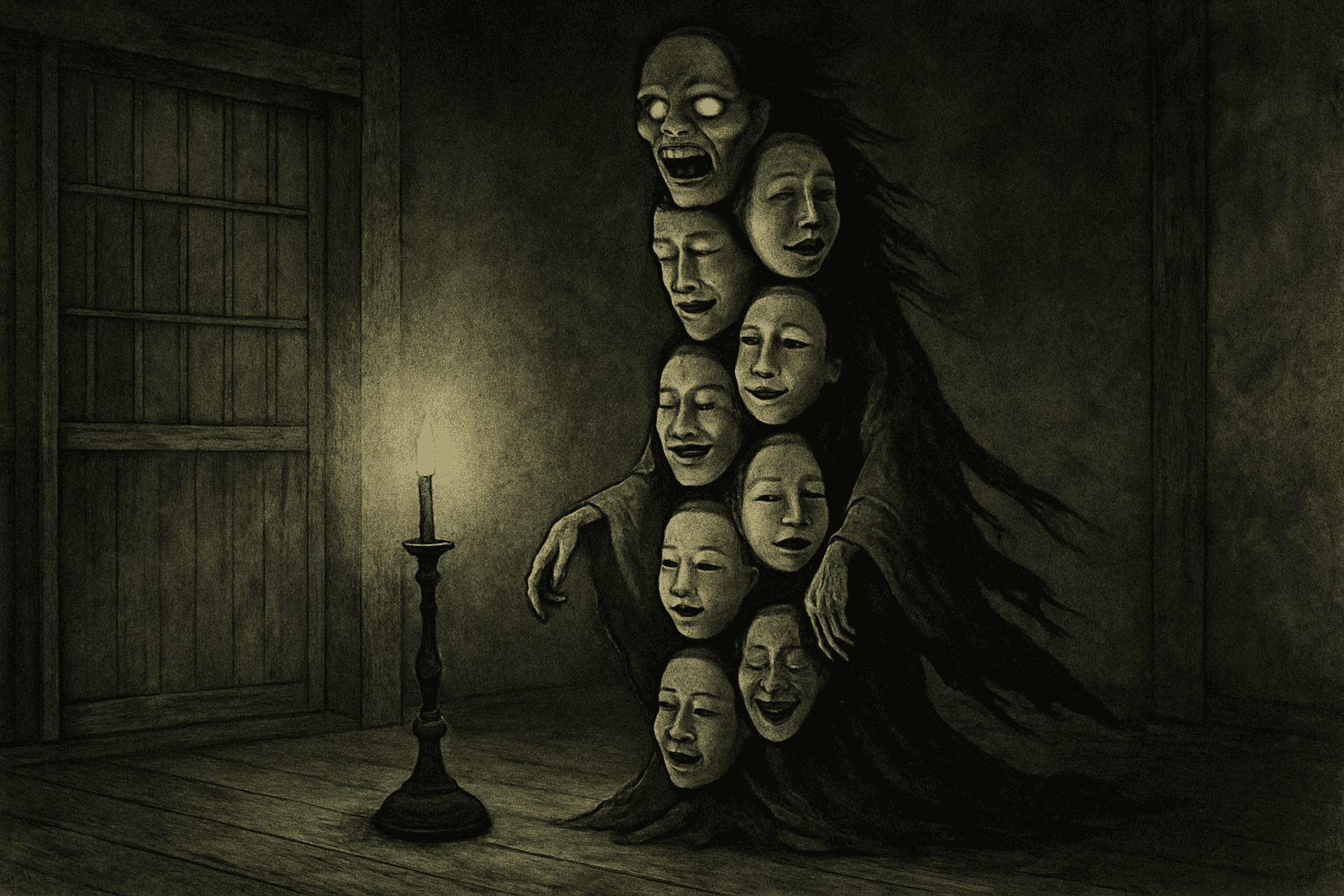
A Noh mask is carved to hold one expression forever — a demon's rage, an old man's calm, a woman's grief frozen mid-thought. Wear enough of them out over enough decades, the Edo-period thinking went, and that frozen expression stops staying put. The menreiki (面霊気) is what happens when a whole storehouse of retired masks gets there at once: not one haunted object but a pile of them, each with its own borrowed face, moving as if a troupe were still rehearsing after the actors had gone home.
What does it look like?
Toriyama Sekien drew the menreiki in his 1784 print collection Hyakki Tsurezure Bukuro (百器徒然袋) as a heap of Noh and sarugaku masks stacked loosely together, several of them tilted or turned as though caught mid-motion. There is no single new body grafted onto them, no added limbs — the masks themselves are the yokai, propped and piled the way a troupe might leave them after a performance, except that a few are plainly looking at something.
The masks of Hata no Kawakatsu
Sekien's brief text does something he does often in this book: it points to a real legend instead of inventing a new one. He writes that if these old masks seem so alive, it may be because they are the masks carved by Hata no Kawakatsu (秦河勝) — and leaves it at that, a suggestion rather than a story spelled out in full.
The reference would have needed no explanation for an Edo reader. Zeami's treatise on Noh, the Fūshikaden (風姿花伝), records that Prince Shōtoku, wanting to pacify a troubled world through performance, had Kawakatsu carve sixty-six masks and perform with them. That performance was remembered as the founding act of sarugaku (申楽), the entertainment art that Noh and Kyōgen both descend from centuries later. By tying the menreiki to Kawakatsu by name, Sekien is claiming these aren't just old props — they are, in effect, first-generation masks, close enough to the root of the art that a hundred years of use was never going to leave them inert.
Objects that ask to be respected
Strip away the Kawakatsu reference and the menreiki still fits the standard tsukumogami logic that runs through the rest of Hyakki Tsurezure Bukuro: an object handled with skill and care for long enough accumulates something like a will. What makes the mask version distinct is what that object was built to do in the first place. A kettle or an umbrella is a tool; a Noh mask is designed from the outset to carry an emotion convincingly enough to move an audience. A menreiki isn't a tool that unexpectedly learned to perform — it's a performer's mask that never quite stopped.
The unstated warning underneath it is the same one that runs through nearly every tsukumogami tale of this period: masks, like any other well-made and long-used thing, deserve to be stored, aired, and handled properly, not left to gather dust in a chest until neglect gives them a reason to complain.
Where it comes from
The Noh mask carries unusual weight even outside yokai stories. Actors treat a fine mask as something close to sacred, addressing it by name and never setting it face-down. Sekien's menreiki reads as that reverence pushed one step further into folklore: if a mask is already thought to hold a role's soul while an actor wears it, it takes very little imagination to wonder what a whole cabinet of them might do once everyone has left the theater for the night. The Kawakatsu legend gives that wondering a specific, namable root instead of a vague appeal to "old things get spirits" — a habit of Sekien's that separates his tsukumogami from generic ghost stories.
Menreiki since Sekien
The menreiki stayed a minor entry in Sekien's catalogue for two centuries before mask-and-spirit yokai found new audiences. It surfaces today mostly among readers and collectors working through the four Sekien picture-book series in facsimile. It has also been reimagined well outside its original form: the mobile game Onmyoji features a shikigami named Menreiki built around a wholly new backstory — a girl merged with a set of mask spirits — that borrows the yokai's name and mask motif but not Sekien's design or his Kawakatsu legend. The original stays quieter and stranger: a pile of retired faces in a dark storeroom, still holding whatever expression they were last asked to wear.