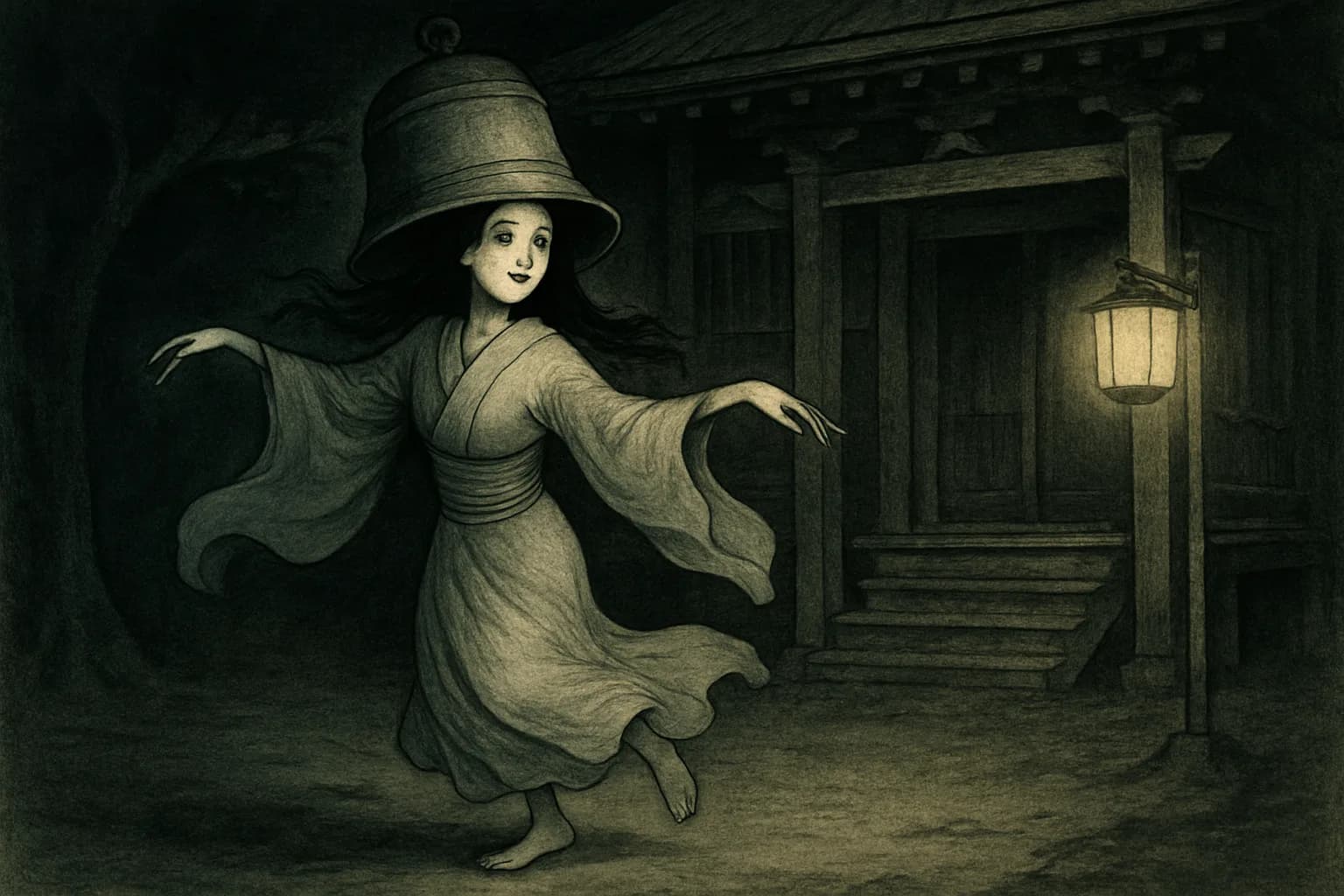
Toriyama Sekien filled his 1784 print collection Hyakki Tsurezure Bukuro (百器徒然袋) with objects that turn dangerous, sly, or grotesque once they wake up. The 鈴彦姫, Suzuhiko-hime, is one of the rare exceptions. It is a kagura suzu — the cluster of small bells a shrine maiden shakes during a Shinto ritual dance — that has quietly become a woman, and gone on dancing.
What does it look like?
Sekien draws her as a young woman in the layered robes of a shrine maiden or an ancient court lady, her face rendered as a bell rather than a face, with a kagura suzu resting at the crown of her head. Small bells trail from her sleeves and hem. Nothing about the image suggests menace: she is caught mid-motion, arms lifted the way a kagura dancer's would be, as though the tool had simply kept doing the one thing it was ever asked to do.
A line borrowed from an older story
Sekien's brief accompanying text doesn't explain who she is so much as gesture at where she came from. He writes of the ancient time when Ame-no-Uzume performed kagura before the heavenly rock door to draw the hidden god out — and says the memory of it comes back to him now, dreamlike. It's a single associative line, not a narrative, but it ties the bell to a specific and very old story: Ame-no-Uzume's dance before Amano-Iwato, the cave where Amaterasu had shut herself away, plunging the world into darkness. Her performance made the assembled gods laugh so loudly that Amaterasu, curious, opened the door — and kagura, ritual dance performed for the gods, is traditionally said to descend from that one performance.
It's worth noting that the earliest versions of the myth, recorded in the Kojiki and Nihon Shoki, don't actually give Ame-no-Uzume a bell — she dances holding a spear wrapped in bamboo grass and vine. Bells belong to the kagura tradition that grew out of the myth over the following centuries, not to the myth itself. Sekien seems aware of that gap and unbothered by it: his sentence reads less like a claim of historical fact than a private association, the kind of link a well-read Edo-period print artist might draw between an object in front of him and a story every reader already knew.
An object still doing its job
Most of Sekien's tsukumogami carry a warning about neglect — an umbrella or a kettle left unused for a hundred years until it finally acts out. Suzuhiko-hime reads differently, because a kagura suzu is rarely retired; a shrine's ritual bells stay in rotation for generations, rung at the same festivals every year. If she is a tool with a hundred years behind her, she is also a tool that has spent that century being handled exactly as intended. That may be why Sekien gives her no grievance and no trick to escape. She simply keeps dancing, doing alone at night what she once did in a miko's hands by daylight.
Where it comes from
Suzuhiko-hime has no folk legend behind her the way a kappa or a tengu does — no version of this story predates Sekien's own print. She belongs to the small set of tsukumogami he appears to have built from scratch for Hyakki Tsurezure Bukuro, working outward from a real ritual object and a real myth rather than any existing oral tradition. Even her name is a puzzle Sekien left unsolved: hime (姫) means "princess" or "lady," but hiko (彦) is the element that ordinarily marks a man's name, paired here with suzu, "bell." No surviving source explains the mismatch. The ukiyo-e artist Tsukioka Yoshitoshi returned to her eighty years later in his own 1865 hyakki yagyō print, adding a fan inscribed with the single word "kagura" to the figure's hand — making the allusion unmistakable for a reader who might have missed Sekien's original line.
Suzuhiko-hime today
The name has had an active second life far from Sekien's woodblock. The mobile game Onmyoji (陰陽師), whose roster draws heavily on Sekien's four print collections, made Suzuhiko-hime an SSR-rarity playable shikigami with her own original design and combat abilities — a fresh character built around the name and the bell, not a redrawing of Sekien's print. Outside games, she remains obscure even by tsukumogami standards, absent from the picture books and mascots that a kappa or a kasa-obake long ago graduated into. The dance stays where Sekien left it: a bell that never asks to be noticed, still moving through the steps it learned at a shrine centuries ago.