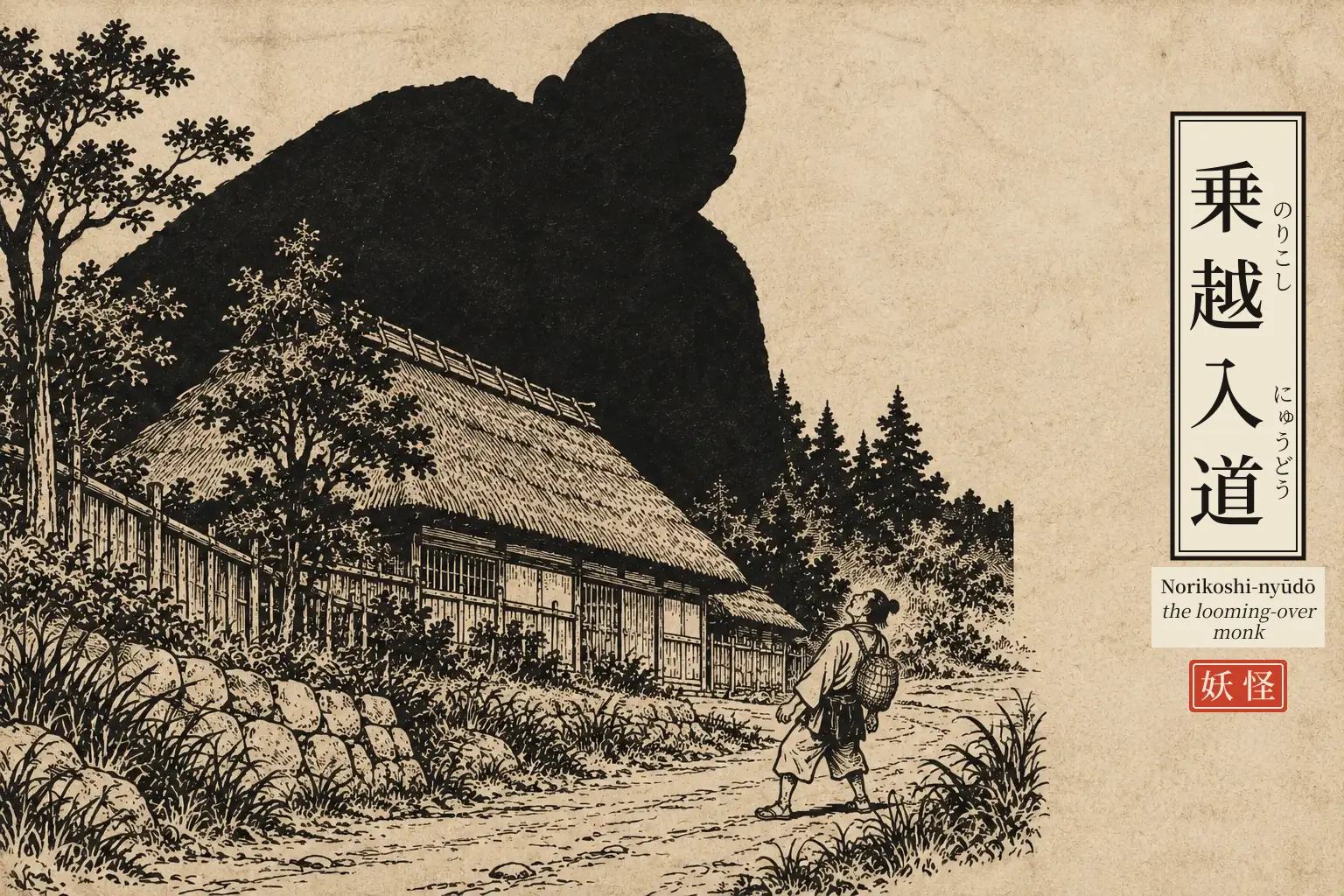
A shadow waits at the edge of a road near Tono, in Iwate Prefecture. At first it looks small, round like a shaved head. You strain to see it clearly. That is the mistake. The harder you look, the bigger the shadow grows. It keeps rising until it towers over the roof of a house. This is norikoshi-nyudo (乗越入道), a size-changing shadow told in the deep hill country of northern Japan. Its name spells out exactly what it does. 乗 (nori) means "to ride" or "to mount." 越 (koshi) means "to cross over." 入道 (nyudo) is an old word for a shaven-headed monk, a common shape for yokai that grow and loom. Together, the name describes something that rides up and over anything in its way.
What does it look like?
Accounts agree that it starts small and grows. Exactly what it looks like beyond that is less certain. Norikoshi-nyudo has no solid body. It is shadow-like, with no clear outline. That is the whole trick: the harder you stare at it, the larger it gets. In the oldest account we found, it starts out shaped like a shaved head. Then it keeps growing, taller and taller, until it clears the roof of a house.
Two tellings of a growing shadow
The oldest account we found comes from folklorist Yanagita Kunio. He recorded it in Tono Monogatari Shui, material folded into an expanded edition of Tono Monogatari in 1935. The specific pages used here are from a later 1948 printing. In that record, the creature is simply called Norikoshi (ノリコシ), without the "nyudo" added later. The story is set in and around Tono, in the hill country of Iwate.
A separate account moves the shadow to the old Waga district, northwest of Tono. Writer Yamada Norio's 1974 book Tohoku Kaidan no Tabi places a version of it at an inn in Hanamaki Onsen — today part of Hanamaki City. There, the shadow starts out looking like a small child, then keeps growing taller. This version does not say what makes it grow, only that it does.
How to make it stop
Tono keeps its own fix for the shadow. If you meet it, do not keep staring up as it grows. Look at it from the top down instead — head first, not feet first. Do that, and it disappears.
Words work too, according to one source. A reference work printed in the magazine Rekishi Dokuhon in December 1989 names a chant used against it: say "Norikoshi-nyudo, minuita" — "Norikoshi-nyudo, I see through you" — and the shadow vanishes. The same source says the trick is shared with Mikoshi-nyudo, a similarly tall, growing shadow-monk.
Where it comes from
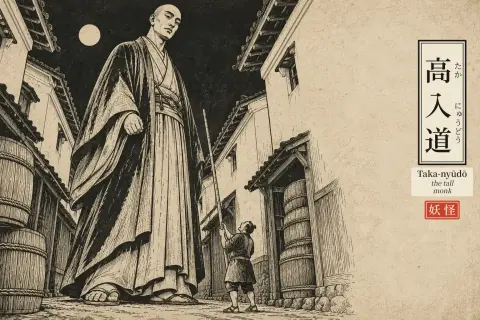
Norikoshi-nyudo belongs to a small family of yokai built on the same idea: a shape that changes size depending on how hard you look at it. Mikoshi-nyudo and Taka-nyūdō, close cousins in that same family, work on the identical premise elsewhere in Japan. One possible reading: all three describe a vague shape that grows the longer someone strains to make sense of it. The shape is not in the dark. It is in how hard you stare at it.
Go deeper
Books worth owning if this world pulls you in.
- The Book of Yokai →Michael Dylan FosterThe most readable scholarly introduction to yokai — where they come from, what they mean, and the major creatures.
- Japandemonium Illustrated: The Yokai Encyclopedias of Toriyama Sekien →trans. Hiroko Yoda & Matt AltThe complete Edo-period bestiaries that so many of these entries trace back to, in full English translation.
Some links are affiliate links; if you buy through them we may earn a small commission at no extra cost to you.
Norikoshi-nyudo today
We found no mascot or franchise that has borrowed its shape, and no sign it became a household name the way kappa or tengu did elsewhere in Japan. What we did find were two separate tellings, recorded decades apart in two different corners of Iwate, that give the same shadow the same core shape: small, dark, and growing. That is a smaller kind of staying power than fame — a story stable enough to be written down twice.