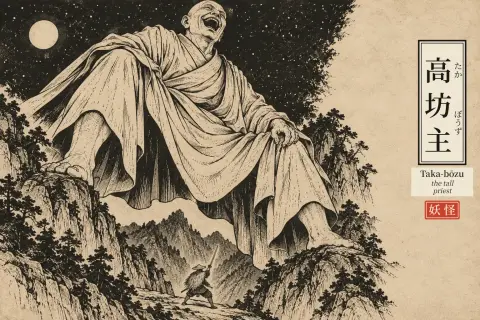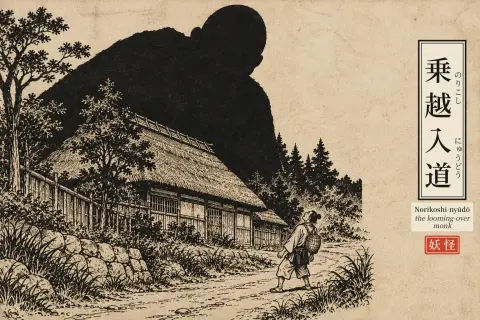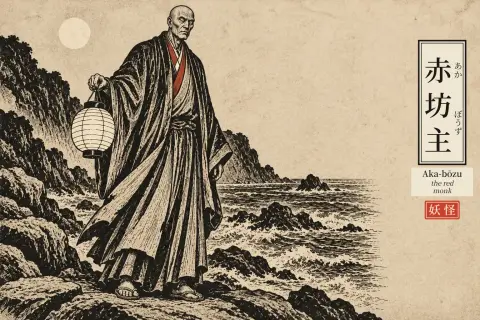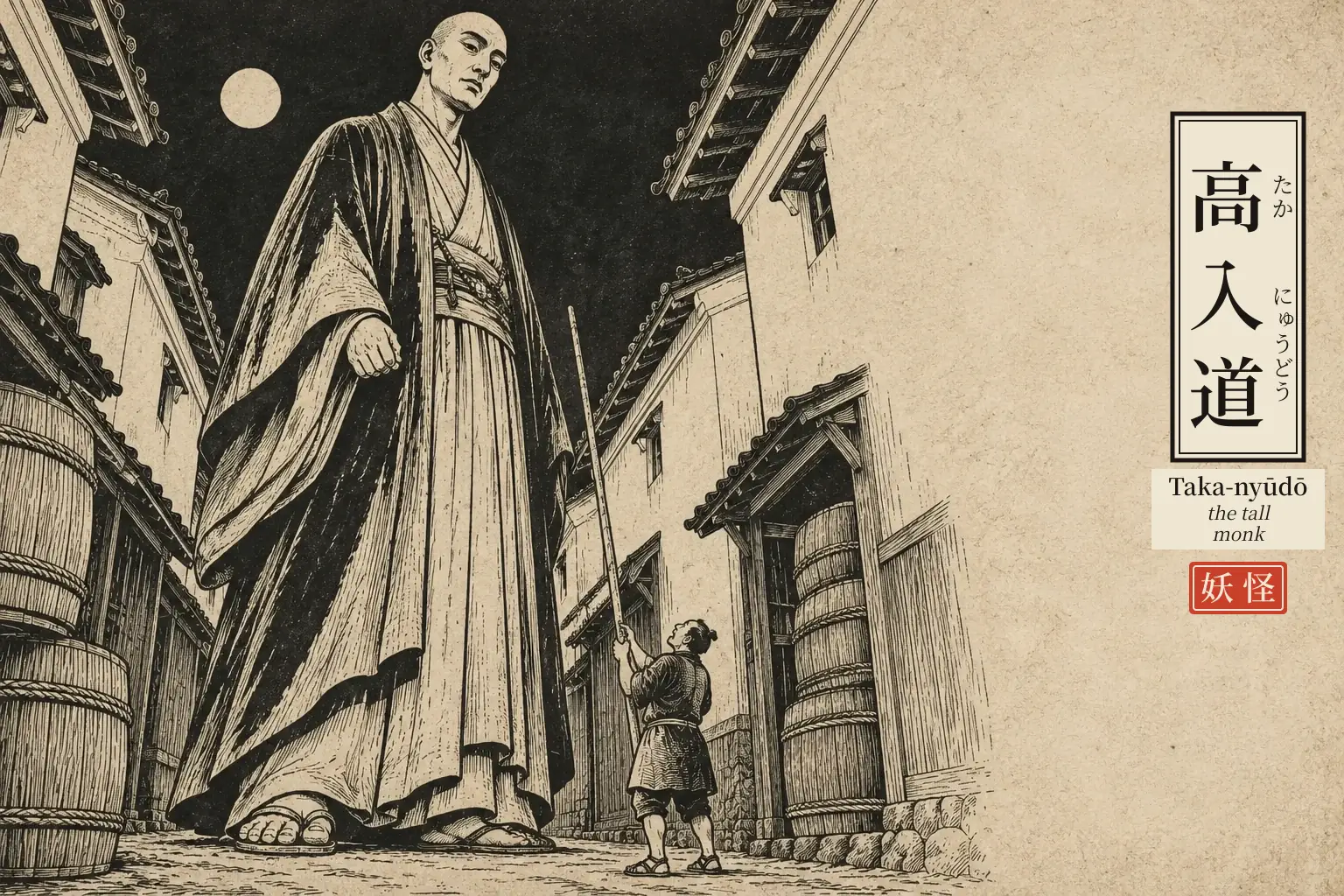
A figure suddenly appears in front of you. You look up to see its face. That is the mistake. The longer you look, the taller it gets. Keep looking, and it keeps growing until it seems to reach the sky. This is taka-nyūdō (高入道), a roadside yokai told mainly in Shikoku and the Kansai region. Its name is blunt about what it does: 高 (taka) means "tall." 入道 (nyūdō) means a shaven-headed monk. Put together, the name describes a priest who will not stop growing.
What does it look like?
A figure appears suddenly, standing in front of a person. They look up at its face, and the trouble starts. The creature grows taller the longer they keep staring, until it towers far over their head, tall enough to reach the sky.
One of the oldest accounts gives it a size. In 1801, the illustrated book Ehon Sayo Shigure told of a taka-nyūdō seen on Gokomachi street in Kyoto, late in the Tenmei era. That one reached about one jō tall — roughly three meters. An older book, Kaidan Tabi no Akebono (1796), describes one that was ten jō tall. That is about thirty meters.
Alleys, breweries, and a street in Osaka everyone knew
In Hyōgo, taka-nyūdō was said to haunt the narrow alleys that run between sake breweries, stepping out suddenly in front of people. Osaka had its own reputation for the creature. It kept appearing in the city until around 1882, and almost no one in Osaka hadn't heard its name.
The yokai also had regional footholds further south. Villages in old Yamashiro-dani-son, in what is now Miyoshi City, Tokushima, told their own taka-nyūdō stories, as did Nawa, a part of old Nagao-chō in Kagawa that is now Sanuki City.
How to make it stop
Folklore gives several ways to end the encounter, and each region had its own.
In Hyōgo, people carried a measuring stick. They measured the giant with it: one shaku, about thirty centimeters. Then two shaku. Then three. Measuring it this way was said to make it vanish.
In Nawa, the fix was a phrase, not a tool. Without looking up, a person was supposed to say "Maketa, mikoshita" — "I lose, I saw through you" — and bow. The giant would vanish. In Tokushima, just across the border, people used a shorter version of the same idea: saying "Mikoshita, mikoshita," twice, with the same effect.
The 1801 Kyoto account ends more bluntly than any chant. A man who ran into the giant on Gokomachi street threw a piece of wood at it without thinking. It disappeared on the spot.
The sumo-wrestling tanuki of Tokushima
Regional tellings disagree about what is actually behind the giant. In Hyōgo, people blamed a tanuki or a kitsune in disguise. In Kagawa, people blamed a kawauso, a river otter. Others blamed a tanuki sitting on a person's shoulder.
Tokushima tells the richest version. There, a tanuki named Takasu no Ingen was said to turn into taka-nyūdō. It challenged people to sumo wrestling. Fishermen were its favorite opponents. Lose to it, and it promised a good catch. Beat it, and the catch would be poor. Fishermen learned to let it win, match after match, just to keep the catch good.
Takasu no Ingen is not forgotten. A small shrine on the Takasu embankment, in the Okinosu district of Tokushima City, still honors it today as Ingen Daimyōjin.
Where it comes from
Folklorist Konno Ensuke groups taka-nyūdō with mikoshi-nyūdō. Yanagita Kunio said taka-bōzu is the same yokai under another name. Taka-nyūdō and mikoshi-nyūdō share the identical trick: a figure that grows for as long as a traveler keeps looking up at it. Whether taka-bōzu does too depends on which account you read.
One telling pushes the idea somewhere stranger. In Kaidan Tabi no Akebono, a farmer who made his living selling snapping turtles is confronted by one turtle's vengeful spirit, grown into a ten-jō-tall taka-nyūdō.
Most regional tellings skip the ghost story entirely. They blame a shapeshifting animal — a tanuki, a fox, an otter. Tokushima went further than blame. It gave the prankster a name, a wrestling habit, and in time, a shrine.
Go deeper
Books worth owning if this world pulls you in.
- The Book of Yokai →Michael Dylan FosterThe most readable scholarly introduction to yokai — where they come from, what they mean, and the major creatures.
- Japandemonium Illustrated: The Yokai Encyclopedias of Toriyama Sekien →trans. Hiroko Yoda & Matt AltThe complete Edo-period bestiaries that so many of these entries trace back to, in full English translation.
Some links are affiliate links; if you buy through them we may earn a small commission at no extra cost to you.
Taka-nyūdō today
Taka-nyūdō never became a mascot the way kappa or tanuki did. Manga artist Mizuki Shigeru included it in his yokai encyclopedia. But we found no plush toy or franchise character.
What survives instead is smaller and stranger: a shrine that still stands on an embankment in Tokushima, dedicated to the tanuki locals once wrestled and let win. The sumo matches are long over. The small shrine by the water is not.