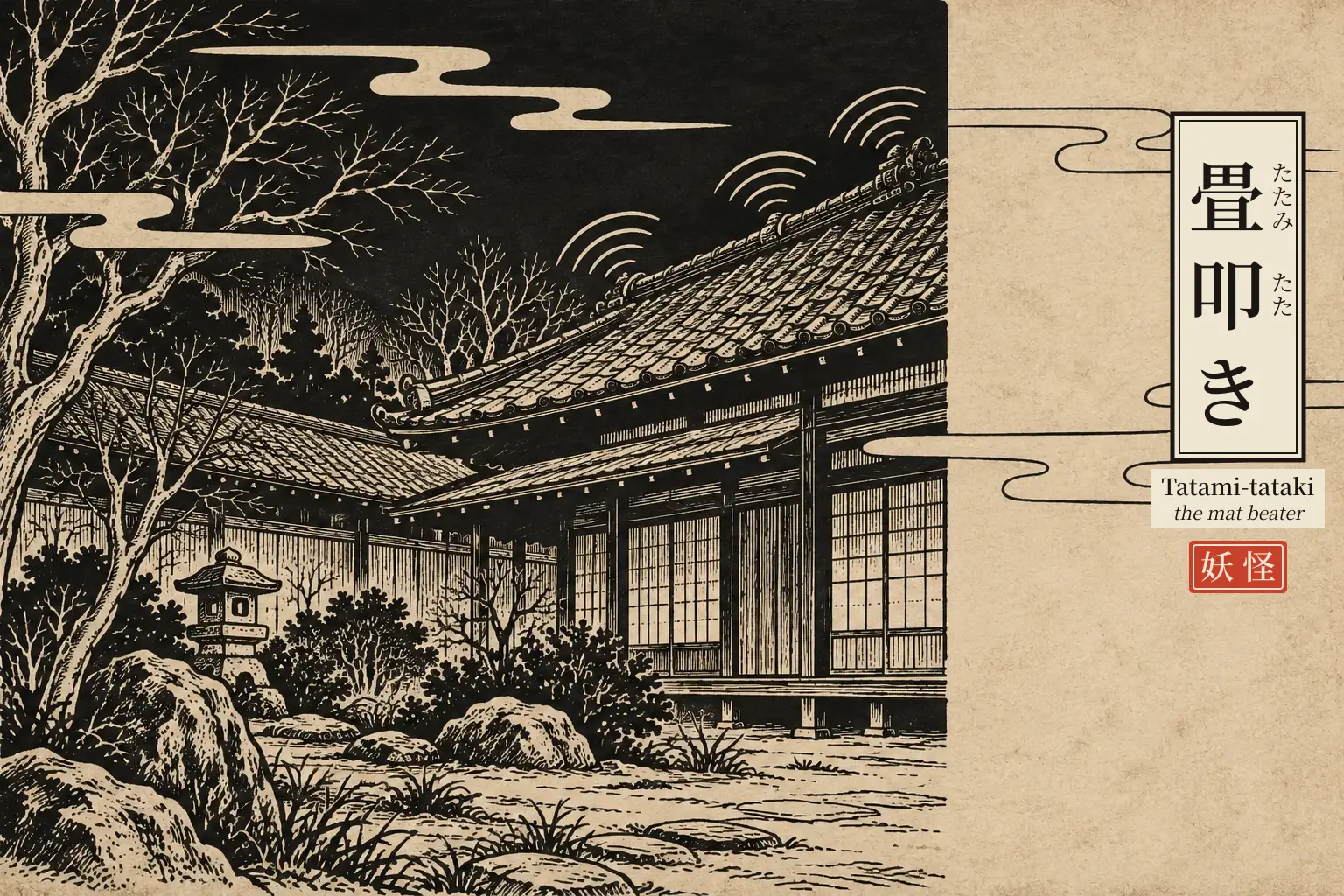
Late on a winter night, a sound like someone beating a mat starts up on the roof. Or in the garden. Or somewhere out in the dark street. Whoever goes to look finds no one there — and no mat. This is tatami-tataki (畳叩き), the "mat beater," a sound heard for generations in four parts of Japan with no one ever caught making it.
What does it sound like?
Tatami-tataki is not described as a creature with a face or a body. Japanese folklore classes it as a kaion genshō — a mysterious-sound phenomenon. What people report is a rhythmic beating sound, but the comparisons change by region. In Yamaguchi it was likened to someone striking a sheet of stiff persimmon-tannin paper, or fanning a large uchiwa fan as hard as they could. In Hiroshima it was called batabata or patapata, as if someone were striking a tatami mat with a cane.
The one place a shape is ever seen belongs to a single Hiroshima story, and even there it is brief: something small and person-shaped, glimpsed coming out of a stone.
Four prefectures, four separate stories
Wakayama, Yamaguchi, Hiroshima and Kōchi each tell this sound differently, and the tellings don't agree on a cause.
In Wakayama, it was heard in a town called Uji, and known there as Uji no Kotama. The Kishū Domain's own gazetteer, the Kii Zoku Fudoki, written in the Tenpō era, describes a batabata sound starting in the east before dawn on winter nights and fading away to the west — which is said to be where the name Batabata comes from.
In Iwakuni, Yamaguchi, a record called the Ganyū Kaidan-roku places it in a specific stretch of years: the Bunkyū era, from autumn into winter. From around ten at night until just before dawn, the whole town could hear the beating sound. The record writes the name with the characters 破多破多 instead of the usual katakana.
In Kōchi, no stone or sound-only mystery is blamed. People pointed instead at a tanuki living in a particular residence. Oddly, the sound was never heard inside that house or right next to it — only from about 300 meters away.
The stone that gives you a fever
Hiroshima's version is the richest, and the strangest. There, the sound came from rooftops and gardens on winter nights. Local tradition blamed a specific stone, the Batabata-ishi, said to curse anyone who touched it with gyaku — an intermittent fever.
One account goes further. Someone once saw a kobito, a small person-shaped being, climb out of the Batabata-ishi and strike it. When they tried to catch the kobito, it fled back inside the stone. So the person took the stone itself home instead. Soon afterward, a bruise matching the stone's own pattern appeared on their face. Only when they panicked and carried the stone back to where they found it did the mark disappear.
A separate, calmer account comes from an Ansei-era essay called Fude no Susabi. A curious person tried to walk toward the sound and pin down where it came from. It never worked. The sound always seemed to be coming from about seven or eight ken — roughly 13 meters — further on, no matter how far they walked.
Where it comes from
No single explanation ties these four traditions together, and the sources don't treat them as one story. A stone, a tanuki, a sound moving from east to west before dawn — each region reached for whatever answer fit its own landscape. One modern note, on a Mizuki Shigeru-affiliated site, offers a poltergeist explanation instead.
What holds the four together is the sound and the futility of chasing it. Every version ends the same way: something is struck, repeatedly, and nothing is ever where the sound says it is.
The Hiroshima district of Takanobashi keeps its own, older memory of this. Local tradition there places a Batabata sighting all the way back in the Hōreki era — a full century before the Bunkyū-era events recorded in Yamaguchi. No book from that time names the story directly, but a monument to it still stands in the neighborhood today.
Tatami-tataki today
Modern Japan has mostly folded tatami-tataki into Mizuki Shigeru's catalogue of yokai: his 1994 picture encyclopedia, Zusetsu Nihon Yōkai Taizen, is the source for several of the sound's regional details still repeated today. A bronze statue of tatami-tataki now stands among the many others on Mizuki Shigeru Road in Sakaiminato, Tottori — a street built entirely around statues of yokai from Japanese folklore.
It keeps better company there than in the stories themselves. In the old tellings, nobody ever got close enough to see what they were chasing — only close enough to hear it move another seven or eight ken away.