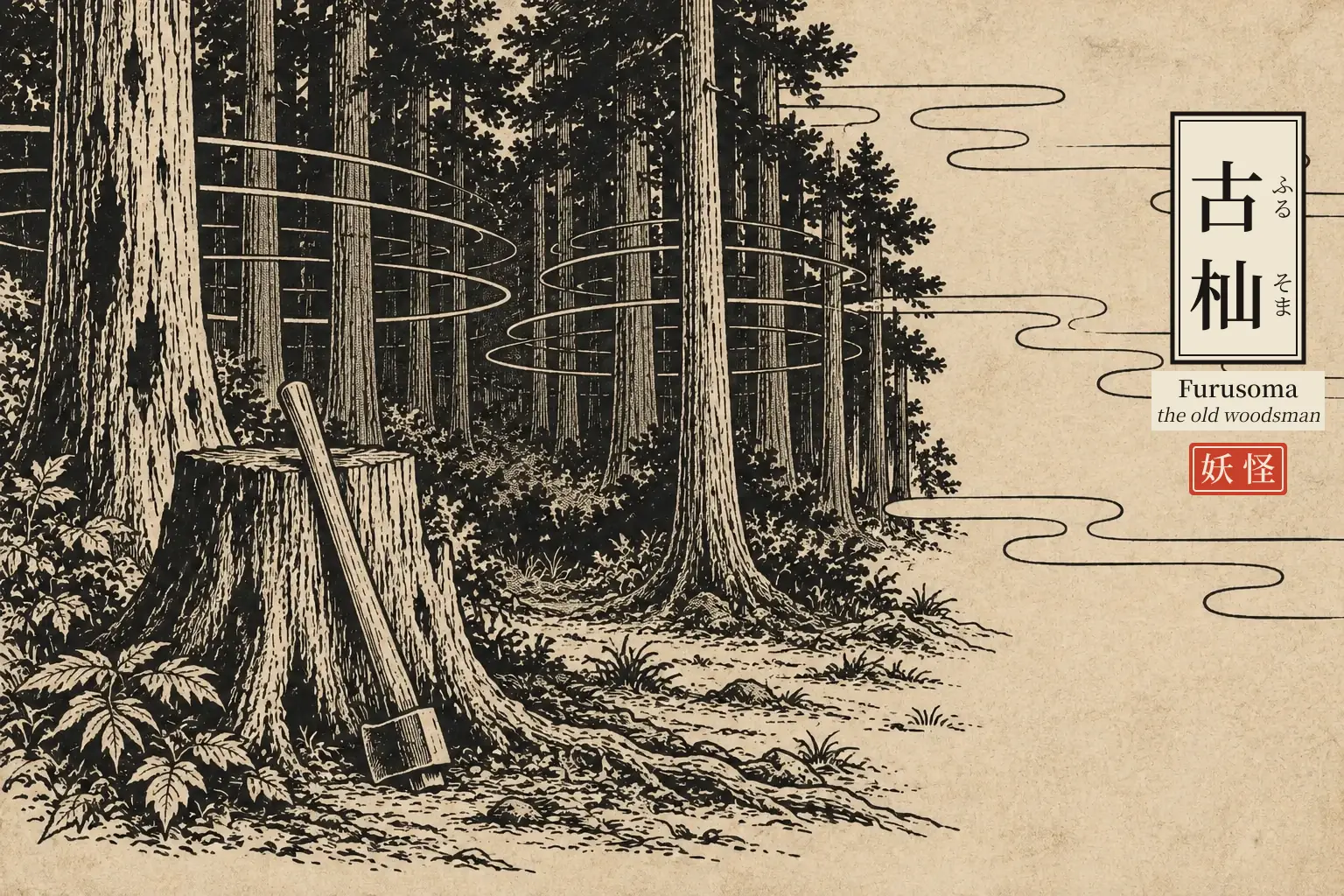
Deep in the Shikoku mountains, a sound like an axe starts up at night. Wood splits, cracks, and finally crashes to the ground. The woodcutters went home hours ago. Come morning, nobody finds a single felled tree. This is furusoma (古杣), a mountain sound with no source and no witness.
What happens when furusoma strikes
The pattern rarely changes. First comes a sound like steel biting wood — kan, kan — or the rasp of a saw. Then the wood cracks and splits. Last comes a heavy crash: the sound of a huge tree hitting the ground.
Anyone who hears it wonders why someone is felling trees after dark. At daybreak, they go to check the spot. No stump shows a fresh cut. No tree lies fallen anywhere nearby. The mountain looks exactly as it did the day before.
By daylight, and something that shakes the hut
Furusoma usually waits for night, but not everywhere. In Nagaoka District, it can also strike in daylight. There, a voice calls out first — iku zo, iku zo, "here it comes, here it comes" — before the tree falls.
In Muroto, on Shikoku's southeastern coast, the sound brings company. People staying overnight in mountain huts say something unseen shakes the whole structure, on top of the usual cutting and crashing.
Where it comes from
The name explains itself once you know the kanji. 古 (furu) means "old." 杣 (soma) means a woodcutter. Together: an old woodcutter, still swinging an axe nobody can see.
Tosa tradition gives that old woodcutter a specific death. A logger died, crushed under the tree he had just felled. He never stopped cutting, the stories say, doomed to repeat the same work forever. Around Ōnomi and Tsuno, in the hills of Kōchi, the story changes only the crime: the ghost belongs to someone who died while cutting timber illegally. Elsewhere, people blame no ghost at all, only the local mountain god, reminding anyone nearby whose land this really is.
Folklorist Sakurai Tokutarō offered a more down-to-earth reading. Walking alone through remote mountains, far from any village, breeds a specific unease. Sakurai thought that unease is what built furusoma and its many regional cousins: a mind straining to explain a sound it can't place.
The earliest dated account goes back to 1941. A short folklore report on Iyayama village, Tokushima, recorded it in the journal Hidabito.
Named differently elsewhere
Shikoku is not the only place that hears this. In many parts of Japan, a similar sound is called tengu-daoshi, "tengu felling," blamed on the long-nosed mountain goblin instead of a ghost. A cutting sound starts, then a crash, and again nothing is ever found.
Kagoshima and Ōita have a cousin called sorakigaeshi. It is usually blamed on a tengu too, though in Ōita a tanuki gets the blame instead, said to kick rocks together with its hind legs to make the noise. Further north, in Niigata, a version called karakidaoshi skips the final crash entirely. The tree cracks and falls. No impact ever sounds. People there blame a mischievous mujina, a badger-like shapeshifter, instead of a goblin or a ghost.
The ink-pen that keeps working
A second explanation has nothing to do with ghosts or gods. In Kōchi City, tradition points to a sumisashi — a carpenter's ink-marking pen — left behind by a woodcutter in the mountains. Forgotten there, the sumisashi is said to pick up a spirit of its own and keep working alone. Some tellings add its ink-pot, or sumitsubo, to the mix. In Ino Town, people blend three things together: the pen, the spirit inside its ink-pot, and the restless ghost of someone who died suddenly in the hills.
In Miyoshi City, in the Iyayama mountains of Tokushima, the story gets a specific setting. A woodcutter once argued bitterly with his foreman. Before storming off, he buried his sumisashi deep in the mountain, a curse meant to make sure no one could ever cut timber there again. Villagers say the sound of a saw still comes from that exact spot.