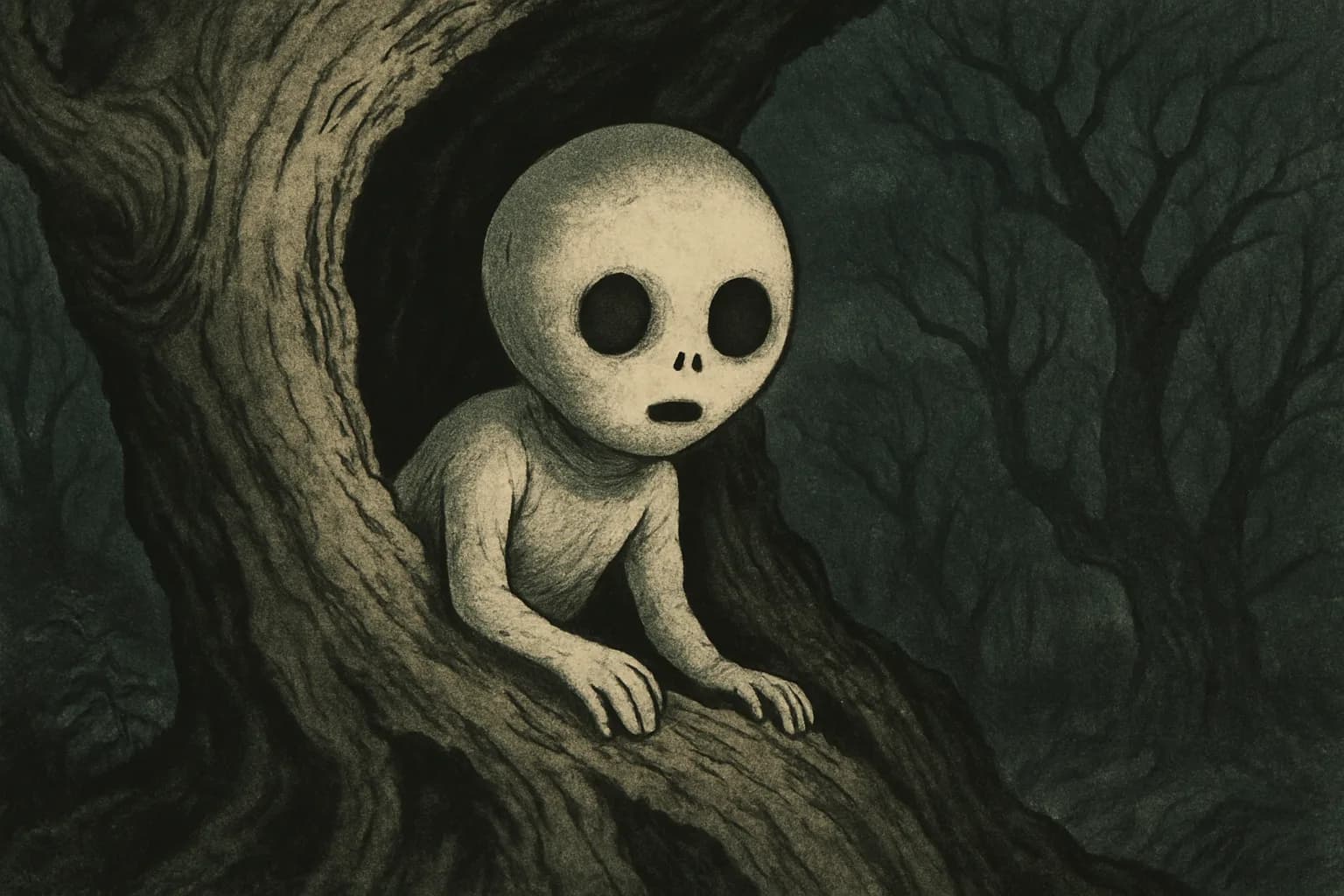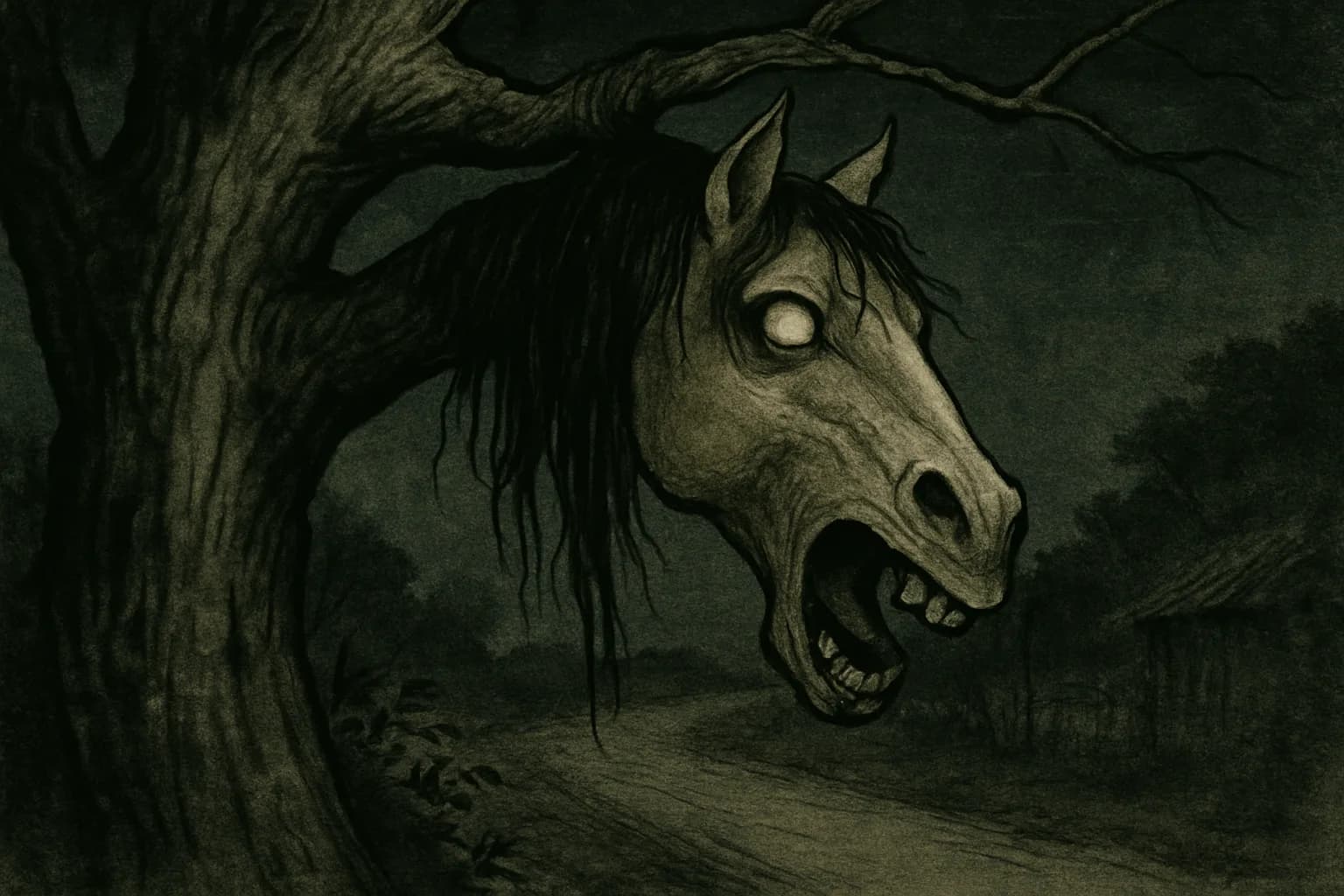
Walk an old road through Oku district in Okayama after dark, under a stand of enoki trees, and local memory says to check the branches before you check the road ahead. Something like a horse's head, and nothing more, may already be hanging there, waiting for someone to pass underneath.
What does it look like?
Just a head. No neck, no body, no legs trailing behind it — a sagari is a horse's head alone, suspended from the branch of an old enoki (Chinese hackberry), or in some Kumamoto accounts from a persimmon tree instead. It hangs above the road, like something that grew there and shouldn't have.
A cry that stops you cold
The sagari doesn't give chase. It doesn't need to — it lets the road do the work and waits for someone to walk into it. In one Okayama account, a man walking at night hears an old enoki rustle with no wind. He looks up and sees a horse's head hanging from a branch. It opens its mouth and neighs, hin, hiin. Kumamoto's version of the story pushes the danger further than fright: anyone who sees the head is said to come down with a sudden, severe fever afterward, as though the shock itself were the wound.
Where the sagari comes from
Folk explanation ties the sagari to ordinary, working horses. In Okayama, it is said to be the spirit of a horse that fell sick and died on the road. That spirit settled into an enoki tree. The result is a ghost that never got any further than the spot where its body gave out — still keeping to the same stretch of road that killed it, night after night.
That story also explains the sagari's attachment to a particular kind of tree. Enoki were long planted in Japan at crossroads, boundary markers, and rest stops along country roads, and Japanese folk belief has treated such marker trees as places where spirits gather for centuries. A horse's ghost settling into one fits an older pattern: the tree as a threshold between the ordinary road and whatever waits just beside it.
The horse itself is a telling detail. In an agricultural economy that depended on pack and draft animals, a sick or worked-to-death horse dying on the road was an ordinary, unremarkable event — which may be exactly why its ghost needed a story. Turning an anonymous roadside death into a fixed apparition with a name and a habit gave travelers something to watch for, and gave the dead animal a kind of afterlife that plain neglect never would have.
Two prefectures, one dangling head
The record splits cleanly between two places. In Oku district, Okayama — on the Chūgoku coast — the emphasis falls on the scream itself, a warning cry meant to send a night walker running. In Kumamoto, further south in Kyushu, the danger is a fever that follows the sighting. Both versions agree on the shape of the encounter: an old tree by the road, a horse's head with nothing beneath it, and a traveler who didn't look up soon enough.
Sagari on record
The sagari is not in the Edo-period yokai picture books. It comes down as local folklore from Okayama and Kumamoto. Murakami Kenji's Yōkai Jiten (2000) collects both versions. Mizuki Shigeru drew it in Yōkikka (2004), his regional yokai series.
Sagari today
The sagari has had a quiet second life in modern yokai media, turning up among the classic apparitions folded into later illustrated yokai encyclopedias and, on occasion, into anime adaptations of the long-running GeGeGe no Kitarō franchise as one of dozens of traditional yokai the series has drawn on over its decades on air. It has never crossed over the way the kappa or tengu did. In Setouchi, the old Oku district, a local museum curator says the exact sighting spots are now lost.