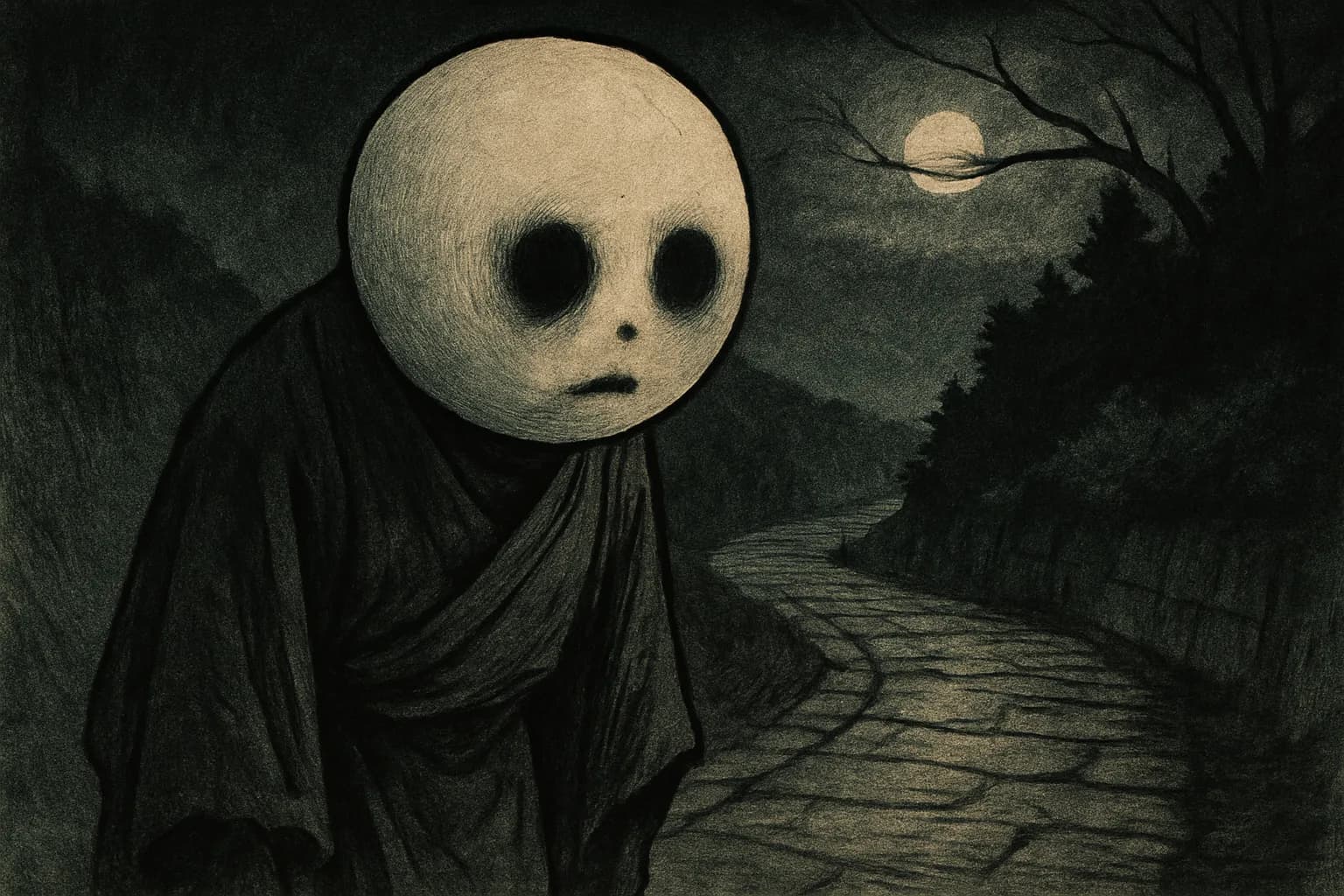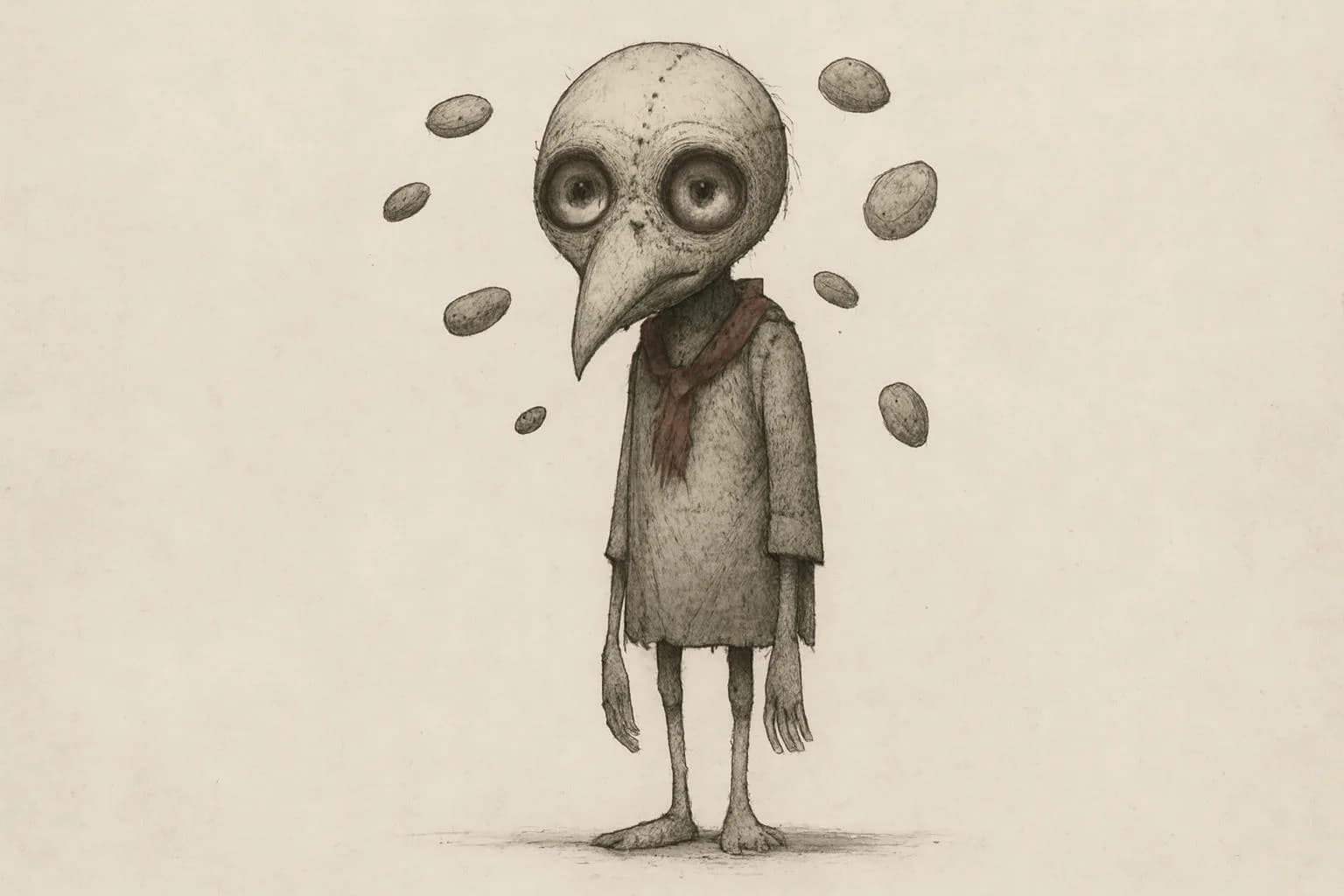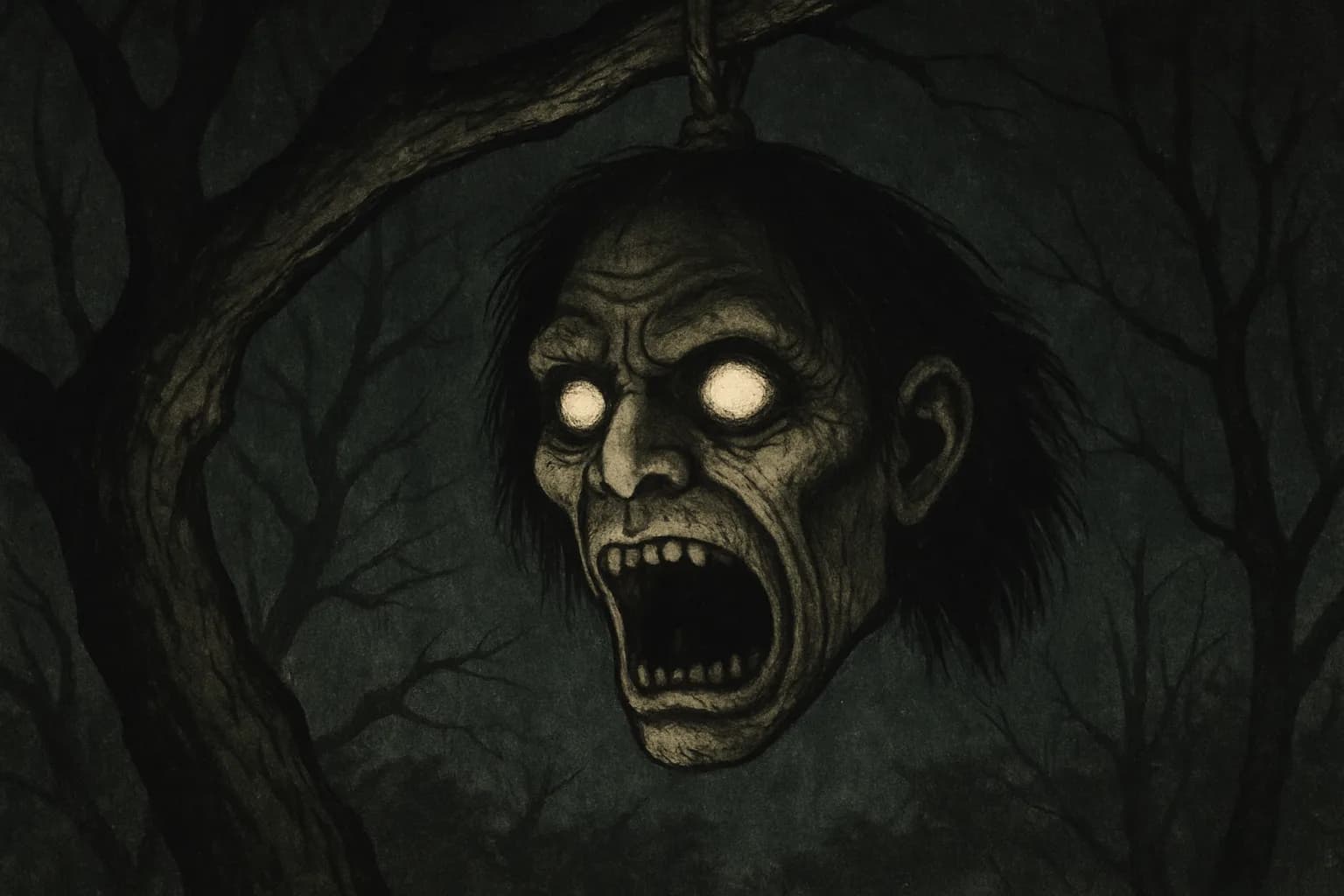
A severed head sits in the crown of an old pine tree, waiting for footsteps. When they come, it lets go — no warning, no rustle of branches, just the sudden weight of it cracking down on whoever is passing underneath. This is tsurube-otoshi, and its name comes from the one thing every account agrees on: the exact motion of a well bucket released from its rope, falling straight and fast.
What does it look like?
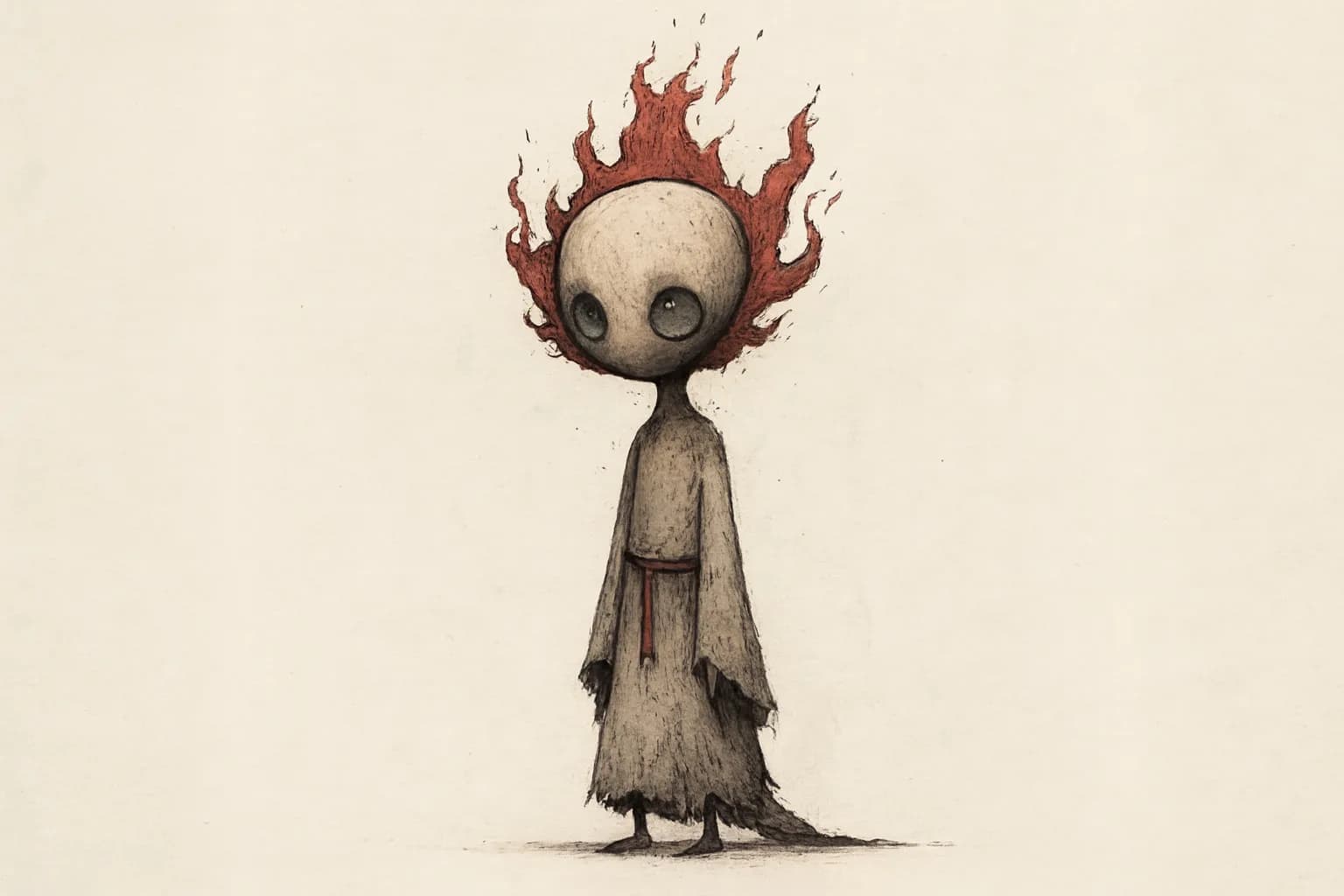
There is no single tsurube-otoshi. Many modern tellings describe a disembodied head. Other versions drop something else entirely: a ball of fire, an actual bucket, or a strange light glimpsed at the foot of the tree. What stays constant is the perch. Tsurube-otoshi favors tall conifers — pine and kaya (Japanese nutmeg-yew) — standing alone along forest roads and the dark edges of villages, the kind of tree a tired traveler would walk under without a second thought.
The bucket falls
In Kyoto's old Sogabe village, it fell suddenly from a kaya tree, cackling. Then it sang out: has the night's work ended? shall I lower the bucket — gii, gii. The "gii, gii" sounds like a creaking well pulley. Then it climbed back up into the tree. Another part of the same village told of an old pine. A severed head came down from it and ate people. Then it stayed away for a while, as if full, and returned two or three days later.
Regional hauntings
Gifu's Ibi district told a plainer version, set in the village of Kuze: a giant tsurube itself, a wooden well bucket, drops out of a great tree onto anyone who walks beneath it. Wakayama's telling, from Kuroe in Kainan and set in the Genroku era (1688–1704), is stranger and crueler. A well bucket sits at the base of an old pine. Something shines inside it, like a gold coin. The traveler who reaches in is pulled into the bucket and hoisted into the branches. There the tsurube-otoshi frightens him, eats him, or throws him to the ground. Between these, the geography splits roughly along a Kansai–Tōkai line: the name "tsurube-otoshi" itself belongs mostly to Kyoto, Shiga, Gifu, Aichi, and Wakayama, while other regions tell close cousins of the same falling-thing-in-the-tree story under other names.
Keep your eyes up
The recorded tales give no charm or ritual against it. They only mark the places. A certain pine or kaya tree became a spot people feared to pass after dark. The Wakayama tale holds the nearest thing to a lesson. Its victim was killed for reaching toward a glint of light.
Where it comes from
The oldest named record is the kaidan collection Kokon Hyakumonogatari Hyōban (1686). There it is called "tsurube-oroshi," a tree spirit that comes down as a ball of fire. The book also records an attempt to explain the phenomenon rather than just retell it: the scholar Yamaoka Genrin proposed that it was tree spirits acting out the five-phases doctrine of wood, fire, water, metal, and earth, manifesting on rainy days as fire falling out of the branches. Toriyama Sekien later drew this fire in Gazu Hyakki Yagyō (1776), but under another name: tsurube-bi, a flame hanging from a tree. So modern books treat the two as separate yokai. Later local research, like the Taishō-era Kuchitanba Kōhi Shū, recorded the Sogabe chant. Other surveys and books collected the Kuze bucket and the Wakayama trap.
Tsurube-otoshi in Japan today
The creature never became a national mascot the way the kappa did. It stayed a regional figure, still cited in Kyoto and Gifu local folklore collections and yokai encyclopedias more than in mainstream pop culture. Where it does surface outside the old prefectures, it's usually as a minor background yokai in the long-running GeGeGe no Kitarō franchise, dropped in alongside other countryside spirits rather than built up into a star. The Wakayama story is the one that sticks: a light at the base of a tree, a hand reaching for it, and then the bucket closing overhead.