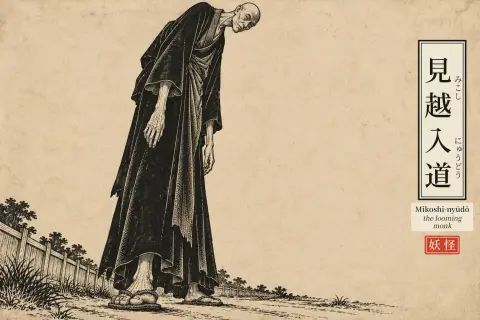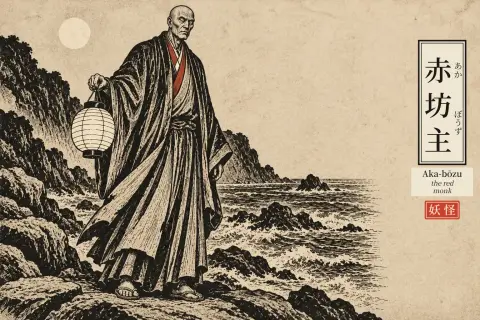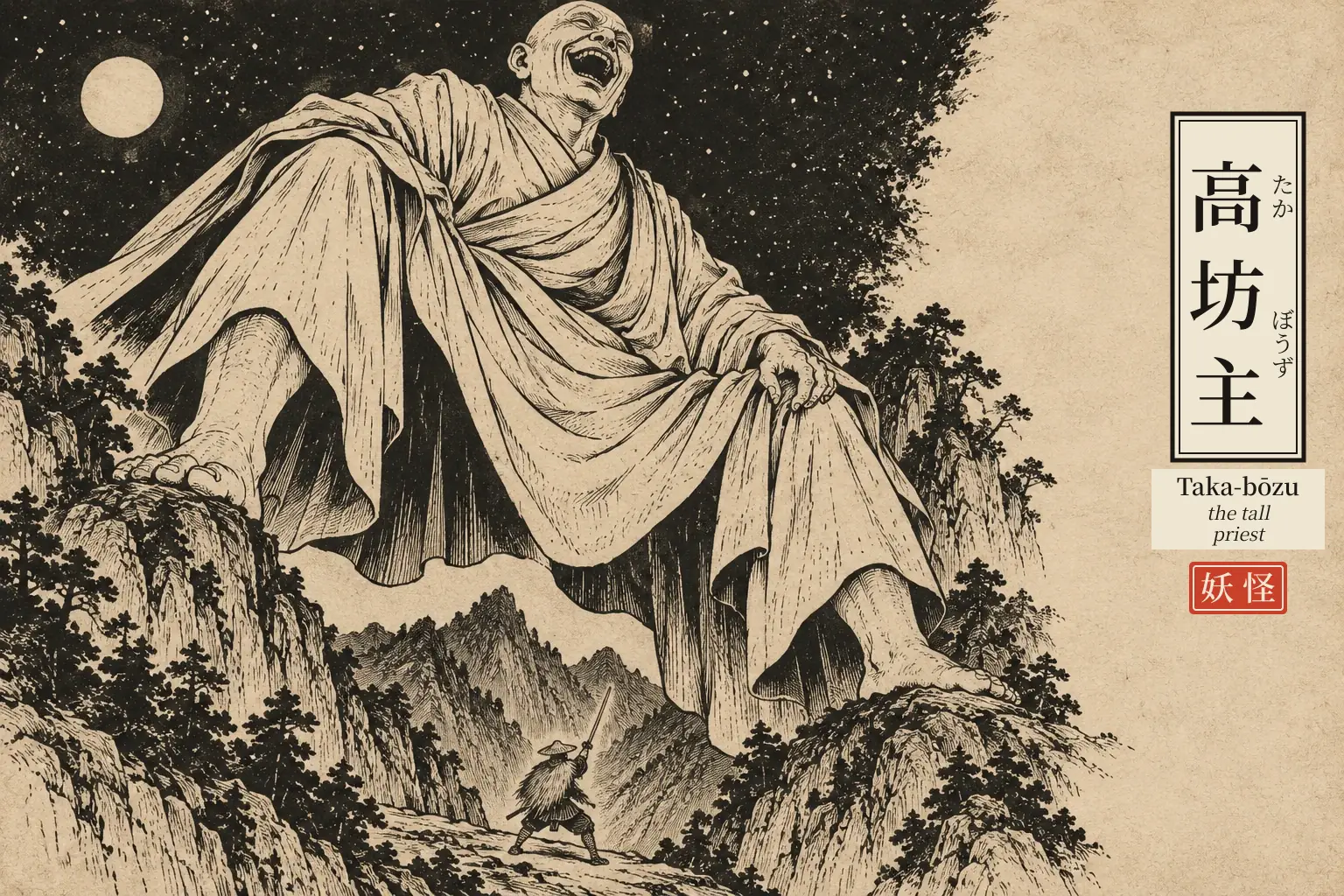
Ask around old Shikoku or the Kinki region about a giant priest on the road, and nobody agrees on what happens next. Most people call it taka-bōzu (高坊主). It is a huge figure shaped like a shaven-headed priest. It appears on roads and mountain passes. What it does to you depends entirely on which village you are in.
What does it look like?
In Kagawa, people described an absurdly tall bōzu standing at a crossroads. At Komaashi Pass, old Nagao, it straddled the mountains on both sides, laughing. In Nara, villagers blamed a tanuki that puffed its belly into a giant about two meters tall, with no eyes, no nose, and no mouth.
One telling adds a trick familiar from its relative, mikoshi-nyūdō: taka-bōzu is said to grow taller the longer you keep looking up at it, and to shrink again if you look back down calmly, without flinching. A 1924 Tokushima gazetteer, the Miyoshi Gunshi, says it shrinks when you look down on it. Some tellings group it with norikoshi-nyūdō and nyūdō-bōzu as versions of one idea, though that grouping isn't something the Miyoshi Gunshi itself claims.
In parts of Tokushima, such as old Yamashirodani village, people called the same giant taka-nyūdō. In 1938, folklorist Yanagita Kunio wrote that taka-bōzu and taka-nyūdō are the same giant.
Five regions, five different troubles
Mostly, taka-bōzu just frightens people and leaves. But the details change by prefecture.
In Tokushima folk belief, anyone who plays outside too late during the wheat-ear season risks being fooled by it. In old Sangawa, Kagawa, anyone who meets it is doomed to fall ill afterward. In Hyōgo, a 1922 record claims something sharper. It bites the throat of anyone who looks up at it.
The Komaashi Pass story ends in violence rather than illness. A person met the laughing, mountain-straddling giant there. That person bravely cut at it with a sword. The giant never appeared at that pass again.
Wakayama's version turns darker still. There, taka-bōzu comes down from the mountains into villages and carries off children who linger outside after dusk. Osaka's version is almost polite by comparison — it shows up only on moonlit nights, at a temple called Minami-mido.
Where it comes from
Most tellings agree on what is really behind the giant: a tanuki, playing a trick on travelers.
Tokushima keeps the clearest case. In Shinhama-honchō, a shapeshifting tanuki known as Taka-bōzu-danuki is still enshrined today as Taka-bōzu Daimyōjin. Nara has more than one tanuki of its own. In Ikoma District, a tanuki named Gozaemon-danuki puffed itself into an eyeless, noseless giant. A brave man refused to look scared. So it kept puffing itself up until it burst. Another Nara tanuki, Kadohe-danuki, is said to have transformed into taka-bōzu too, in old Kōriyama.
Kyoto took a different approach entirely. The 1686 kaidan (ghost story) collection Kokon Hyakumonogatari Hyōban records a sighting near Ōmiya-Shijō-bōmon. Cowardly people were the ones most likely to run into it, and always from behind. The book offers its own explanation: a frightened person was mistaking the long shadow trailing behind them for the yokai itself.
Go deeper
Books worth owning if this world pulls you in.
- The Book of Yokai →Michael Dylan FosterThe most readable scholarly introduction to yokai — where they come from, what they mean, and the major creatures.
- Japandemonium Illustrated: The Yokai Encyclopedias of Toriyama Sekien →trans. Hiroko Yoda & Matt AltThe complete Edo-period bestiaries that so many of these entries trace back to, in full English translation.
Some links are affiliate links; if you buy through them we may earn a small commission at no extra cost to you.
Taka-bōzu today
Manga artist Mizuki Shigeru painted it for his yokai series Yōki-ka. But we found no mascot or toy for it.
What is left instead is smaller and stranger: a shrine on a street in Tokushima City's Shinhama-honchō, built for a tanuki once blamed for a giant on the road. Taka-bōzu Daimyōjin is still there.