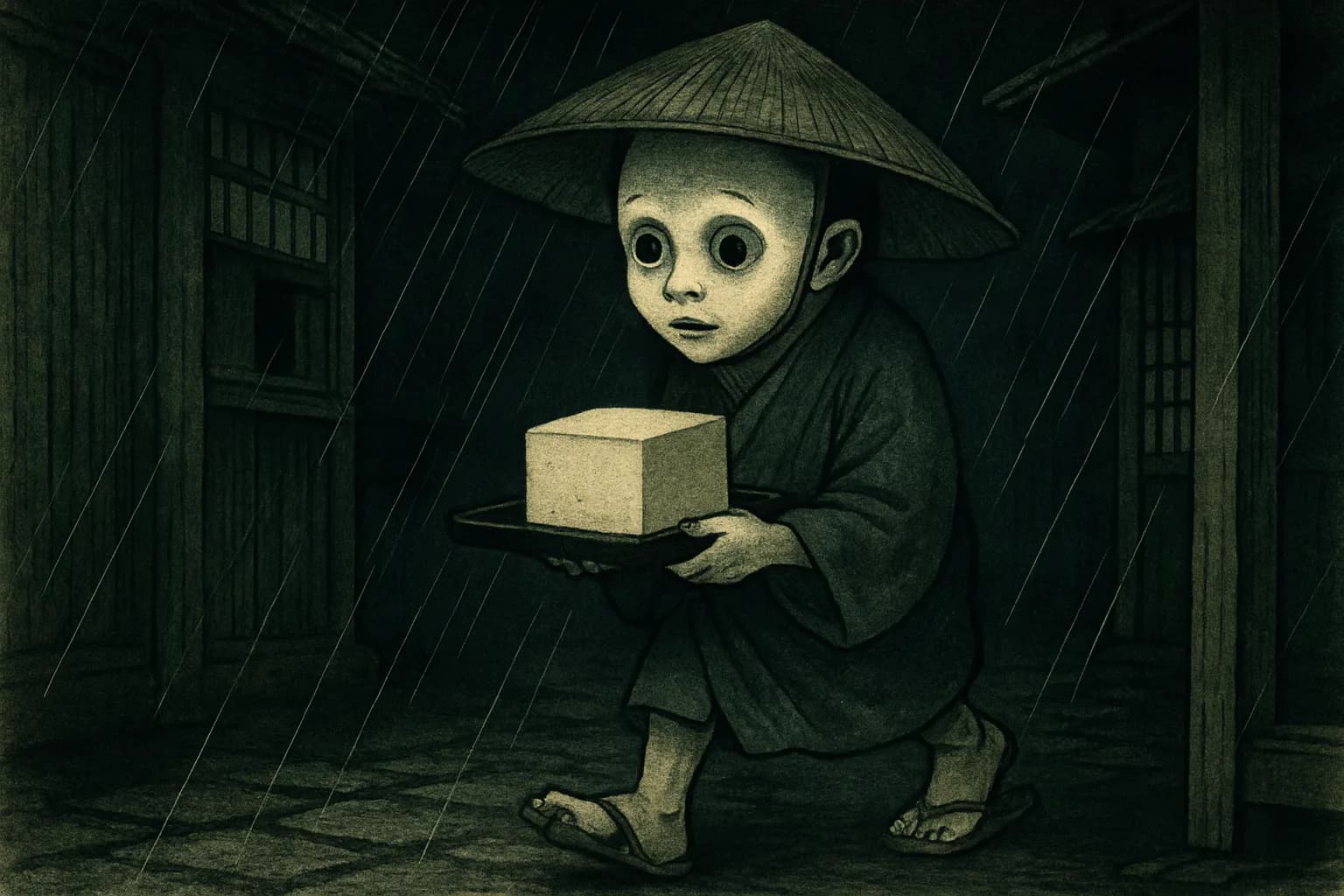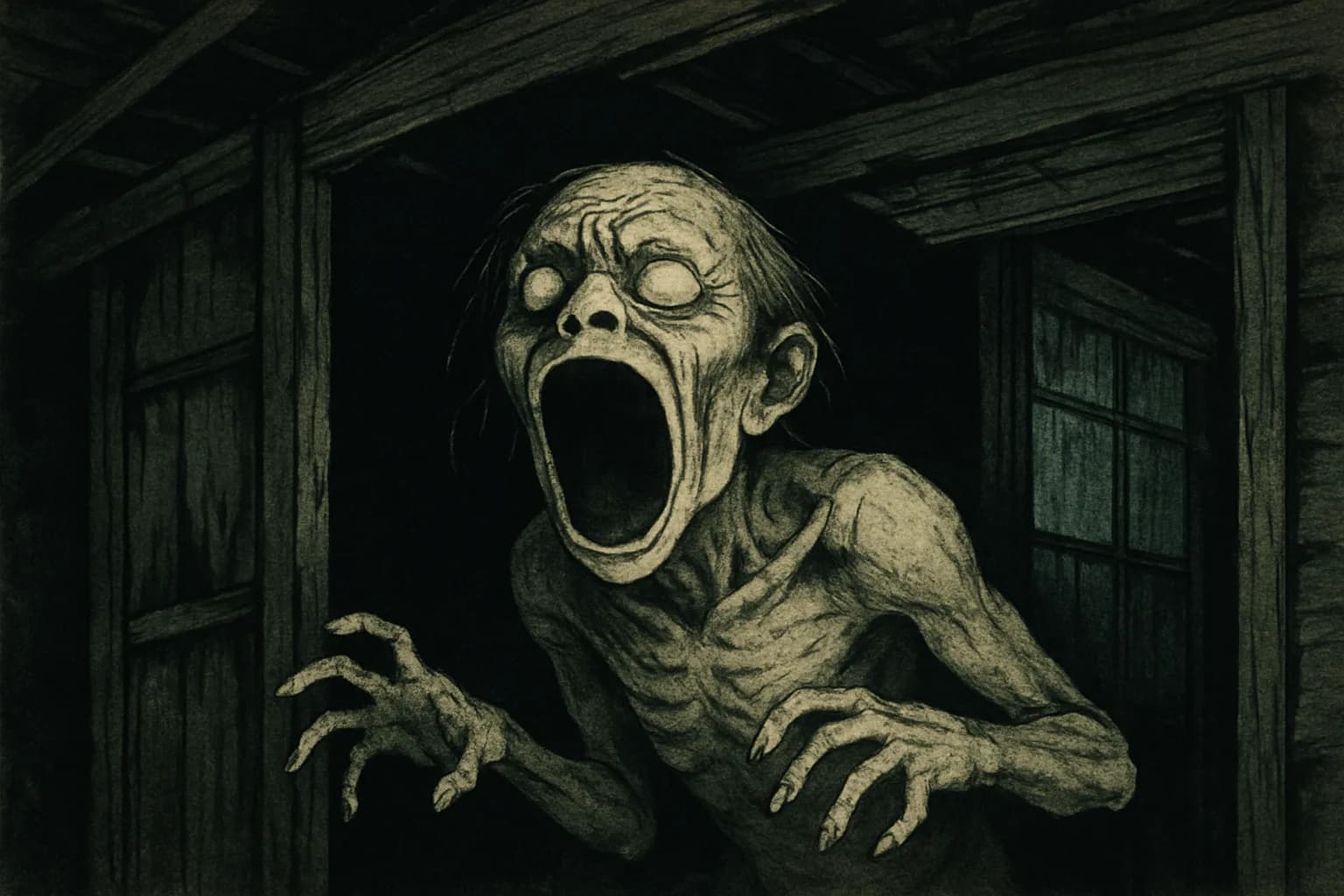
Most yokai have a body you could describe to a sketch artist: fur, fangs, a dish of water balanced on the head. Uwan has none of that. Walk past a ruined temple or an empty, falling-down house at the wrong moment and something inside shouts a single word — "Uwan!" — and that is the entire encounter. No claws reach for you, nothing follows you home. The yokai is the shout itself.
What does it look like?
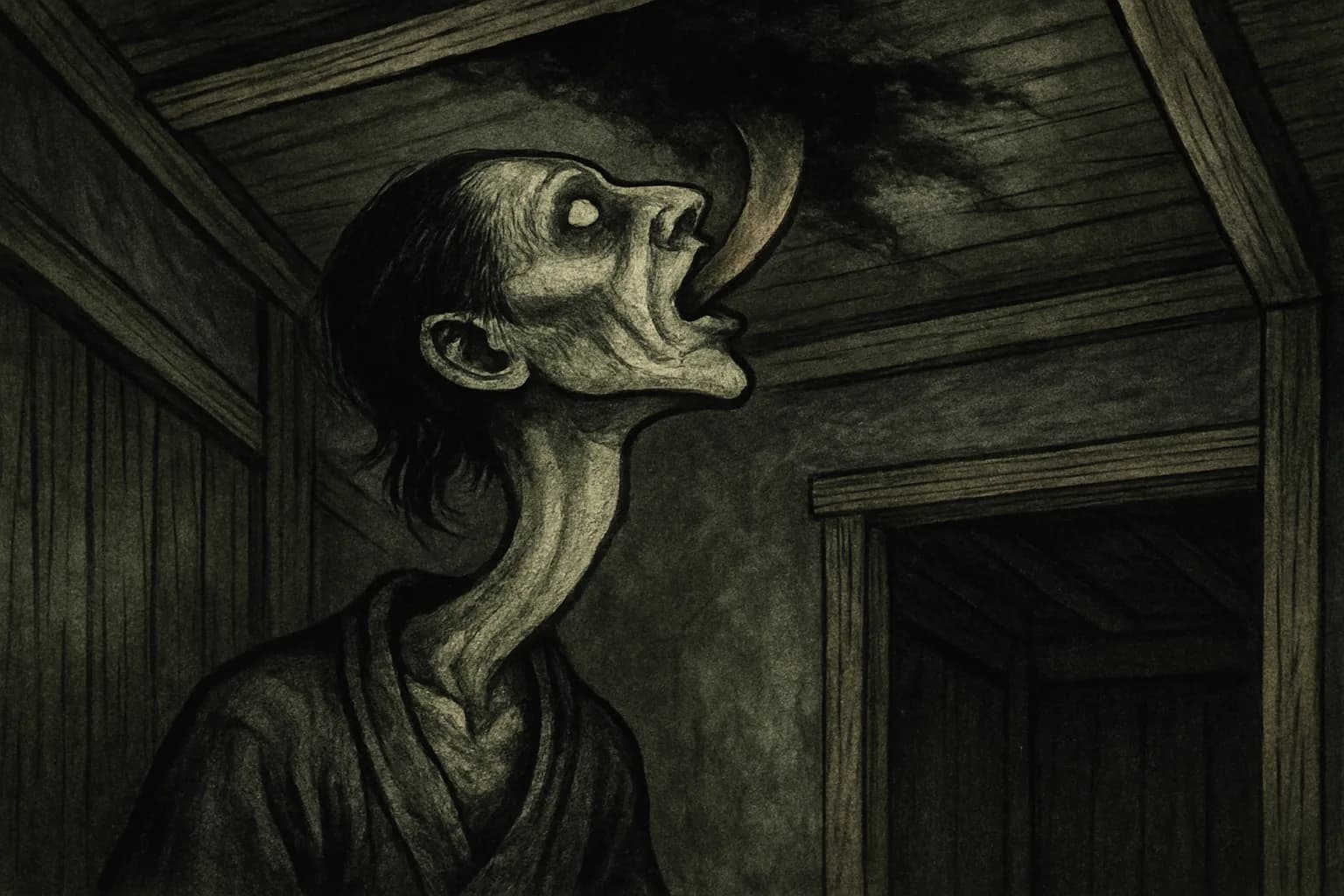
Nobody can say with confidence, and that uncertainty is the point. Toriyama Sekien drew it for his 1776 print series Gazu Hyakki Yagyo (画図百鬼夜行, "The Illustrated Night Parade of a Hundred Demons") as a wide-mouthed, oni-like face looming out of the dark behind a torn paper screen or crumbling wall — the kind of gap you'd find in a house nobody has repaired in years. But Sekien's own image is a guess, an artist filling in a blank. The written accounts that fed his print never describe a face, a shape, or even a size. They only describe a sound coming from a building where no one should be.
A voice from an empty house
The setting is always the same: a temple gone to ruin, a house abandoned after its family died out or moved on, the kind of structure people in Edo-period Japan already associated with lingering misfortune. Someone passes too close, or is foolish enough to peer inside, and the silence breaks with that one bellowed syllable. It is loud enough to stop a traveler's heart, and that is apparently the whole ambition of the thing. There is no report of Uwan touching anyone, dragging anyone off, or being seen twice.
That restraint is unusual for a yokai catalogue built largely from cautionary tales about drowning, kidnapping, and curses. Uwan doesn't warn children away from rivers or explain a death. It explains a single, specific kind of fright: the jolt of a loud noise in a place you already suspected was wrong.
Answer it back
Folk instruction for surviving an Uwan encounter is refreshingly simple, and it's the detail every retelling keeps. If the voice shouts "Uwan!" at you, shout "Uwan!" back. According to the tradition Sekien was drawing on, that's the end of it — the thing goes quiet and leaves you alone. There's no bowing, no offering, no ritual object required, just matching the noise with equal noise. It plays like a rule for children too scared to walk past a haunted house alone: answer the dark, and the dark backs down.
Where it comes from
Sekien built much of the Gazu Hyakki Yagyo out of wordplay and half-remembered local superstition, giving concrete faces to phenomena that were really just noises, coincidences, or unease about specific kinds of places — the echo he turned into Yamabiko, the damp bathroom stain he turned into Akaname. Uwan belongs to that same family: an onomatopoeic name (there's no kanji for it, only the sound spelled out) attached to the universal experience of a derelict building making an unexplained noise. Regional folklore from Aomori carries a similar belief about voices calling from old, empty structures, and it's easy to see the two traditions feeding each other — a real, spooky, structural creak or gust of wind through broken walls, given a name and a rule for dealing with it.
Read this way, Uwan isn't really about a monster at all. It's what happens when a culture takes "that old house makes me uneasy" and turns it into a character with a single line of dialogue.
Uwan today
Because it has no design to protect and no famous battle to its name, Uwan rarely gets top billing outside of yokai reference works, where it's a fixture of any complete run-through of Sekien's night parade. Folklorists who write about the hyakki yagyo prints still single it out as one of the purest examples in the catalogue of a yokai defined entirely by sound rather than sight — a monster you could describe accurately without ever having seen it, because nobody ever has.