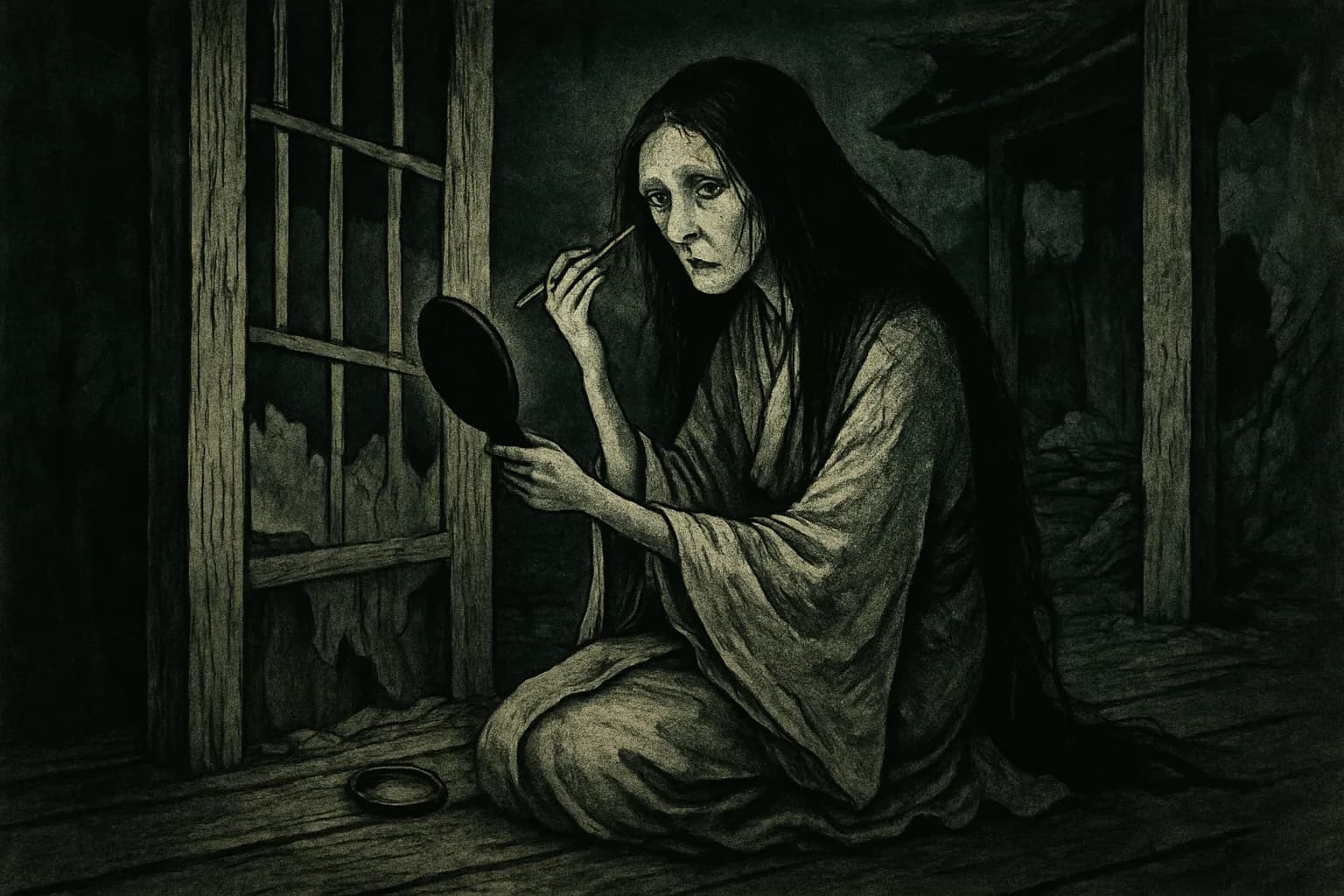
Walk past a shuttered mansion in old Kyoto, the kind whose garden has gone to weeds and whose sliding doors have rotted off their tracks, and folklore says you might still find a light in one room. Inside, a woman in faded court robes sits before a mirror, blackening her teeth and shaping her eyebrows exactly as court etiquette demanded centuries ago. No one is coming to see her. She grooms herself anyway.
What does it look like?
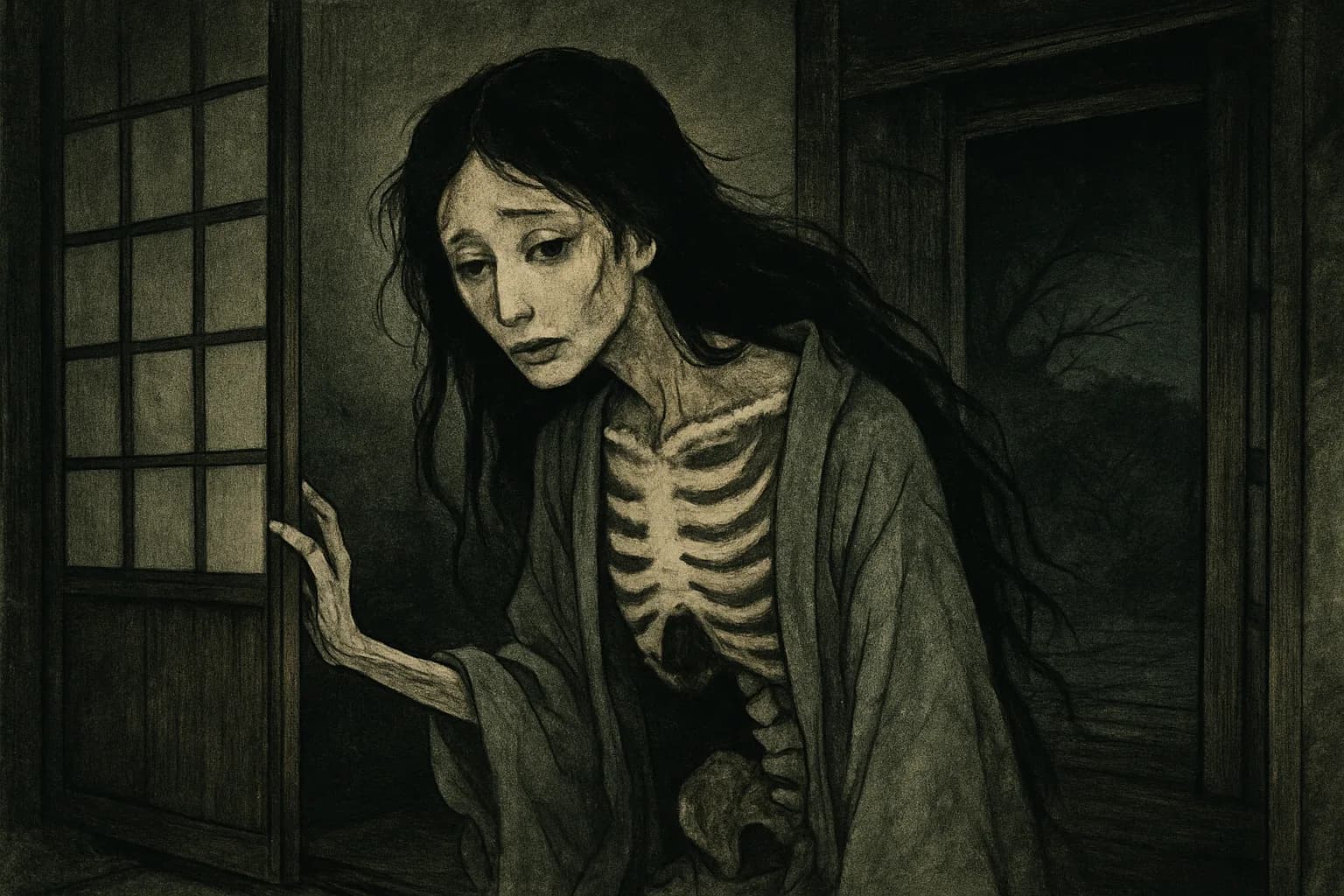
Toriyama Sekien drew Ao-nyobo for his 1781 catalogue Konjaku Hyakki Shui (今昔百鬼拾遺, "A Supplement to the Hundred Demons of the Past and Present"), and the print is quieter than most of his monsters. She appears as a woman in the multi-layered robes of a Heian-style lady-in-waiting, hair grown long and unkempt, seated in a decaying room with a hand mirror or cosmetic box nearby. Her teeth are blackened in the ohaguro style and her brows are plucked and repainted higher on the forehead as hikimayu — both standard aristocratic fashions for women of rank, kept up here long after the household around her has fallen apart.
A lady-in-waiting who never received a promotion
The name is a small joke buried in classical vocabulary. In Heian-period court usage, ao-nyōbō was a real term for a junior or inexperienced lady-in-waiting — someone new enough to the palace hierarchy that she was still assigned the plainer blue-green (ao) robes given to low-ranking attendants, rather than the more elaborate colors senior women earned. Sekien took an ordinary bureaucratic label for "the new girl on staff" and gave it a second life as a ghost who is still, after everything, waiting for her career at court to go somewhere.
That reading fits the picture. She isn't a fearsome apparition reaching for a victim. She is stuck at her toilette, endlessly rehearsing the self-presentation a court lady owed to a household that no longer exists to see it.
Habits of an empty house
Ao-nyobo's stories, such as they are, stay small and domestic. She doesn't chase travelers or curse a bloodline. She occupies abandoned aristocratic residences — the kind of once-grand yashiki left to rot after a family's fortunes collapsed, a common enough sight as Kyoto's court nobility lost income and relevance across the medieval and early modern centuries — and continues her routine there: dressing, blackening her teeth, adjusting her eyebrows, as if a lord might still walk through the gate and expect to find the household properly turned out. The dread in the image comes less from violence than from repetition: a ritual of readiness performed for a guest who is centuries overdue.
Where it comes from
Sekien's entries in Konjaku Hyakki Shui often work by taking a real word or social type and pushing it slightly askew into the supernatural, and Ao-nyobo reads as exactly that kind of literary invention rather than a transcription of village belief — no earlier source or regional oral tradition for her has been recorded. The joke depends on knowing court vocabulary: an audience that recognized ao-nyōbō as "junior attendant" would catch that Sekien had turned a real rank into a haunting, using the abandoned mansion as a stand-in for a court whose glory had already drained out of it by his own era. Edo-period readers, several centuries removed from the Heian aristocracy at its height, would have found real pathos in a ghost still performing the manners of a world that had already ended.
Ao-nyobo today
She has stayed a minor figure, cited mostly in yokai reference books alongside Sekien's other prints of solitary women in decayed settings, without a signature legend or a battle scene that would give her a modern foothold in games or anime. What survives is the print and its quiet joke: a woman who never made it past junior rank, still keeping herself presentable in a house nobody visits anymore.