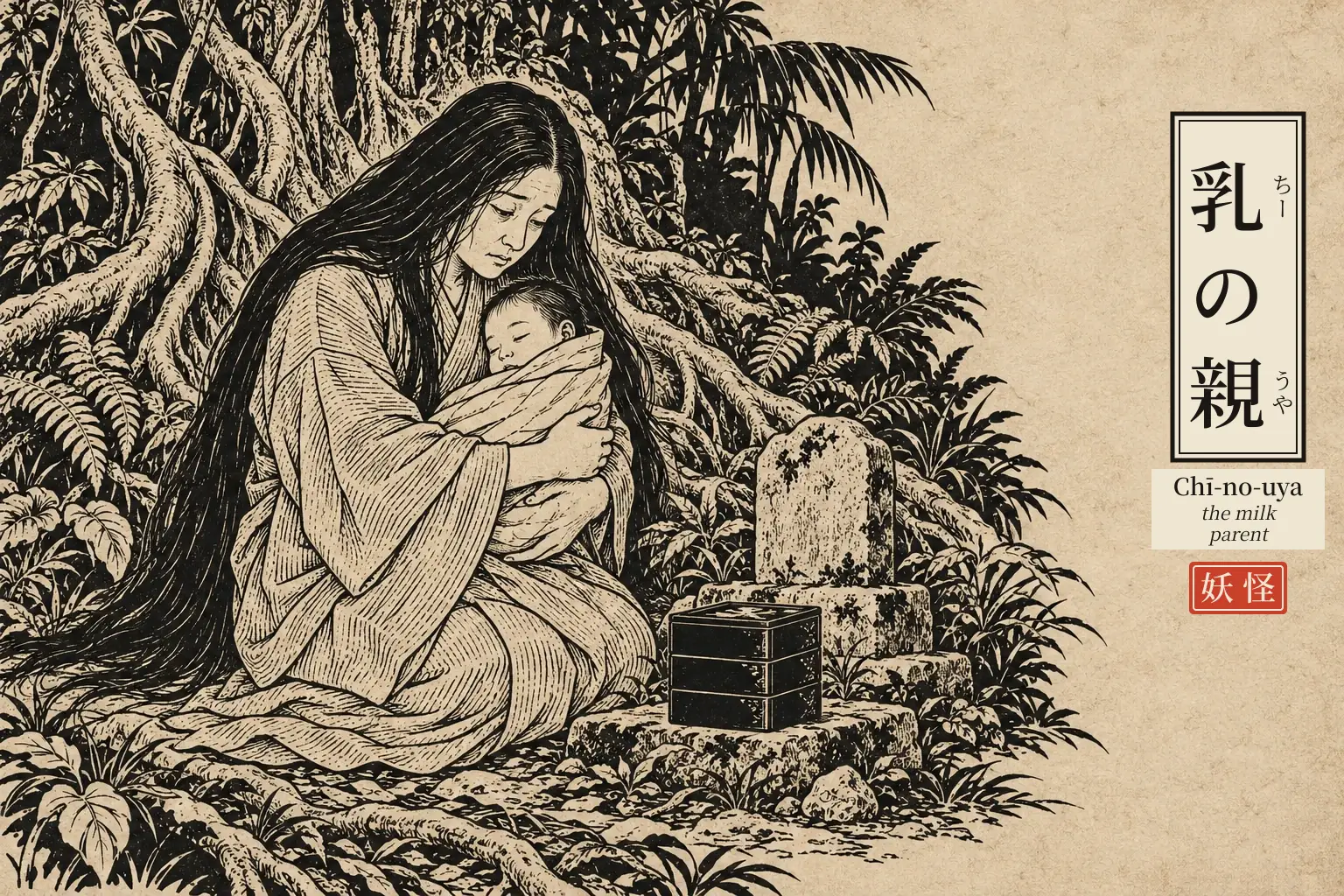
At the edge of a village in Kunigami or Ōgimi, at Okinawa's northern tip, there is a small grave for a child who died too young. It is called a warabe-baka. Families did not treat it as empty ground. They packed food into a jūbako, a stacked lacquer box, and left it there as an offering. The offering had an address: chi-no-uya (乳の親), written with 乳 (chī, "milk" or "breast"), の (no, "of"), and 親 (uya, "parent"). The milk parent. A yokai believed to live at the grave and nurse the dead child herself.
What does chi-no-uya look like?
Two Okinawan folklore records describe her the same way. She has a gentle face. Her black hair hangs long, with the soft, worn look of hair washed many times over. Her breasts are very large — a detail one source and one of the anecdotes below both single out, and the one that gives her both her name and her job.
In Kunigami and Ōgimi, she nurses the dead
A 1933 folklore dictionary, the Nihon Minzokugaku Jiten, records the custom plainly. Children who died young in these two villages were buried at a warabe-baka. The chi-no-uya was said to live at the grave. She nursed the children buried there. When a child of six or younger died, the family prepared food in a jūbako and set it at the grave. It was an offering, and a request: care for this child now.
In Nakijin and nearby villages, she takes the living
Travel south along the coast to Nakijin village, and the story turns on its head. There, and in nearby places, the chi-no-uya living at a grave or in water is not asked to nurse anyone. She is feared for taking children who are still alive. Parents avoided letting an infant see its own reflection. A baby shown a mirror, it was said, would mistake the water's surface for glass. It would want to crawl toward the water. And the chi-no-uya, waiting there, would pull it under.
Two stories from the villages
The folklorist Shimabukuro Genshichi wrote down two anecdotes in his 1929 book Yanbaru no Dozoku, "Folk Customs of Yanbaru." Both are credited to the chi-no-uya, though neither names a village.
In the first, a child was recovering from an illness in bed. A woman with large breasts appeared. She beckoned, "come here," and vanished. At once the child's condition worsened, and the child died not long after.
In the second, a woman nobody recognized came again and again to a shop to buy sweets, a baby in her arms. Her hair looked freshly washed. Around that same time, villagers kept hearing a baby cry from a grave at the edge of town — except, oddly, never while the woman was in the shop. When people finally opened the grave, they found a living baby inside, crying.
Where it comes from
Nakayama's account of Kunigami and Ōgimi, and Shimabukuro's account of Nakijin and nearby villages, describe what sounds like one creature doing two opposite jobs: comforting the dead in one place, endangering the living in another. Okinawan folklore does not reconcile the two traditions. It simply records both, side by side, each tied to its own villages.
Even her name is unsettled. Japanese Wikipedia lists three readings of the same characters: chī-no-uya, chichi-no-uya and chichi-no-oya. We could not match each reading to the source that uses it.
One belief answers a dead child's loss with comfort, imagining it still fed and held. The other answers a living child's danger with vigilance, warning parents not to let it wander near graves or water. Both versions reach for the same image — a woman whose body is built only for nursing — to carry a warning or a wish that plain words could not hold.
Go deeper
Where Japanese ghosts come from.
- Yūrei: The Japanese Ghost →Zack DavissonWhere Japanese ghosts come from, told through old paintings, kabuki and ghost stories.
- Kwaidan: Stories and Studies of Strange Things →Lafcadio HearnThe classic 1904 collection of Japanese ghost stories that shaped how the West first met kaidan.
Some links are affiliate links; if you buy through them we may earn a small commission at no extra cost to you.
Chi-no-uya in Okinawa today
The warabe-baka Nakayama described in 1933 belonged to Kunigami and Ōgimi specifically, villages that still stand today in the same forested district of northern Okinawa. Whether the offerings he recorded are still made is not something any source consulted here confirms. What survives clearly is the record itself: Kunigami, Ōgimi, Nakijin and elsewhere, one yokai, and two very different reasons to be careful around a child's grave.