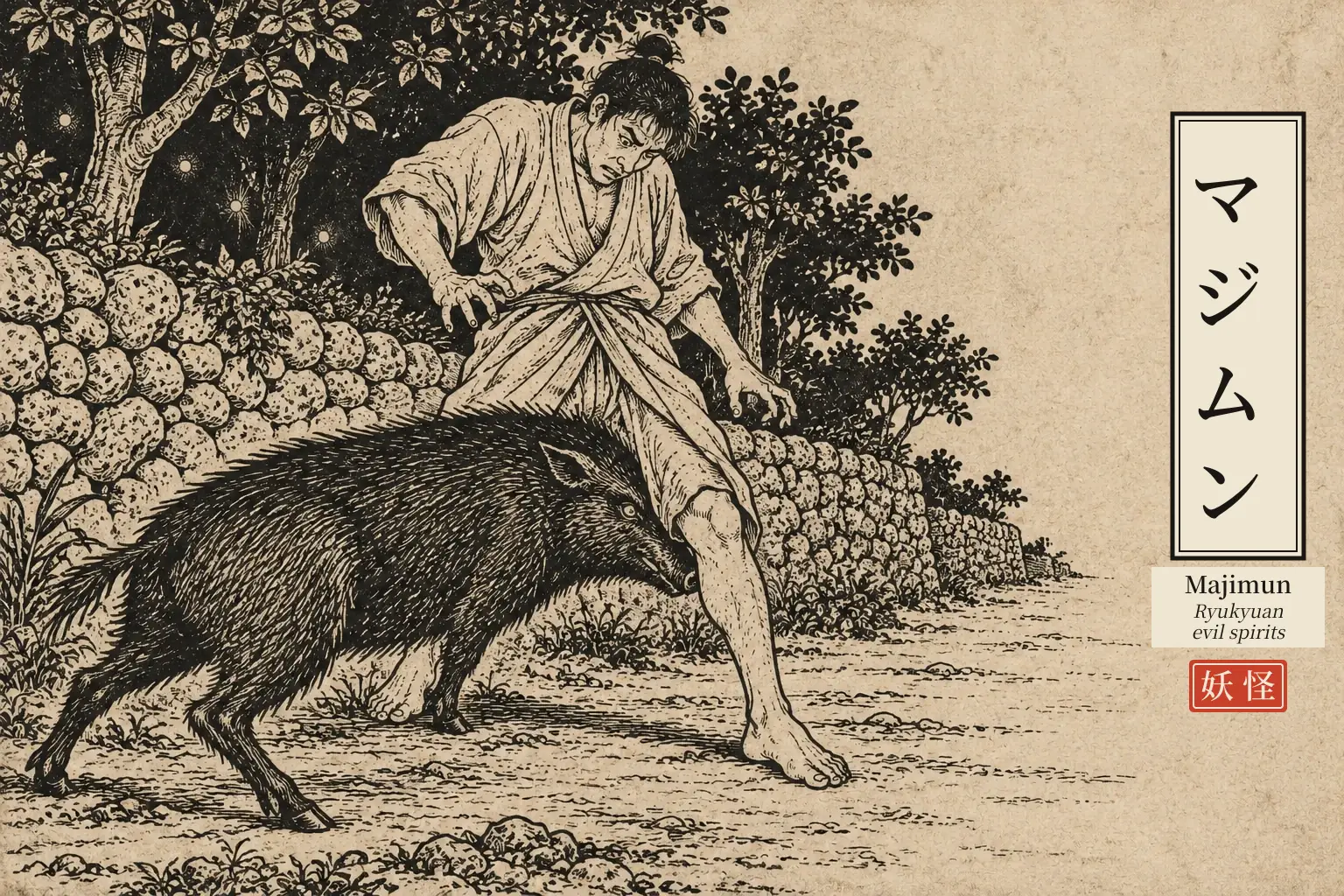
Majimun is an umbrella word. In the Ryukyuan speech of Okinawa and the Amami Islands, it names many of the evil spirits in that tradition. The word covers a dead baby's ghost, a transformed pig, a runaway funeral bier, and a worn-out rice paddle that has become something else. Ask what a majimun looks like, and the honest answer is: it depends which one.
One rule holds across almost every kind. Let an animal-shaped majimun crawl between your legs, and you die. Okinawan children grew up warned never to let it happen.
The types, and the one that's real
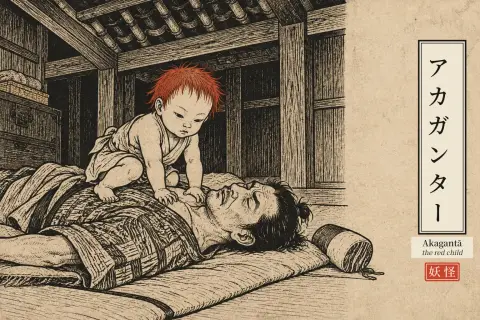
Most majimun take an animal's shape. Akangwaa-majimun is the ghost of a dead baby, moving on all fours and trying to crawl under a person's legs just like the others. Ushi-majimun looks like a cow. In Yomitan village it's described as something close to jet black. In Shimajiri district, people say it's actually a gan, the lacquered bier used to carry a coffin at a funeral, wearing a cow's shape. Uwaagwaa-majimun takes a pig's form and waits on dark roads. Afiraa-majimun takes a duck's shape; one source, which calls it Aifuraa-majimun instead, describes it as missing one leg.
Only one majimun is not a spirit at all. In parts of the Amami Islands, people call the habu — a real, venomous pit viper — a majimun too, and treat it as a messenger of the gods. Every other majimun is something that was never alive, or stopped being alive, and started moving anyway.
A duck made of fireflies, a cow with a secret horn
The old accounts are oddly specific about how each majimun got caught.
A farmer walking home one night ran into an Afiraa-majimun. It kept trying to pass between his legs, so he threw a stone at it. It burst apart into countless fireflies, scattered around him, and vanished at the first crow of a rooster.
A karate practitioner once fought a cow majimun outright. After a long struggle he broke off one of its horns and pinned it to the ground — then passed out from exhaustion himself. By morning, the horn had turned into a decoration from a funeral bier. The cow had been the gan all along.
The gan-no-majimun, the bier-spirit itself, is said to haunt a slope called Bunbun-zaka in Unten, part of Nakijin village, where it takes the shape of a cow or horse and attacks travelers. On Miyako Island, where funeral biers are painted red, it is said to appear instead as a red horse. And outside a house where someone lies near death, people reported hearing the gan-no-sei pacing — footsteps, and a creaking sound, as if someone were shouldering a heavy load.
The pig game at the night gathering
Okinawan cooking has long favored pork, and the pig-shaped majimun shows up in that light. Young people used to gather at night in the fields for mo-ashibi — playing the three-stringed sanshin, singing, courting. If a stranger wandered in, the group would chant at them: "Uwaanta, guuguunta" — pig words, pig noises — to see how they reacted. A human stranger stayed put. Uwaagwaa-majimun, the pig itself, would bolt.
On Amami Ōshima, a cluster of related pig-monsters each carry a missing body part: one lacks an ear, another both ears, another an eye. Uwaagwaa-majimun isn't described with any missing part. It still isn't human.
Hichi, the one that walks you away
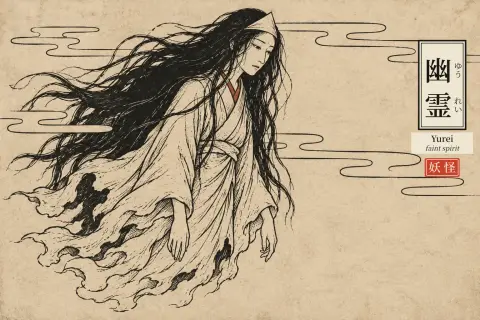
Hichi-majimun is a yūrei, a ghost — one of at least two ghost-type majimun here, alongside the baby-ghost Akangwaa. It waits at crossroads to lead travelers astray, and once it has you, it can cover ground "like the wind," carrying victims twenty or thirty ri from home before letting go. It forces a choice: red rice or white rice. Choose red, and it feeds you red clay. Choose white, and it feeds you sea foam. Walking a night road with a comb stuck in your hair, or a sieve in your hands, is said to be an open invitation to it. The old countermeasure was gendered: a man ties on a fundoshi loincloth as a headband, a woman drapes a koshimaki waist-wrap over her head, and either is said to turn Hichi away.
On Kikaijima, in the Amami Islands, a folktale called "The Twenty-Third Night" tells of a woman who died in a difficult childbirth and became a black, pillar-shaped spirit reaching from the ground to the sky. Locals there call her Shichi, and some tellings treat her as the same being as Hichi, just under the island's own name for it.
Even furniture gets a turn. Mishigee-majimun is an old rice paddle that has outlived its use and become something else. A related type, made from a worn ladle, goes by Nabigee-majimun.
Where it comes from
Majimun has no single origin story, the way kappa or tengu do. It works more like the English word "monster": a label that many separate, local ghost stories all happen to answer to. The earliest written record is Shimabukuro Genshichi's 1929 book Yamahara no Dozoku, which describes the crossroads-haunting Hichi. The animal- and object-shaped types — the cow, the pig, the paddle — first appear in print two years later, in Kinjō Chōei's 1931 survey "Ryūkyū Yōkai Henka Shumoku," in the journal Kyōdo Kenkyū. Scholars since have mostly treated majimun the way a dictionary treats a category word, cataloguing everything it was used to describe rather than settling on one shape for it.
That habu snake is the clue worth sitting with. Everything else called majimun is dead matter moving — a corpse's spirit, a broken paddle, a funeral bier. The one real animal on the list is also the one actually dangerous to meet in the dark. The word seems to have grown to cover anything in the Ryukyuan night that could kill you without warning, whether or not it was ever alive.
Go deeper
Where Japanese ghosts come from.
- Yūrei: The Japanese Ghost →Zack DavissonWhere Japanese ghosts come from, told through old paintings, kabuki and ghost stories.
- Kwaidan: Stories and Studies of Strange Things →Lafcadio HearnThe classic 1904 collection of Japanese ghost stories that shaped how the West first met kaidan.
Some links are affiliate links; if you buy through them we may earn a small commission at no extra cost to you.
Majimun today
Okinawa's homegrown superhero show, Ryūjin Mabuyā (2008–2010), cast the "Majimun Gundan" as its villain army, and the heroes fight to protect the mabui stones from it. The lineup reads as a direct pull from the folklore word.
Majimun are said to be poor at turning corners. Reach a dead end at a T-junction, and one that is coming down the road goes straight on into whatever house sits directly opposite. That is why an ishigantō, a small inscribed stone tablet, is still set up at these dead-end junctions in Okinawa today. It is there to stop the majimun at the corner.