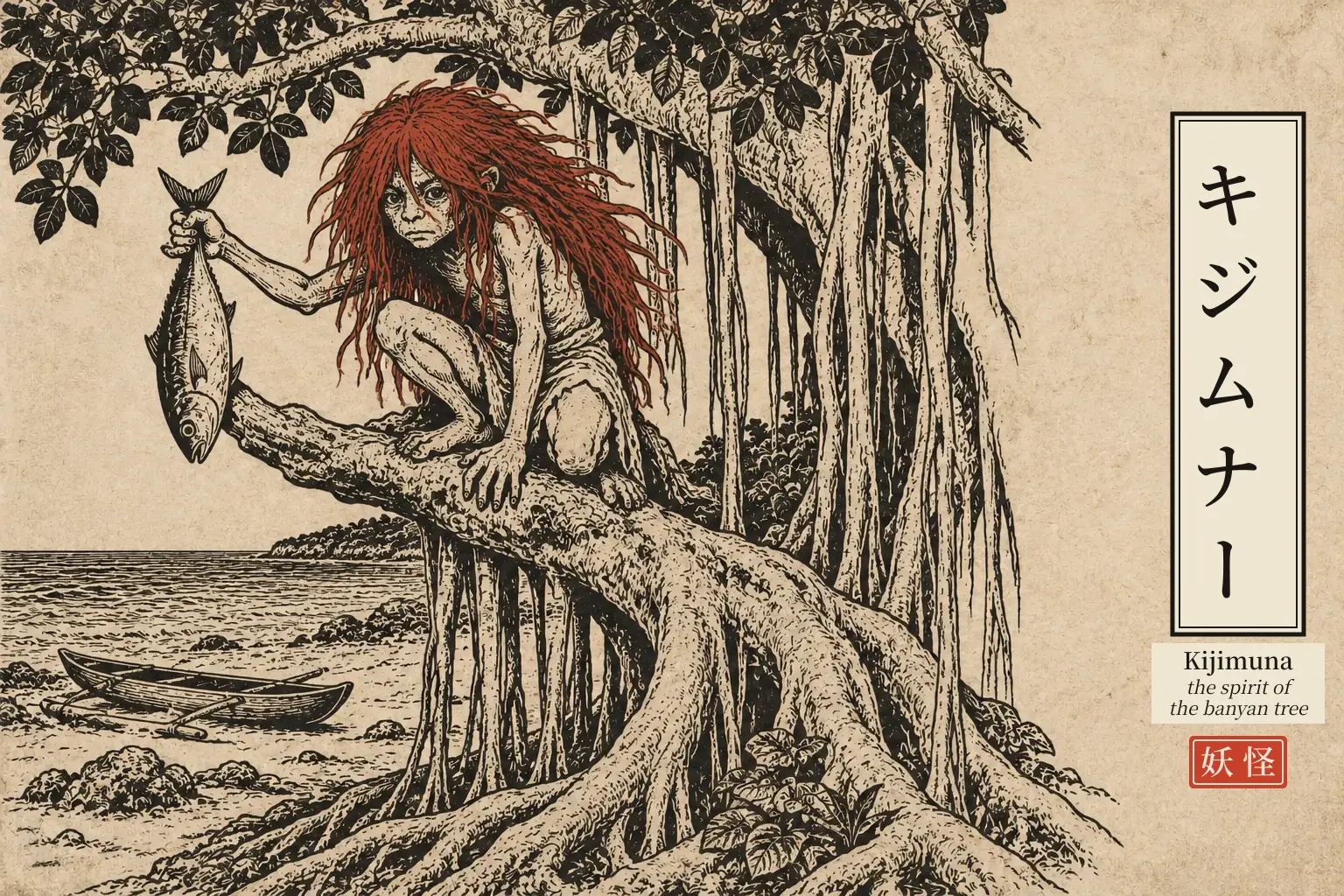
A child sits in the branches of an old tree, hair bright red, legs swinging. Get on its good side, and it will keep you supplied with fish for life. Cut the tree down, and it will drown you. This is kijimuna, the tree spirit of the Okinawa Islands. Its name is written in katakana — キジムナー — with no kanji of its own.
What does it look like?
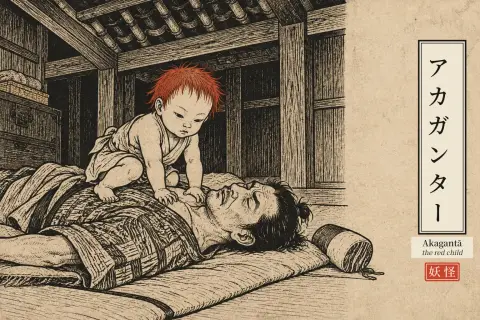
Most accounts describe kijimuna as a child whose entire body is bright red. Others say it simply has red hair, or a red face. Some tellings make it long-haired and hairy all over instead. A few say its hands stretch out like tree branches. Others say it looks like an old man at first glance — until you notice it is actually the tree. In certain regional versions it grows large and pitch black. Some stories give it unusually large testicles, a detail that comes up more than once in the old accounts.
It walks with a bounding, hopping gait. It has both male and female forms. It grows up, marries, and is sometimes said to appear with a whole family in tow. It lives inside an old tree — most often a banyan, or gajumaru, the thick-rooted fig that grows across Okinawa.
A good neighbor, until it isn't
Kijimuna is rarely hostile on its own. People who get along with it describe something closer to a neighbor. It rides along on fishing boats and helps haul in the catch. It lends a hand with chores for a meal in return. It comes to borrow fire from the hearth at dinnertime, and is even said to spend New Year's with the families it favors.
Among the things it loves to eat are river crabs and fish eyes — especially the left eye, or both. Fish it a gurukun — a common reef fish — and it is said to prefer eating the head. Befriend a kijimuna, and it will keep bringing you more fish than you can use. That is supposedly how a family gets rich off one. There is a catch, literally: every fish it helps you catch comes back missing an eye. That is the part it already ate.
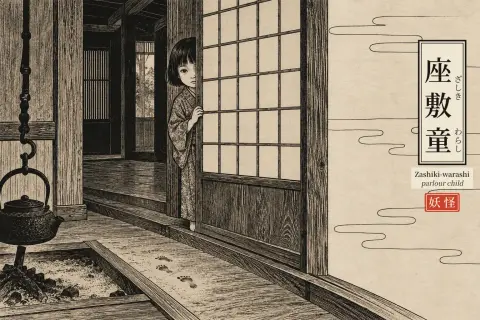
The goodwill has a hard limit. Cut down or mistreat the tree a kijimuna lives in, and it is said to retaliate. It can kill livestock, sink boats, or drown the people responsible. It plays smaller tricks too. It disguises red clay as red rice to feed to people. It traps someone in a space as narrow as a tree hollow. It presses down on sleepers in the night, or steals a traveler's light on a dark road. It can reportedly slip through any gap, no matter how small. Much like the zashiki-warashi of the Tōhoku region, a kijimuna's favor is said to make a household prosper — and its dislike, to run one into ruin.
How people kept it close, or drove it off
Okinawans who wanted a kijimuna gone had a short list of things it reportedly hated: octopus, chicken, a hot pot lid, and farts. Burning its tree, or driving a nail into the trunk, was also said to work. One story collected from the islands warns what that can cost. An old man had befriended a kijimuna, then grew uneasy and drove it away using these methods. He died three days later.
In Kijoka, a hamlet in Ogimi village, locals call it bunagayaa. The legend is said to have begun there. Each year, on the old lunar calendar's eighth day of the eighth month, it was said to visit a certain house's pigpen, strangle the pig, and burn the body. A man in the same village once broke wind at a kijimuna for a laugh, after it had given him fish. It shoved him into a deep part of the river, and he drowned.
A darker variant lives on Yaganna, a small island in the Haneji Inland Sea used only for burials and off-limits to casual visitors. There the spirit is called seema. A trespasser who sets foot on the island risks being suffocated — a male seema forcing its genitals, and a female seema its breast, into the intruder's mouth.
Even into the Shōwa era, Okinawan children played a game to see a kijimuna's footprints. Draw a circle on quiet, dim ground. Scatter white flour inside it, and light incense at the center. Say a chant, hide, and count to about twenty. Come back, and footprints appear in the flour.
Where it comes from
One scholarly theory names the spirit kiinushii: the old Okinawan belief that something lives inside a large tree. In this reading, kijimuna is that belief given a child's face and a temper. What sets kijimuna apart is how social it is. It marries, raises a family, and fishes alongside people. It keeps a grudge like a neighbor would, not like a nature spirit kept at arm's length. Folklorists have also compared it to the kappa, for its child-like body and its dealings with humans. By the usual academic account, the legend has no confirmed roots in the Yaeyama Islands further south. Today, though, it is treated as belonging to the whole of Okinawa.
Kijimuna also answers to several other names, depending on where you are: seema, seemagu, bunangayaa, bunagai, michibata, handanmii, and akagandaa. That spread is a reminder: this is oral, village-level folklore, not a single fixed text.
Go deeper
Books worth owning if this world pulls you in.
- The Book of Yokai →Michael Dylan FosterThe most readable scholarly introduction to yokai — where they come from, what they mean, and the major creatures.
- Japandemonium Illustrated: The Yokai Encyclopedias of Toriyama Sekien →trans. Hiroko Yoda & Matt AltThe complete Edo-period bestiaries that so many of these entries trace back to, in full English translation.
Some links are affiliate links; if you buy through them we may earn a small commission at no extra cost to you.
Kijimuna in Japan today
A bronze statue of the kijimuna stands on the Mizuki Shigeru Road in Sakaiminato, Tottori. In Okinawa itself, the local broadcaster Okinawa Television uses a kijimuna mascot, nicknamed Yu-tan. A station on the JR West Sakai Line, properly named Babasakichō, carries "Kijimuna Station" as its yokai-themed nickname. Okinawa Pro-Wrestling once had a masked wrestler built around the character, who fought under the name Dingo.
Yaganna, the island where its darkest story is told, is still kept only for burials. The pigpen in Kijoka, where it is said to appear every year, is a smaller thing — one house, one date on the old lunar calendar, each August.