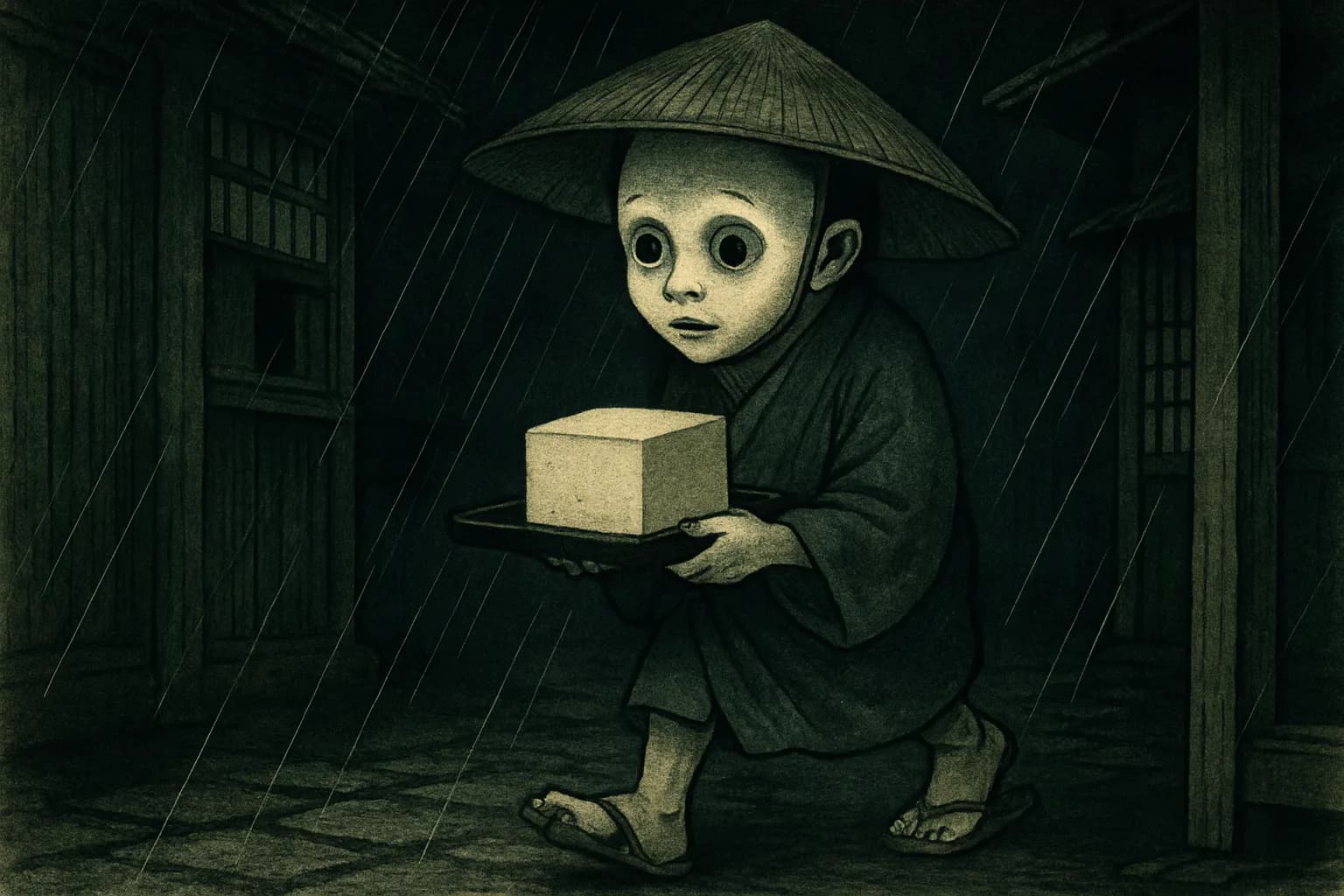
A boy in an oversized straw hat, soaked from the shoulders down, stands at the edge of a puddle holding out a wooden tray. On it sits a single block of tofu, topped with a bright maple leaf. He says nothing. He doesn't need to — tofu-kozo has been showing up like this on rainy Edo nights, tray extended, for close to two hundred and fifty years.
What does it look like?
The name is the whole description: 豆腐 (tofu) and 小僧 (kozo, "little boy" or young temple page). Most illustrations agree on the essentials — a child, dressed like a novice monk or errand boy, wearing a wide kasa hat far too big for him, out walking in the rain with a small tray balanced in both hands. On the tray: one square of tofu, garnished with a maple leaf pressed into the surface. Later prints, especially through the early 1800s, sometimes gave him a single round eye in the middle of his face, borrowing the look of the older roadside spirit hitotsume-kozo.
He doesn't lurk in a specific river, mountain, or shrine the way most yokai do. He just appears — on a wet road, under an eave, at the edge of a bridge — and holds out the tray.
An Edo bestseller before he was a yokai
Tofu-kozo is unusual among yokai because the paper trail runs the other direction. He didn't start as village folklore that writers later collected; he started as a character in kibyoshi, the illustrated comic booklets sold on the streets of Edo, sometime in the 1770s. From there he spread fast: cheap woodblock omocha-e (toy prints) sold him as a paper toy, he turned up in board games and gag prints, and by the time Toriyama Sekien folded him into his yokai compendium Konjaku Hyakki Shui (1781), he was already a familiar face to Edo readers rather than a new discovery. Scholars who study Edo print culture, including Adam Kabat, have pointed to tofu-kozo as one of the clearest early cases of a yokai built and sold as entertainment merchandise, decades before "character goods" was a phrase anyone used.
What happens if you take the tofu
For a creature with no bite, claw, or curse to his name, tofu-kozo carries one quietly unsettling piece of folklore: old accounts warn that eating the tofu he offers will cover the eater's body in mold, the same way a forgotten block of tofu sours and spots in damp weather. Nobody tells a story about him dragging anyone into a river or stealing a soul. The worst he does is make you smell like his rain-soaked tray.
That mildness was more or less the joke. Edo audiences already had plenty of genuinely dangerous yokai to worry about; a spirit whose entire threat was bad snack etiquette read as funny precisely because it broke the pattern.
Where it comes from
Because tofu-kozo emerged from popular fiction rather than village belief, his "origin" isn't a folk explanation for a real fear the way the kappa explains drownings. He's closer to a running gag that solidified into a stock character — a boy shape, a hat, a tray — flexible enough for different artists and writers to riff on for decades. The occasional overlap with hitotsume-kozo's single eye suggests illustrators borrowed freely between yokai characters that shared a "small, harmless, roadside" niche, mixing and matching features as the fad demanded.
Tofu-kozo today
The tray-and-tofu silhouette still gets used as visual shorthand for "gentle, minor yokai" in modern manga and anime that stage large casts of folklore creatures, including background appearances in Mizuki Shigeru's GeGeGe no Kitaro, where he shows up as one face among Kitaro's crowd of yokai allies rather than as a rewritten character. Historians of Japanese pop culture have started citing him as an early data point for how far back "cute mascot from something scary" goes in Japan — long before kappa plushies or prefectural mascot costumes, there was a soggy boy in a big hat, selling tofu nobody asked for.