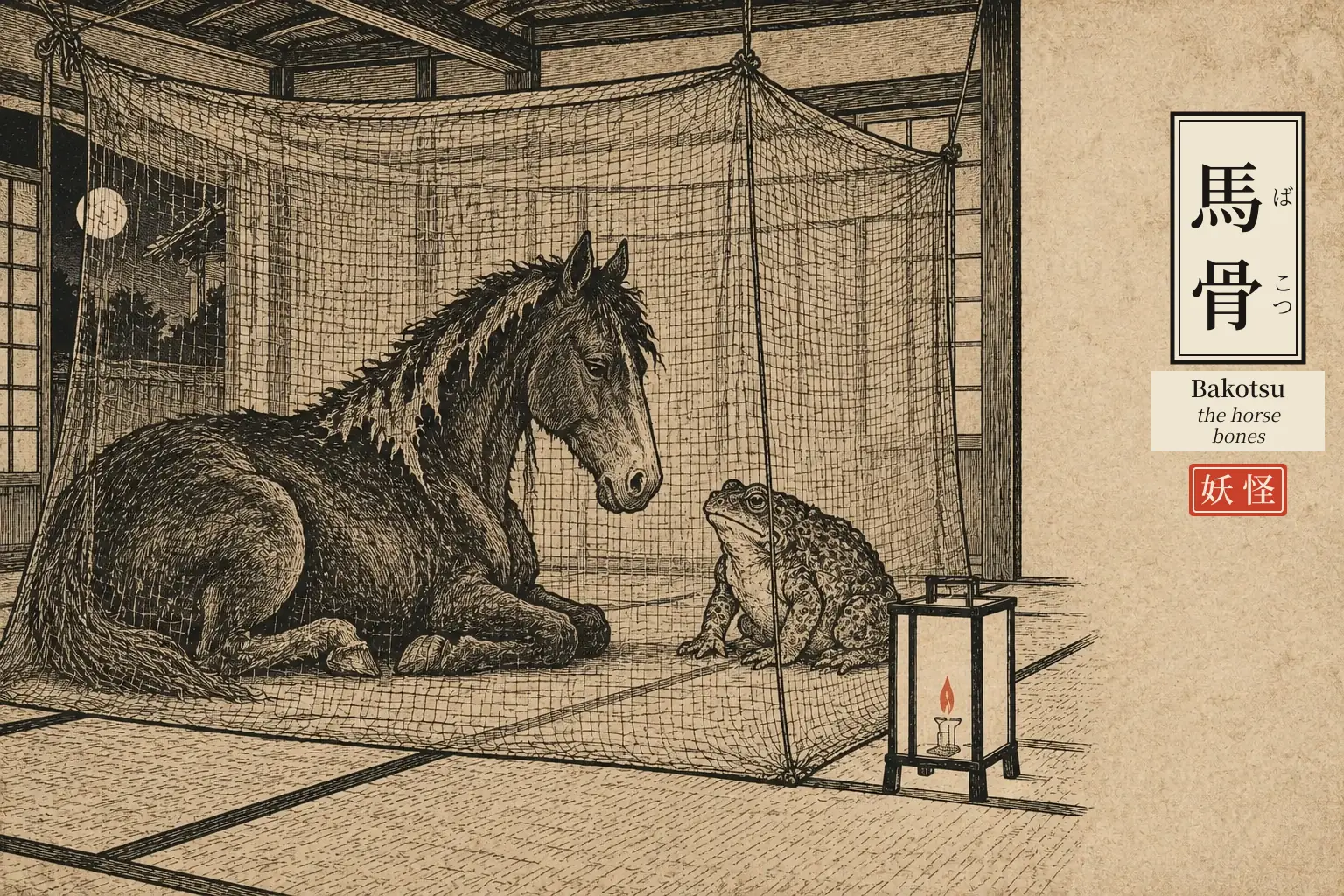
A mosquito net hangs in a room. Inside it, two animals face each other. One is a toad. The other is a horse that died in a fire. This is the bakotsu (馬骨), and its name is as plain as it gets: 馬, "horse," and 骨, "bone."
It comes from one scene in one scroll, which survives in two copies. Yet that scene holds a small map of old beliefs about fire, animals and the home.
What does it look like?
The bakotsu is a horse yokai. The scroll shows it indoors, inside a kaya, the hanging mosquito net of an old Japanese bedroom. Inside the net with it is Yadomori, a toad yokai. The two face each other.
The scroll's text says what the horse is. It is a horse that burned to death in a fire and turned into a yokai.
Modern English descriptions, such as the English Wikipedia entry, call it a skeletal, flaming horse. The Japanese sources we read describe the scene, not a skeleton.
The scroll it lives in
The bakotsu appears in the Tosa Obake Zōshi, a picture scroll of 16 yokai tales. All of them are set in Tosa, today's Kōchi Prefecture, on the island of Shikoku. The scroll opens with yokai from all over Japan gathering in Tosa. It closes at dawn, as they all leave.
The painter is unknown. Scholars, including the folklorist Tsunemitsu Tōru, think it was an unknown country painter, not a famous artist. They call the drawing plain and clumsy. Komatsu Kazuhiko and Tsunemitsu both note that its yokai feel friendly more than frightening.
Two copies survive, and they do not quite match.
| Copy | Date | Notes |
|---|---|---|
| Privately held | Judged mid-to-late Edo period | A colophon says it was used to entertain a young lord at night |
| Sakawa Town Board of Education, Kōchi | Dated Ansei 6 (1859) | Same tales, but a different order and some different details |
The bakotsu appears in both. How the Sakawa copy reached the town's board of education, and how the scroll was passed down, is still unclear.
The toad inside the net
The bakotsu's partner explains a lot about it. Yadomori, 宿守, means roughly "house keeper." On Shikoku it was simply a regional name for the toad. It was not a name kept for a monster.
People believed the toad guarded the home. In the Uwa area of Ehime, it warned the family of burglars. In Kōchi, a toad living under the floor would hug the main pillar during a storm. A house it guarded, people said, did not catch fire.
So killing one was a bad idea. The scroll says the Yadomori comes into the bedroom of whoever killed a toad. Tsunemitsu reads this as the logic of the picture. It shows an animal people were told not to kill, coming back to the person who did.
Why a burned horse?
The horse may follow the same logic; that is our reading, not a source's. In many parts of Japan, people held that letting your animals die in a house fire was bad.
| Where | What it brought |
|---|---|
| Yamaguchi | The house would not prosper |
| Shizuoka, Yamanashi, Aichi, Fukui | A curse lasting seven generations |
In Tōhoku and other areas, people said horses feared fire. A horse that saw flames during a house fire could freeze and fail to run.
Where it comes from
Horse bones and fire were already linked in old Japan. In the Edo period, people made cheap, poor candles from fat taken from horse bones. Those candles were also called uma no hone, "horse bone."
There is also a saying: doko no uma no hone, "a horse bone from who knows where." A cattle version exists too. One folk explanation ties it to the bones of horses and cattle burned in fires. Japanese Wikipedia suggests the scroll's note about fire may draw on that idea.
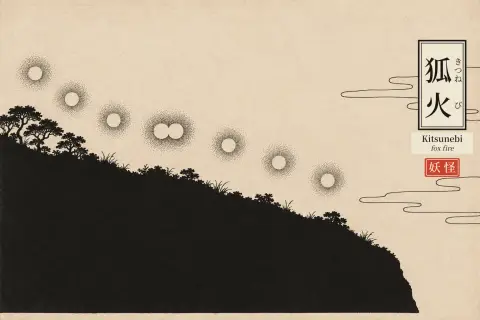
Foxes come into it too. An old belief held that foxes burned horse bones as fuel for kitsunebi, or fox fire. A 1968 edition of the Muromachi-era dictionaries Jinten Ainōshō (1532) and Ainōshō records it.
Put together, the scene pairs two animals that households were told not to let die. One is killed by a person. One is lost to fire.
Go deeper
Where Japanese ghosts come from.
- Yūrei: The Japanese Ghost →Zack DavissonWhere Japanese ghosts come from, told through old paintings, kabuki and ghost stories.
- Kwaidan: Stories and Studies of Strange Things →Lafcadio HearnThe classic 1904 collection of Japanese ghost stories that shaped how the West first met kaidan.
Some links are affiliate links; if you buy through them we may earn a small commission at no extra cost to you.
Bakotsu today
Today the name also turns up in the manga One Piece. English Wikipedia notes that Saint Ethanbaron V. Nusjuro, one of the Five Elders, takes the bakotsu as his monster form.
That form is a modern design, not the scroll's picture. The Tosa Obake Zōshi shows something quieter. It is a horse and a toad under one mosquito net, somewhere in Tosa.