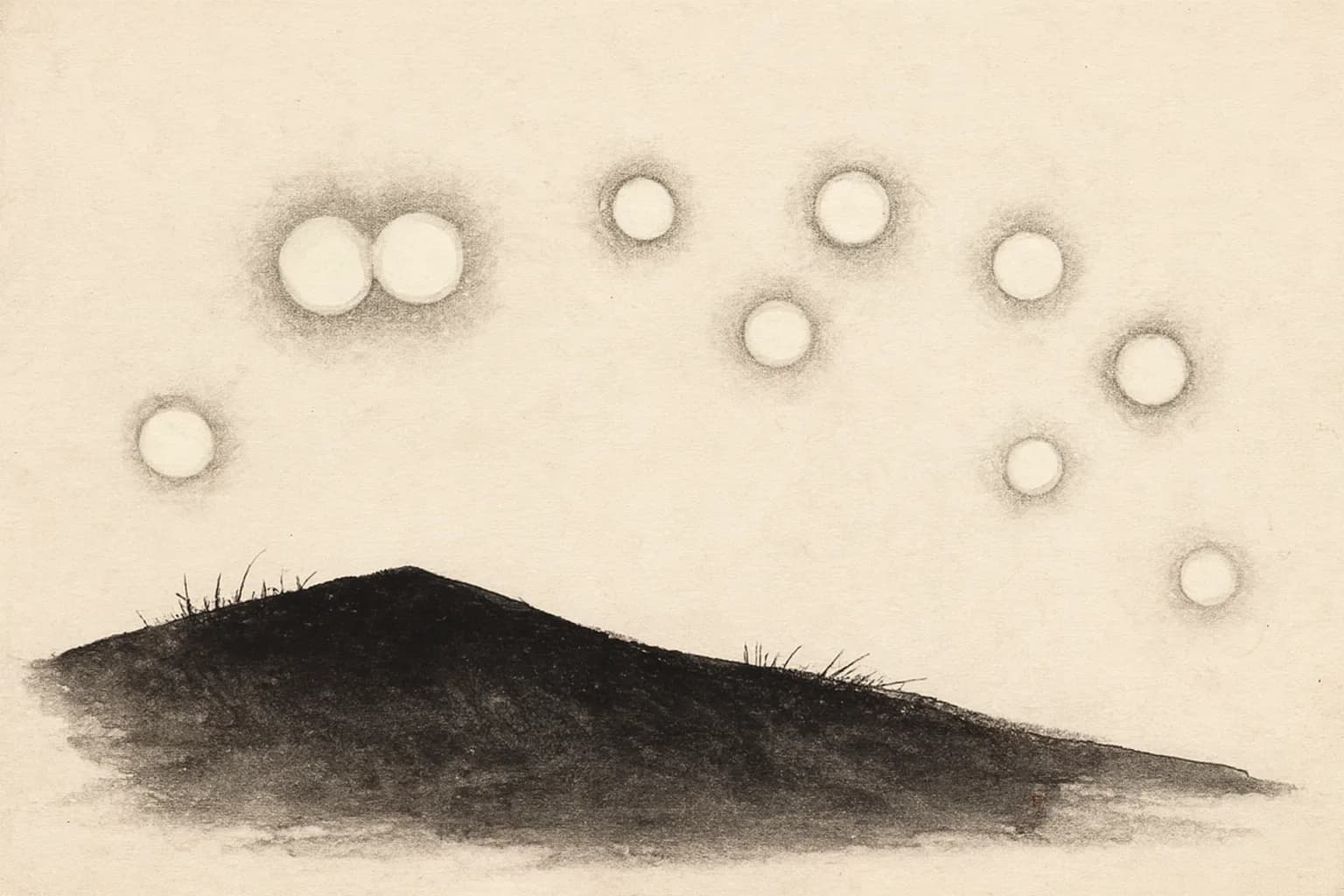
Travelers crossing the countryside after dark once told of strange lights drifting over rice paddies and forest edges: small, cold flames with no visible source, strung out in a wavering line or clustered like distant lanterns. The Japanese had a name ready for them: kitsunebi (狐火) — fox fire — a ghost light blamed squarely on the mischief of foxes and treated as both a warning and a spectacle worth traveling to see.
What does kitsunebi look like?
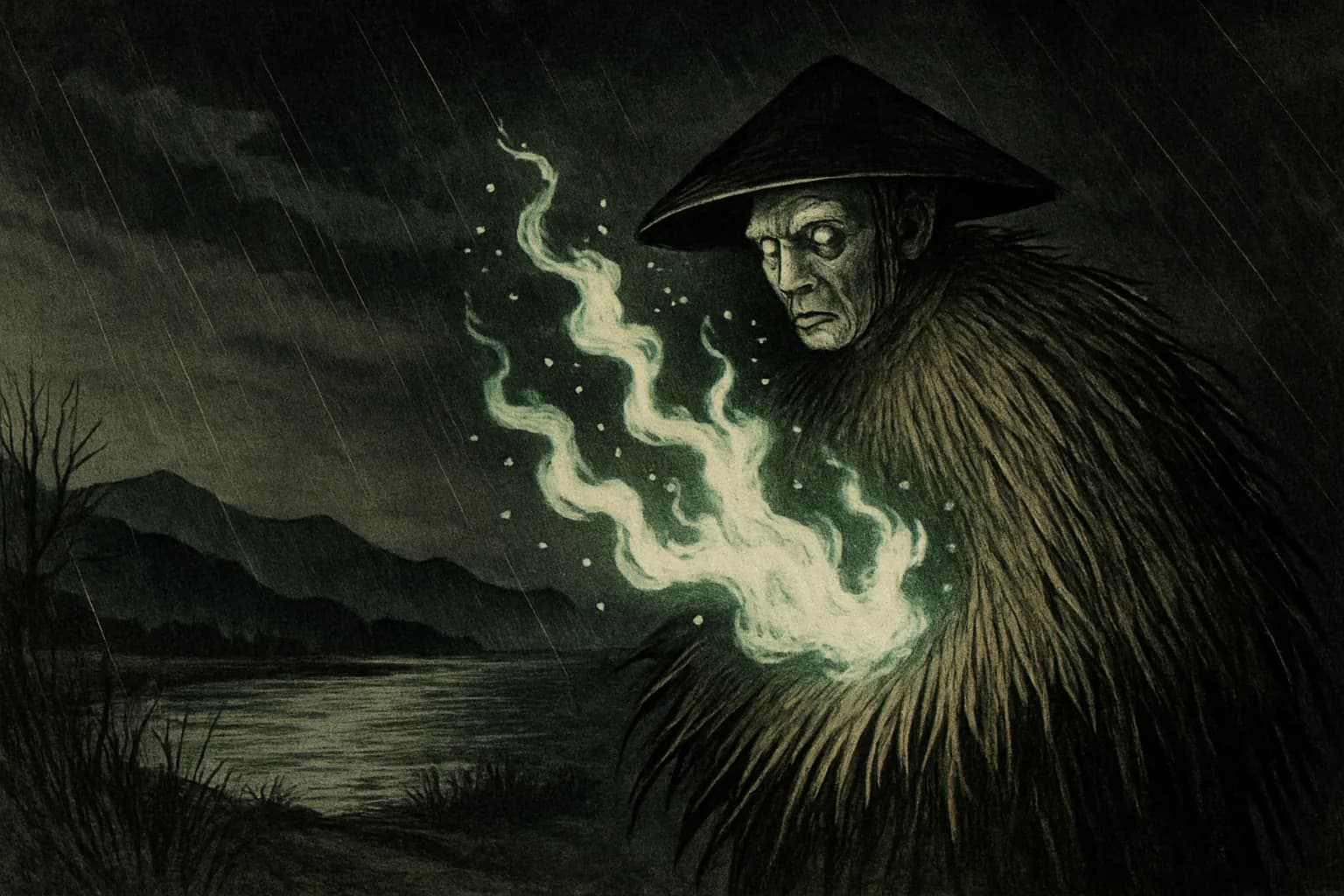
Kitsunebi is described as a ghostly light rather than a creature, typically a pale orange, blue, or white glow that flickers and drifts at a distance, often appearing in chains of many lights strung across dark fields or mountainsides. Crucially, it produces no heat and burns nothing, distinguishing it from an ordinary fire or lantern. Witnesses often reported the lights multiplying, splitting, or moving in ways no physical flame could, sometimes forming a long procession stretching across the horizon like a parade of distant torches.
Colour is not fixed. Red and orange run through most accounts, while blue-green turns up often enough to read as normal.
Fox torches, and a wedding you should not follow
The lights go by more than one name. Kitsune-taimatsu (狐松明), "fox torches", is the version used where the lights were pictured as something the animals carry rather than something they exhale, and English has quietly settled on fox-fire as the everyday translation. The name you meet depends on the province and the century, but they point at the same thing: lights in the dark with a fox behind them.
The most evocative version is the kitsune no yomeiri (狐の嫁入り), the fox wedding. A line of lanterns moving through the hills at night, in a place where no road runs and no procession should be, was read as a wedding party of foxes escorting a bride. Villagers who saw one were expected to leave it alone. Following the lights to find out who was marrying whom was exactly the mistake the story exists to warn against, and the phrase survives in ordinary Japanese today as the name for a sun-shower — rain falling while the sun is out, weather as improbable as the procession.
The fox behind the flame
Popular belief held that foxes produced the light themselves, most commonly by breathing it out, striking it from their tails, or rubbing bones together in their mouths, though accounts vary by region. Kitsunebi was treated as a natural extension of the kitsune's known talent for illusion: just as a fox might conjure a false banquet or a false road, it could conjure a false light to draw a traveler off the safe path and into a marsh, a ditch, or simply hopelessly lost until dawn. Encountering kitsunebi was rarely described as directly deadly, but it carried real danger for anyone who followed it blindly into unfamiliar terrain at night.
What were people actually seeing?
Not every explanation stopped at the supernatural. Even in the Edo period, some observers connected the lights to natural causes. Three of those explanations still fit the sightings well.
Marsh gas. Rotting plants in wet ground give off methane. Mixed with phosphine, it can catch fire on contact with air. The flame is pale. It drifts, it splits, and it gives off no useful heat — which is how kitsunebi is described everywhere it is told.
Distant light, bent by air. A lantern a few kilometres off can seem to float when warm and cold air layer over damp fields. The light wavers, jumps, and looks far nearer than it is. Fog does the rest.
Processions that were real. Some chains of light were probably people. Night travel by torch was ordinary, and a party crossing a far ridge looks like nothing standing on the ground below.
None of this explains why the fox took the blame, and that part is not physics. Japan already had an animal famous for fooling the eye. An unexplained light needed an author, and the fox was standing right there.
Kitsunebi, onibi, and hitodama
Japanese has several words for a light that has no business being there, and they are not interchangeable. The difference is not what the flame looks like — it is who owns it.
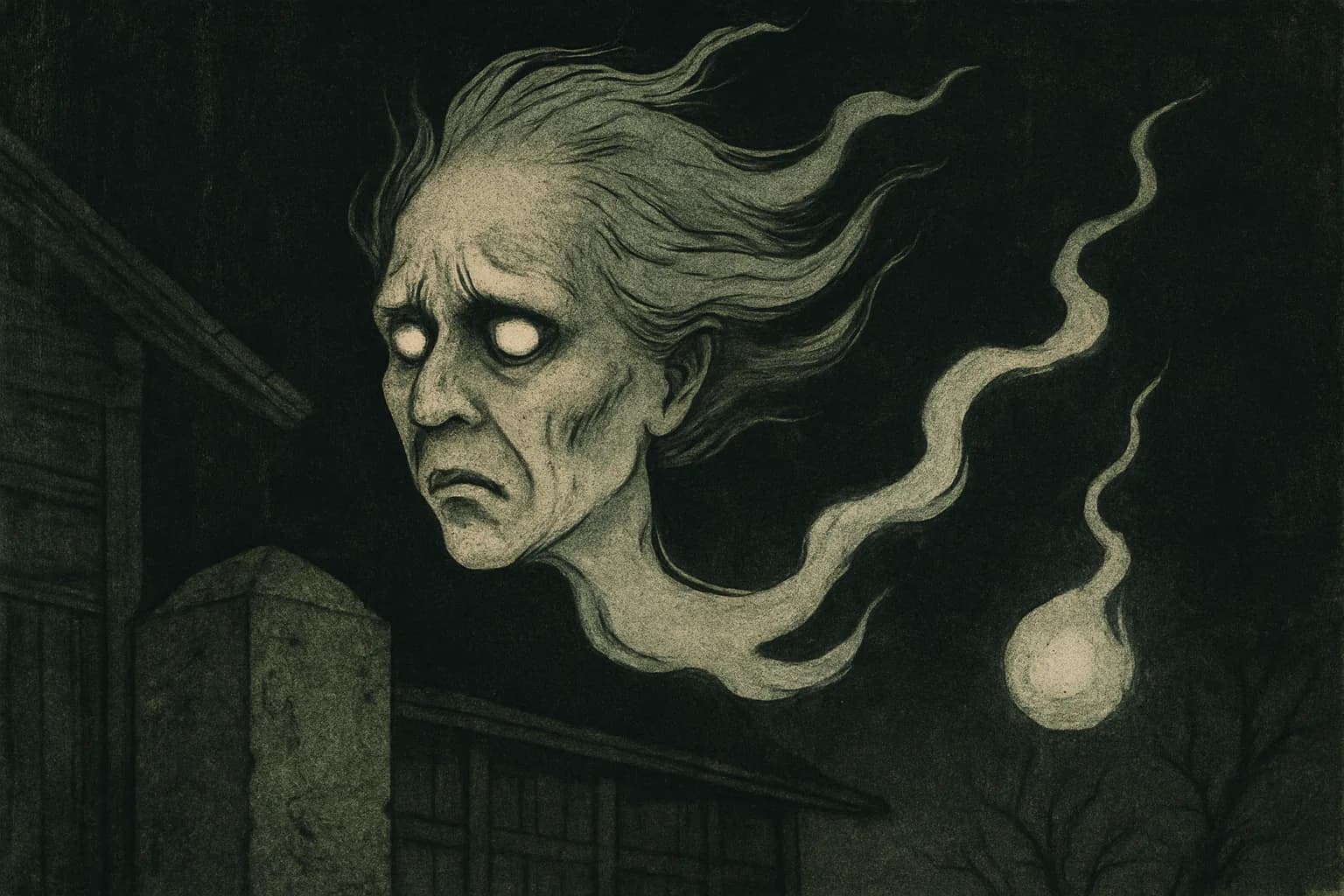
Kitsunebi has an author. Something made it, on purpose, and that something is a fox with a reason. Hitodama (人魂), "human soul", is the soul itself, seen leaving a body around the time of a death and drifting off low over the ground. Onibi (鬼火), "demon fire", is the ownerless case: a flame that rises where the dead lie or where something went wrong, with no one steering it.
So the test is the same one that separates the rest of the catalogue: ask what the light wants. If it is leading you somewhere, it is a fox. If it is leaving, it is a soul. If it is simply burning where it stands, it is onibi.
English has a foxfire of its own, and it is not this. That word names the faint green glow of fungi on rotting wood. It stays put, it is cold, and it is alive. Kitsunebi travels, and the whole point of the story is that something is carrying it.
The New Year's fox-fire procession at Oji
The most famous kitsunebi legend is tied to Oji, in what is now northern Tokyo, home to a great enoki (nettle tree) said to be the gathering point for foxes from all over the Kanto region on New Year's Eve. According to the tale, foxes from the surrounding provinces would travel to the tree, and as each one approached, it lit a kitsunebi, so that local farmers watching from a distance could count the fires strung out across the dark fields and predict the coming year's harvest from their number and brightness. The scene was famous enough in its own time to be immortalized by Utagawa Hiroshige in One Hundred Famous Views of Edo (1857), whose print of the Ōji enoki on New Year's Eve shows the foxes gathered beneath the tree, each with its own small flame, in a haze of ghostly light.
That association endures locally: the Oji district still holds a festival on New Year's Eve reenacting the fox procession, with participants dressed as foxes walking by torchlight to the shrine.
Where the fox fires are told — and the one place they are not
Kitsunebi is one of the most evenly distributed ghost lights in Japan. Versions of it are recorded from Hokkaido down through Honshu, Shikoku and Kyushu — and then the trail stops. The Ryukyus have no fox fire.
The reason is not cultural but zoological. Japan's wild foxes do not live that far south. The Japanese red fox ranges across Honshu, Shikoku and Kyushu, and the Ezo red fox has Hokkaido, but no fox is native to Okinawa. A folklore built on the assumption that a clever animal is out there in the dark, doing this to you on purpose, cannot take root in a place where the animal has never been. Okinawa has its own rich catalogue of night lights and shape-shifters; it simply blames something else.
That map is worth holding onto, because it explains the shape of the belief. Kitsunebi is not a local legend that spread. It is what happens when a nationwide animal meets a nationwide phenomenon — lights over wet ground at night — and the two get fastened together everywhere the animal lives.
The lights that guide a procession
There is one more job the fox fires do, and it is easy to miss if you only read kitsunebi as a trap for travellers. In a good deal of folklore the lights are simply illumination — the lanterns of a yokai gathering, carried or kindled so that something else can take place.
The fox wedding is the familiar case, but the same logic covers larger occasions: a Hyakki Yagyō (百鬼夜行), the night parade of a hundred demons, needs light to parade by. Where a long chain of fires is seen crossing country nobody walks, the reading is not always "a fox is lying to you." Sometimes it is "something is passing, and you were not invited."
It is a useful corrective to the trickster reading. Not every ghost light in Japan is aimed at a human being. Some of them are just other people's lanterns.
Where kitsunebi comes from
Kitsunebi sits at the intersection of two older Japanese beliefs: the widespread folk conviction that foxes possess supernatural cunning and the ability to deceive the senses, and a long tradition of unexplained will-o'-the-wisp-style lights appearing over marshland and open country at night, a phenomenon reported across many cultures. Japan folded that mysterious light into its existing fox lore, giving an otherwise formless natural mystery a specific, familiar culprit and turning a genuinely disorienting nighttime experience into a story that also served as practical caution: don't wander off known paths in the dark, whatever pretty light seems to be showing you the way.
Kitsunebi in Japan today
Kitsunebi survives today less as a feared omen and more as an atmospheric image, invoked in ghost story collections, seasonal festivals, and depictions of the countryside at night. The Oji fox-fire procession remains an active local tradition on New Year's Eve, drawing visitors who walk the same route the legendary foxes once did. As a phrase and an image, kitsunebi still captures something particular about the Japanese countryside after dark: beautiful, faintly uncanny, and never quite trustworthy as a guide home.