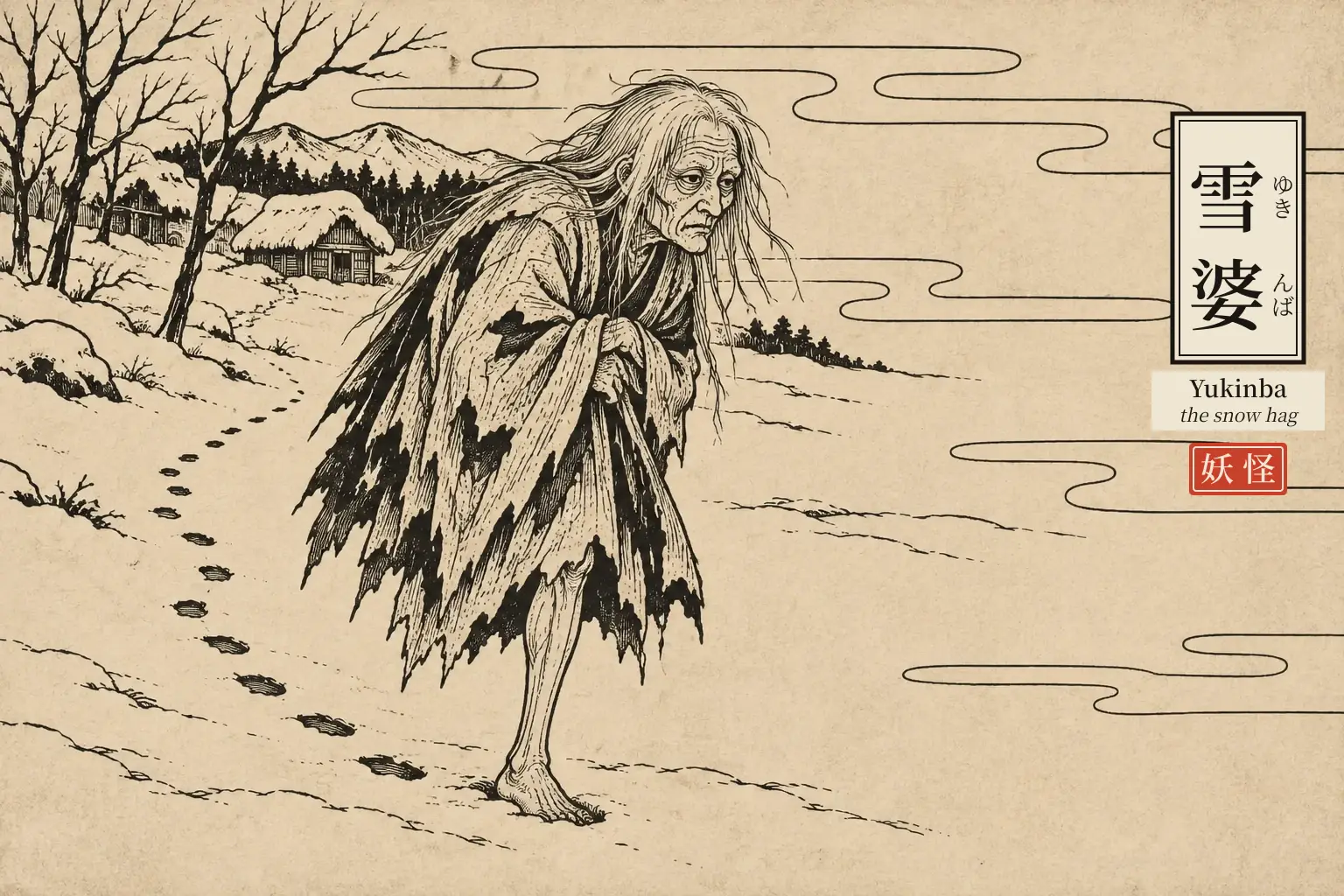
On the worst nights of winter, when the snow comes sideways and the road home disappears under drifts, travelers in Japan's snow country used to watch for a figure standing very still in the white-out: a woman, impossibly pale, wrapped in a white kimono, waiting. This is Yuki-onna, the Snow Woman — one of the most quietly terrifying figures in Japanese folklore, because her danger is not claws or fangs but cold itself, and the very human weakness of being drawn to something beautiful in the dark.
What does Yuki-onna look like?
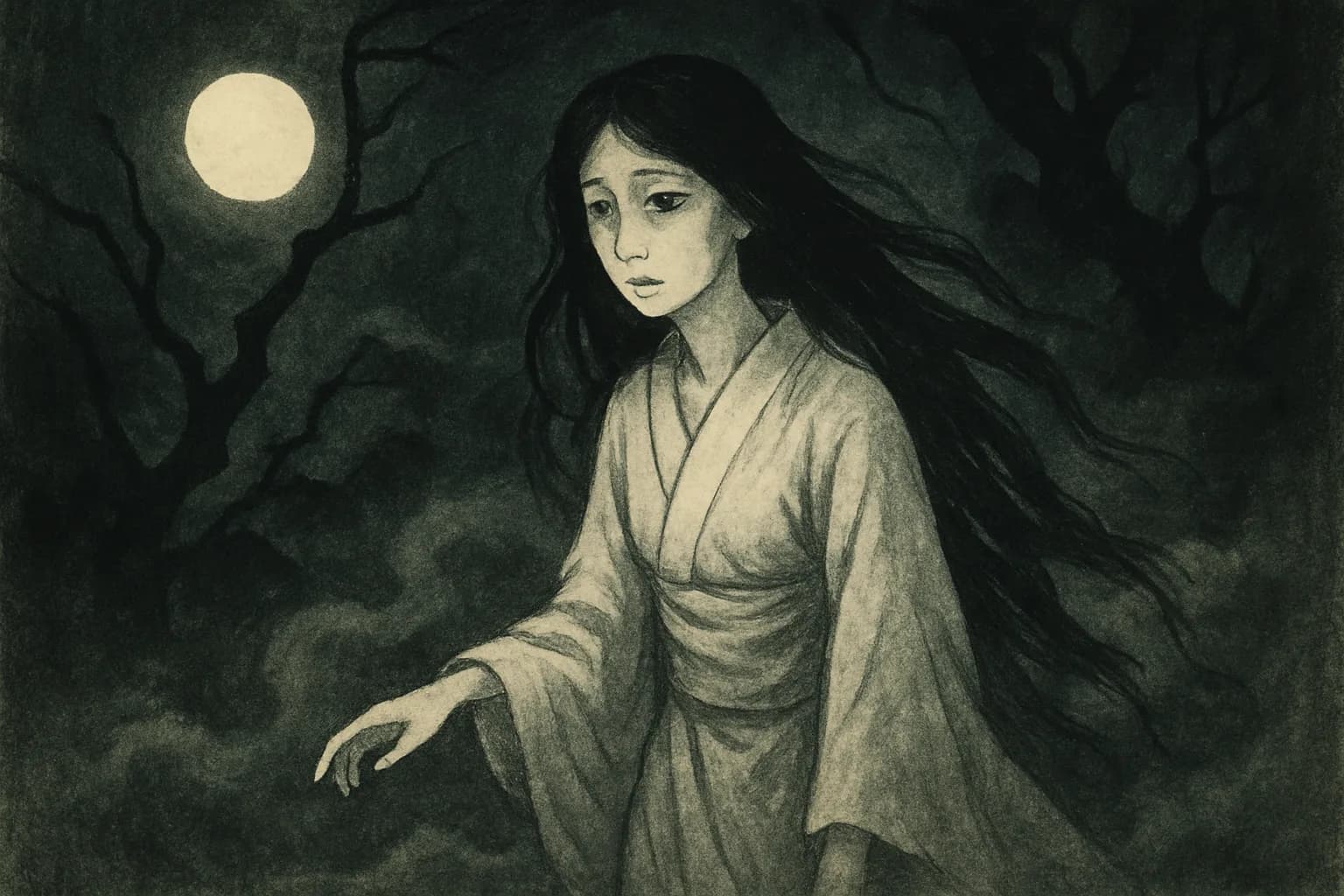
Most accounts share the essentials: Yuki-onna appears as a woman of unearthly beauty, with skin as white as the snow around her and long black hair that stands out starkly against it. She is usually dressed in a white kimono, or sometimes described as barely dressed at all, seemingly immune to a cold that would kill an ordinary person in minutes. Her feet often leave no footprints — in some tellings she has no feet at all, gliding over the snow like mist. She favors the worst weather, appearing in blizzards and heavy snowfall, often carrying a child in some regional versions, a detail that is never as comforting as it sounds.
Her eyes are the giveaway. Storytellers describe them as strange and unsettling to meet — the eyes of something watching you the way a predator watches, even as the rest of her looks like a woman lost in the storm and in need of help.
Breath that freezes, a kiss that kills
Yuki-onna's central power is her freezing breath. In the most common version of her legend, she approaches lone travelers — often men — stranded in a snowstorm, and simply breathes on them, or exhales frost directly into their faces. The victim freezes to death on the spot, sometimes with a look of terrible beauty on their frozen features.
She is strongly associated with mountain passes, remote roads, and anywhere a traveler might be caught alone after dark in winter. In many regions she was said to specifically target woodcutters and travelers who ignored warnings not to go out during a storm — making her, like so many yokai, a folk explanation for a real and mundane danger: people did freeze to death in Japan's brutal snow-country winters, and a ghost story gave that danger a face and a warning.
The tale of the broken promise
The single most famous Yuki-onna story, published by the writer Lafcadio Hearn in Kwaidan (1904), tells of two woodcutters, an old man and a young man named Minokichi, caught in a terrible snowstorm and forced to shelter in a small hut. In the night, Minokichi wakes to see Yuki-onna leaning over his older companion, breathing frost onto his face. She kills the old man, then turns to the young Minokichi — but instead of freezing him too, she spares him, struck by his youth and beauty, on one condition: he must never tell anyone what he saw that night, or she will kill him.
Years later, married to a beautiful woman named O-Yuki who bears him several children, Minokichi is struck one evening by how much his wife resembles the strange woman from that night long ago, and he tells her the story he swore never to repeat. O-Yuki reveals that she was the Yuki-onna who spared him — and that she would kill him now for breaking his promise, if not for their children. She spares him one final time and vanishes into the snow forever, never to be seen again.
The story endures because it captures exactly what makes Yuki-onna different from most monsters: she is not purely malevolent. She keeps her word, she can love, and she is bound by the same rules of promise and consequence that govern human relationships — which makes her betrayal, and her mercy, land harder than any straightforward monster ever could.
Where Yuki-onna comes from
Yuki-onna belongs to a wide family of Japanese snow and winter spirits, and scholars generally place her origin in the genuine, ever-present danger of Japan's heaviest snowfall regions, where blizzards could and did kill travelers who lost their way. Turning that danger into a beautiful, sorrowful woman gave communities a story that was easier to tell around a fire than a simple weather report — a way to warn children and pass down caution about winter roads while also expressing something more complicated: the seductive, deadly beauty of snow itself, and the loneliness of the region's long, isolated winters.
She appears in print by 1685, in a tale set in Echigo. Toriyama Sekien later drew her in 1776. Versions of her story recur across the snow-country prefectures of Tohoku, Niigata, and Nagano, each with local variations on how she kills, who she spares, and why.
Yuki-onna in Japan today
Yuki-onna remains one of the most enduring and adapted figures in Japanese ghost storytelling, a fixture of kaidan (ghost story) collections and a recognizable archetype — the beautiful, dangerous woman of winter — that echoes through later Japanese fiction and film. Snow-country towns in Tohoku and Niigata still tell local versions of her legend as part of regional folklore tourism, and the image of a pale woman standing alone in a snowstorm remains instantly recognizable to Japanese audiences as a quiet warning: don't linger out in the snow, and be careful what beauty you follow into the dark.
She endures precisely because her story refuses to be simple — equal parts warning, tragedy, and love story, wrapped in the coldest weather Japan has to offer.