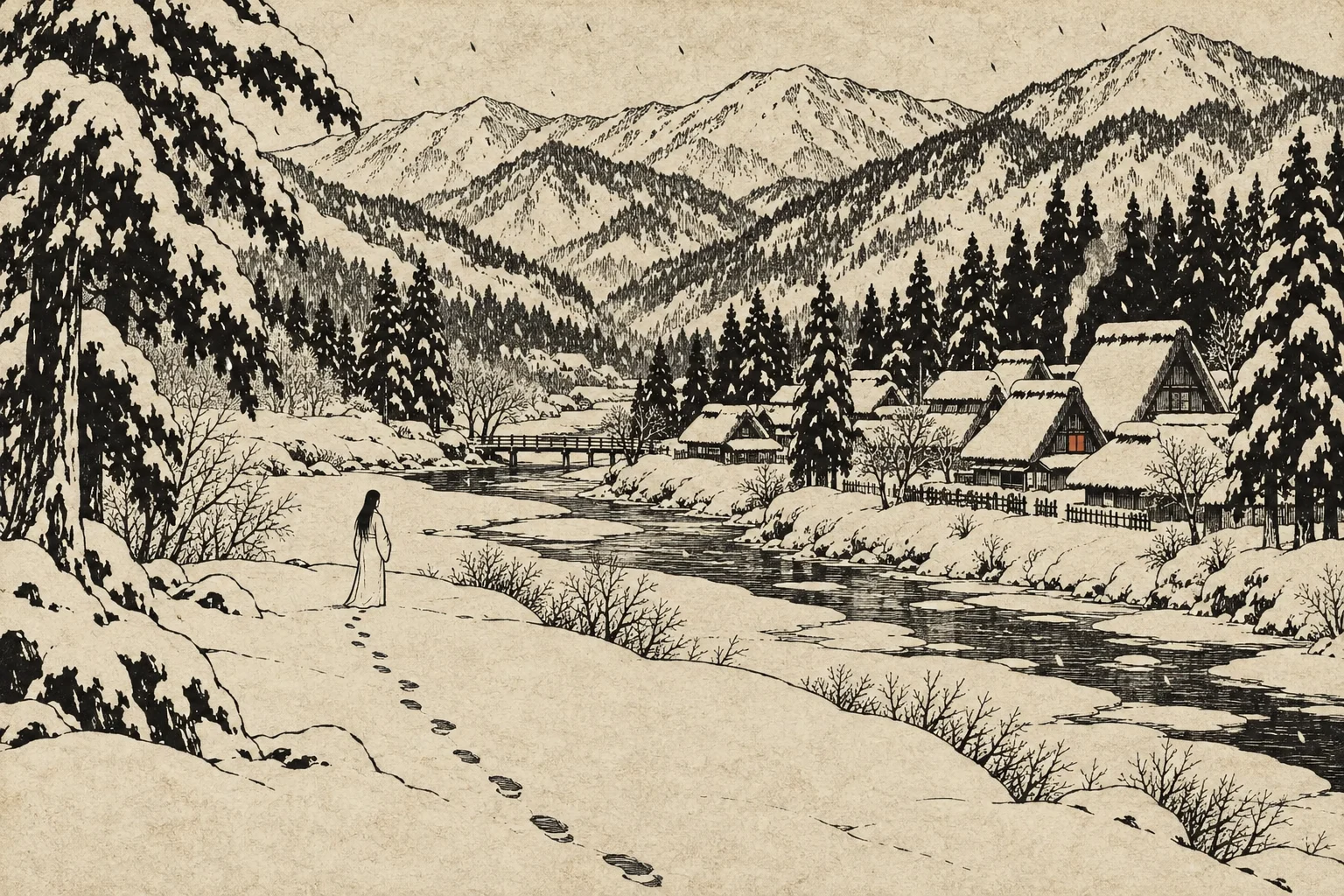
Snow country is the part of Japan where winter lasts half the year. Niigata, Nagano, Akita and the rest of the north can sit under deep snow from December to March. It is also where most of Japan's winter yokai come from.
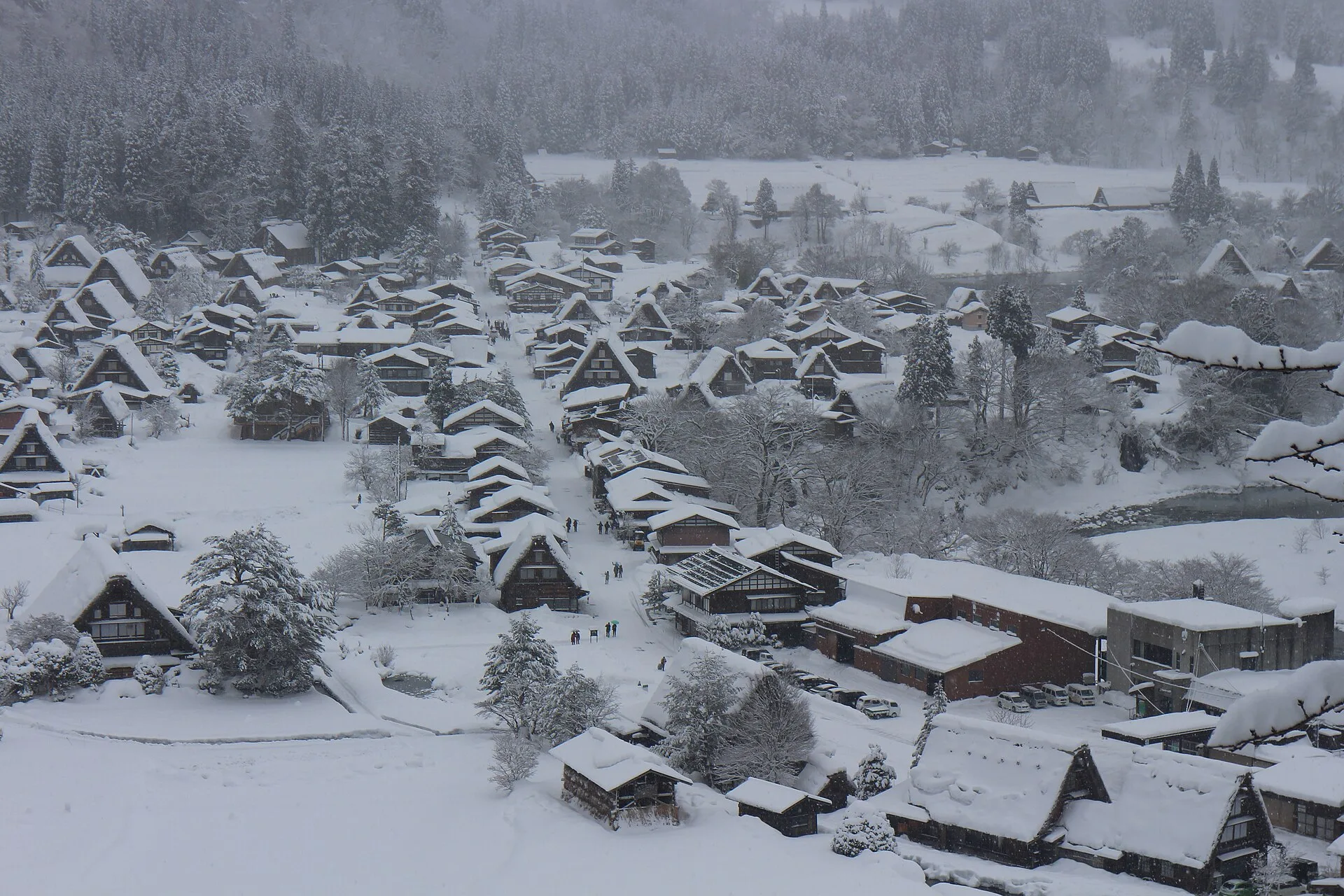 Photo: Suicasmo, CC BY-SA 4.0
We have seven of them in our own articles, and this page puts them side by side. Our full list of 330 yokai holds no other snow or winter entries yet. As we read the table, four of the seven seem to be about the body. They explain freezing, a cut with no pain, blood that will not flow, and skin burned by sitting too close to the fire.
The other three are about something else: what you see on a snowy road, and who comes and goes with the season. More on why at the end.
Seven winter yokai, side by side
Each row comes from our own article on that yokai.
| Yokai | What it does | Where | Oldest dated record |
|---|---|---|---|
| Yuki-onna | Stands in the white-out. Her breath kills. The baby she hands you is ice-cold and will not let go | Tohoku, Niigata, Nagano | Sōgi Shokoku Monogatari (1685) |
| Kamaitachi | A gust hits your leg. A deep cut opens, with no pain and almost no blood | Niigata, Nagano; also Kinki, Shikoku | Kokon Hyakumonogatari Hyōban (1686) |
| Teke-teke | A woman cut in two by a train. The cold stops her bleeding, so she cannot die quickly | A cold northern town; a similar legend names Muroran | In print 2003; told in manga from 1993 |
| Namahage | Masked visitors on New Year's Eve. They come to peel off the burn marks of the lazy | Oga Peninsula, Akita | Sugae Masumi's travel diary (1811); UNESCO-listed in 2018 |
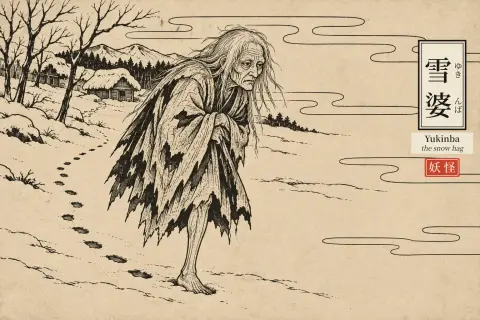
| Yukinba | A one-legged hag who comes with the snow and is gone when the sky clears | Ehime; Yamanashi | Tabi to Densetsu (1928) |
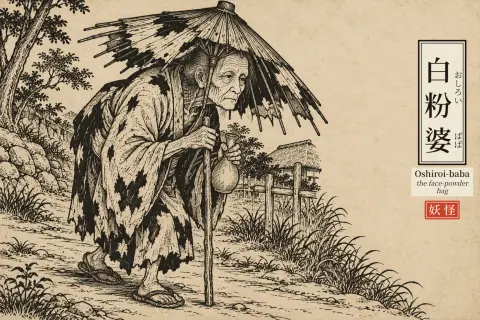
| Oshiroi-baba | A hunched old woman with a white-powdered face on a snow-dark road | Nara | Toriyama Sekien (1781) |
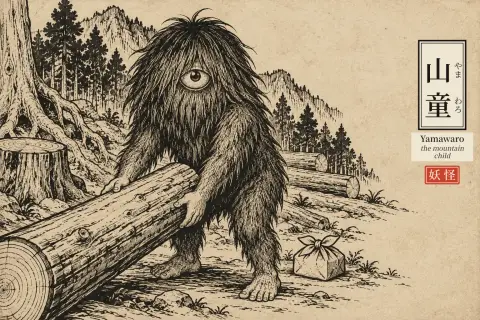
| Yamawaro | The kappa, gone up into the mountains for the cold half of the year | Kyushu | Wakan Sansai Zue (1712) |
Yuki-onna: the cold itself
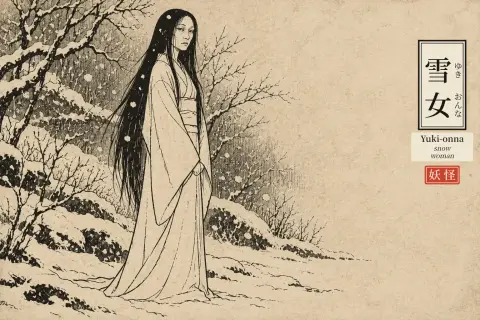
The Snow Woman is the best-known winter yokai. Her danger is not claws or teeth. It is the cold.
In Lafcadio Hearn's Kwaidan (1904), she breathes on a sleeping old man. Her breath is "like a bright white smoke," and he dies of it. A storyteller in Tōno told of a father who died the same way, after the Snow Woman breathed on him.
A village story from Kurihara, in Miyagi, gives her a second weapon. She asks you to hold her baby. The baby is as cold as ice, and it will not let go. This is the same shape as the many "hold my baby" tales of Japan. In the snow, the weight in your arms is the cold.
Kamaitachi: a cut you do not feel
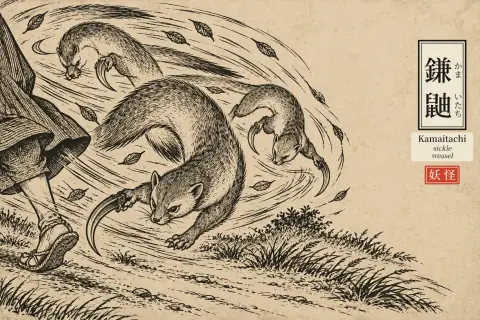
The kamaitachi is a weasel with sickle claws. It rides the wind across open ground.
Victims in the snow country told the same story. A gust hit their leg first. A clean cut appeared second. There was no pain and almost no blood. The attacks came in cold, dry weather, on open fields.
The wound was real enough to get the name too. In parts of Japan, kamaitachi meant the injury, not only the creature. Since the Meiji era, people have argued about the cause. One idea blamed a vacuum inside a whirlwind. The physicist Terada Torahiko rejected it and blamed sand or grit hitting the skin.
Teke-teke: the cold that will not let you die
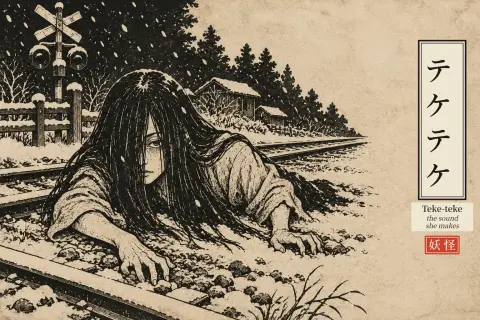
Teke-teke is a modern urban legend, not an old one. It is on this page because the cold does the work in it.
In the version most sources tell, a woman falls onto the tracks in a cold northern town. A train cuts her in two. The cold is so bad that her blood vessels freeze and the bleeding stops. So she does not die at once. She drags herself along, teke teke, calling for help.
Japanese Wikipedia points out that a northern winter is not really cold enough to do this. The story does not need it to be true. It needs the listener to feel that cold can keep you alive in the worst way.
Namahage: the burn marks of a long winter
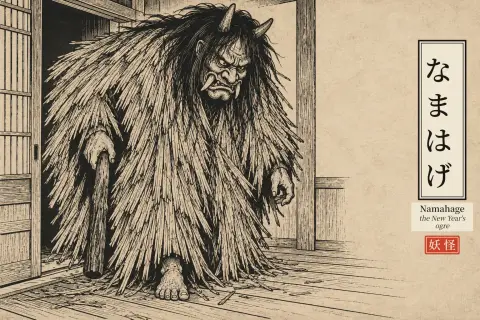
Every December 31st on the Oga Peninsula, young men in straw capes and wooden masks walk from house to house. They stomp in and roar at the children: "Are there any crybabies here? Any lazy ones?"
The name may hold the reason. Folklorists read namahage as coming from namomi and hagu. Namomi are the red, blotchy burn marks on the hands and legs of someone who sits too long by the open hearth through the winter. Hagu means to peel off. A namahage, in this reading, comes to strip the marks of laziness off your legs.
So even this visiting god is about the body in winter. It is the person who never gets up from the fire.
Yukinba and Oshiroi-baba: what you see on a snowy road
The other two old women are not about the body. They are about the snow itself.
Yukinba, the snow hag of Ehime, has one leg. She leaves a single line of footprints in fresh snow. An old scroll tells a story set in Okuetsu, not Ehime. One February, a man crossing a snowy field heard a woman call to him. He looked up, saw her, and ran. When the snow stopped and the sky cleared, she was gone.
Oshiroi-baba is harder to pin down. Toriyama Sekien drew her in 1781: a bent old woman with a white-powdered face, on a dark road in the snow. In 1960, the folklorist Fujisawa Morihiko said she was the same as yuki-onna, coming for sake on snowy nights in Noto. No such Noto tradition has been found. She may be several old-woman stories under one name.
Snow plays tricks on the eye in other ways too. On Mount Zao, between Yamagata and Miyagi, wind packs snow and ice onto the fir trees all winter. By February they stand on the slope like a crowd of white figures. In English they are often called "snow monsters." Nobody tells stories about them as yokai. But you can see how a shape in the snow becomes someone standing there.
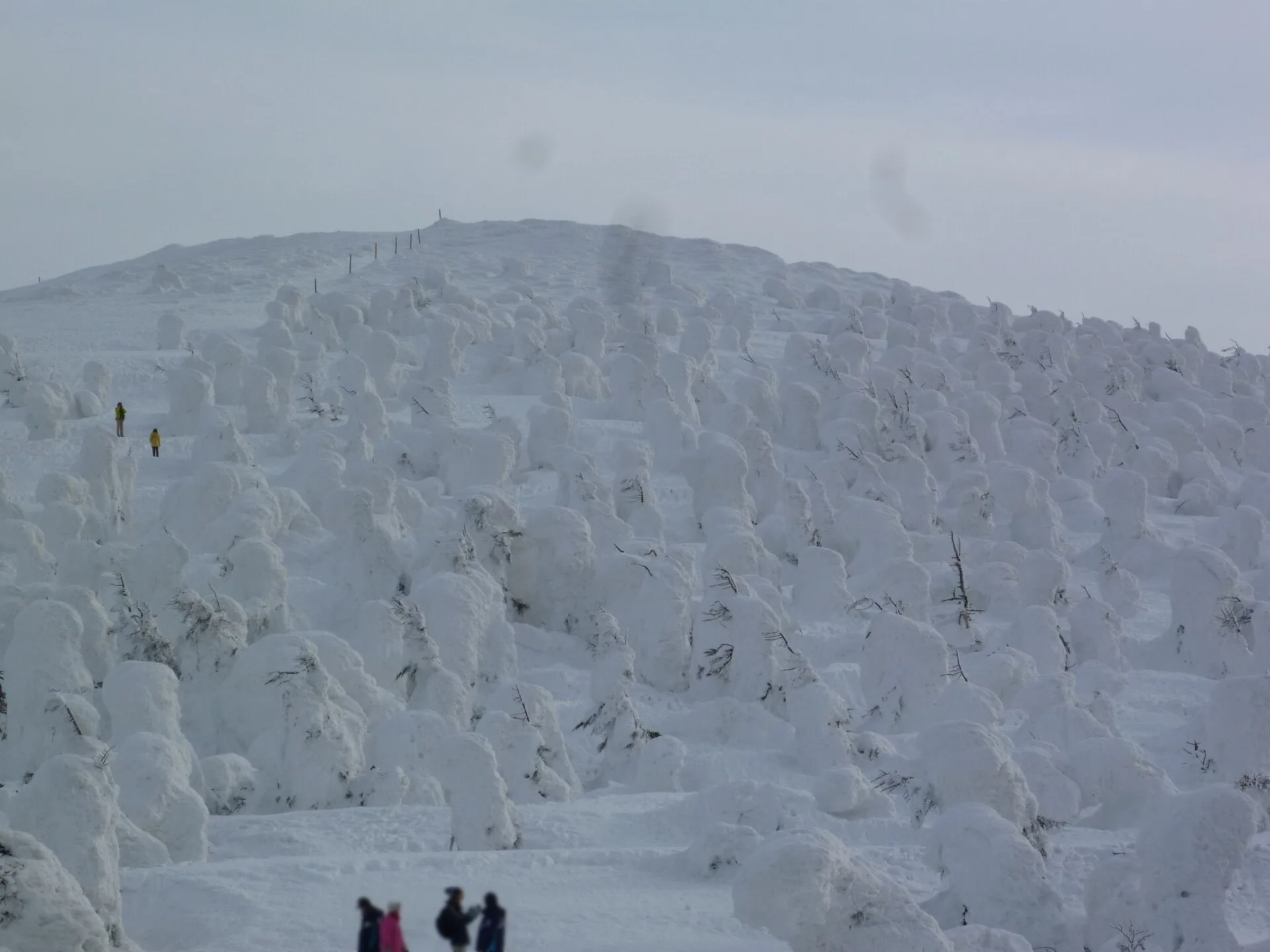 Photo: Suz-b, CC BY-SA 3.0
Yamawaro: the one who leaves for the winter
The yamawaro of Kyushu is the kappa's winter life. Around the autumn equinox, the kappa climbs out of its river and goes up into the mountains. There it becomes the yamawaro, a hairy mountain child.
Loggers in the high forests left rice for it. In return, it helped them move logs. In spring, it went back down to the river and became a kappa again.
Folklorists see a pattern here. The powers that guard the rice fields in summer go back to the hills when the harvest is over. The yamawaro is that idea with a face.
Winter yokai are about a body in a place
Read the table again and sort it.
- About the body (4): yuki-onna (freezing), kamaitachi (a cut without pain), teke-teke (blood that will not flow), namahage (burn marks from the fire)
- About the snowy road (2): yukinba (one-legged footprints), oshiroi-baba (a white face in the dark)
- About the season (1): yamawaro (the kappa goes up the mountain)
Many other yokai families are about places: the river, the mountain, the house. Winter yokai are about a body in a place.
Some snow yokai are not in the table yet
Many lists of snow yokai name four more. We have not found the village records behind them yet, so they stay off the table until we do.
- Tsurara-onna, the icicle woman, who becomes a man's wife and will not get into a hot bath
- Yuki-jiji, an old man of the snow said to come with avalanches in Niigata
- Yuki-warashi and yukinbō, snow children
- Yuki-onba and yukinko, a snow mother who asks you to hold her child
Most English lists trace these to the yokai books of Mizuki Shigeru. When we find the older records his books drew on, they will get their own pages.
Our reading: the cold had no face, so they gave it one
This part is our own reading, not a record.
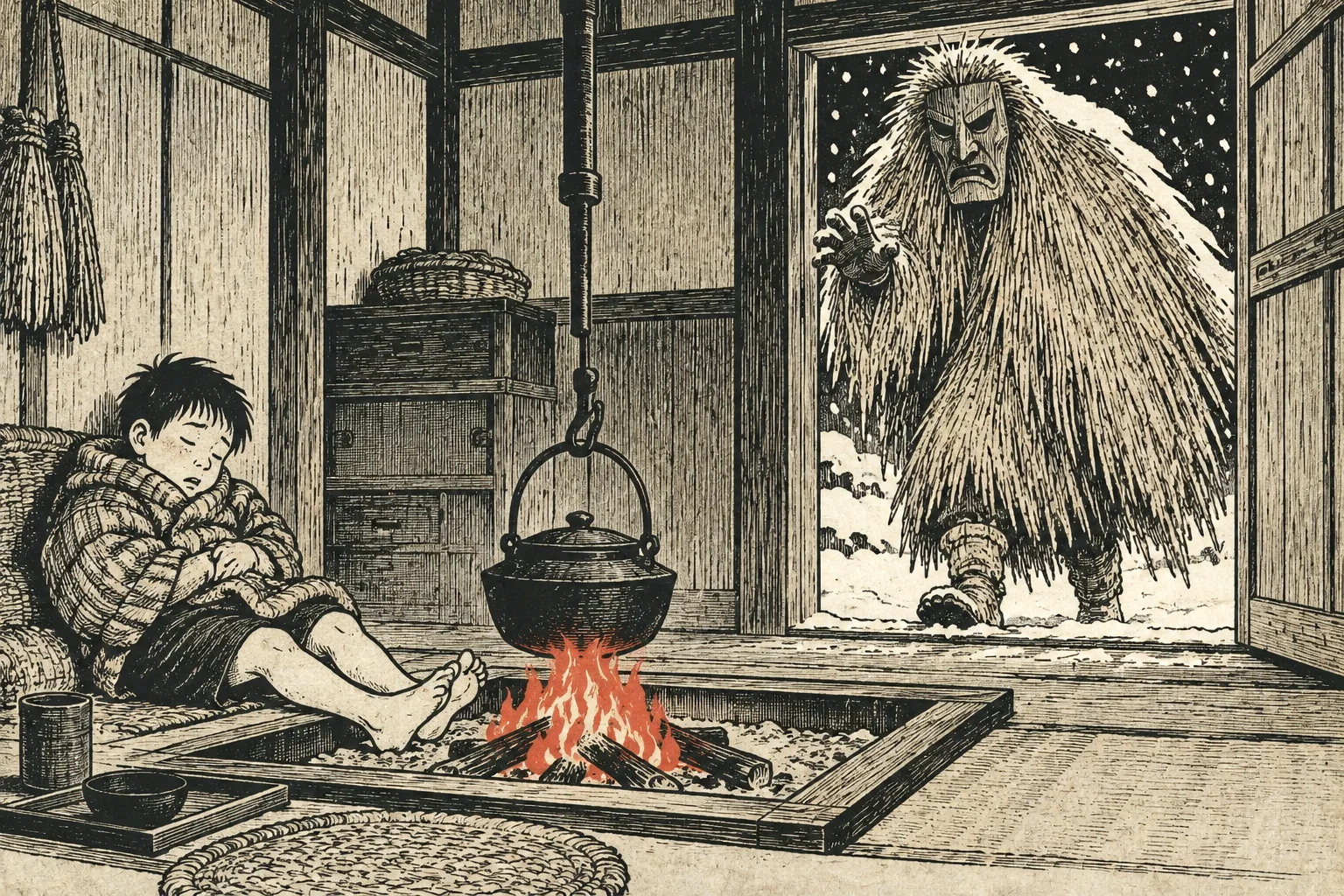
Snow country was dangerous in slow ways. Nobody fought the cold. It simply worked on you. Fingers froze on a long walk home. Skin split in dry wind. Children sat by the fire all winter and did nothing.
These were real dangers with no face. Each winter yokai gives one of them a face, and a rule to go with it. Do not stop in the white-out. Do not take what is handed to you in the snow. Do not cross open ground in the wind. Do not sit by the fire all winter, or the namahage will come for your shins.
The river yokai warned children away from the water. The winter yokai warned grown people about their own bodies. That may be why so many of them are about touch, breath and skin, and so few have claws.
The photos on this page come from Wikimedia Commons.